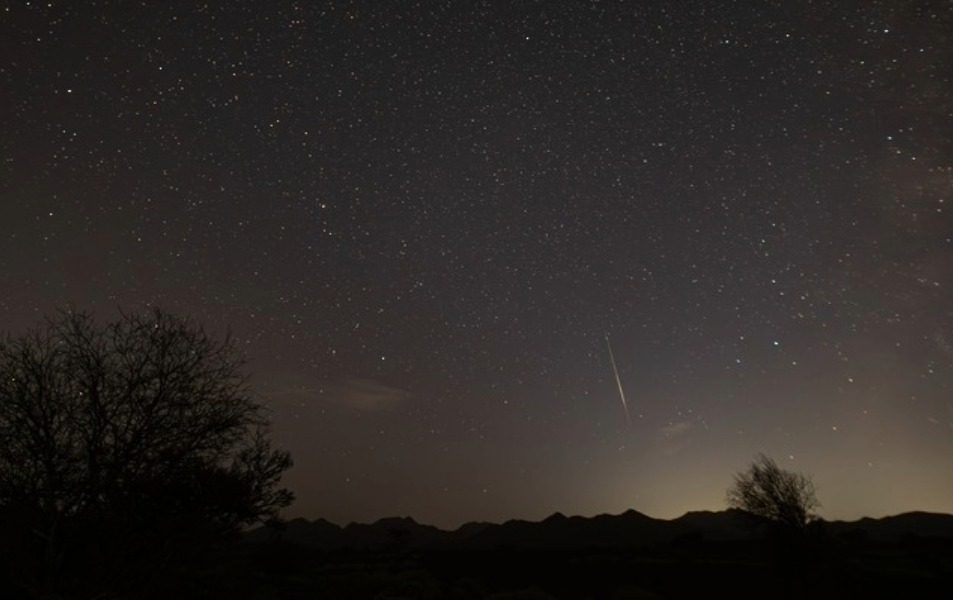

MUSCAT : The observation was conducted by the Oman Society of Astronomy and Space at a location away from sources of light pollution, with seven participants taking part in the monitoring exercise.
Ibrahim bin Mohammed Al Mahrouqi, Deputy Chairman of the Society’s Board of Directors, said more than 35 meteors were recorded before the formal documentation period began. Systematic observations then continued from midnight until 4am, during which 297 meteors were documented.
The number of meteors increased steadily as the night progressed. Between midnight and 1 am, observers recorded 42 meteors, followed by 62 between 1 am and 2 am. The number increased to 85 between 2 am and 3 am before reaching a peak of 108 meteors between 3 am and 4 am.
Al Mahrouqi stated that the results reflect the importance of observations conducted after midnight and before dawn, when the Perseid radiant rises higher in the sky.
He said the documentation aims to measure the shower’s Zenithal Hourly Rate (ZHR), an important indicator used to study meteor shower activity. Regular observations over several years can help researchers understand the distribution and density of dust and debris left along the orbit of Comet Swift-Tuttle, the source of the Perseid meteor shower.
Comparing activity levels from year to year can indicate whether Earth has passed through areas containing denser concentrations of debris and contribute to models that could help predict periods of stronger meteor activity.
Al Mahrouqi said analysing the size and distribution of particles produced by the comet can also provide insights into changes in its nucleus over time, while helping scientists better understand space debris and assess its potential effects on satellites during periods of heightened meteor activity.
The elevation of the Perseid radiant and Earth’s movement around the Sun are among the factors influencing the number of meteors visible from Earth. The side of Earth facing its direction of travel encounters more meteoroid particles, making the hours before dawn particularly favourable for meteor-shower observations.
Al Mahrouqi said recording more than 100 meteors during the final hour demonstrated the favourable observing conditions and relatively dark sky during the peak night. The absence of moonlight also allowed observers to detect fainter meteors that can be difficult to see under brighter skies, in addition to brighter meteors and fireballs.
He noted that confirming whether individual meteors belong to the Perseids also requires tracking their paths and determining whether they can be traced back to the shower’s radiant point.
The Oman Society of Astronomy and Space said the initiative forms part of efforts to move beyond general astronomical observation towards systematic scientific documentation. The Society aims to record, analyse and preserve observational data in its archive, allowing results to be compared with observations from future years and used in astronomical studies and programmes.
For all the latest news from Oman and GCC, follow us on Twitter, Instagram and LinkedIn, like us on Facebook and subscribe to our YouTube page, which is updated daily.
Read More
- Oman’s Duqm spaceport completes second successful rocket launch
- Oman police urge public to keep OTPs, passwords and PINs secret
- More than 1,000 join Viksit Bharat Solidarity Run in Muscat
- Oman Maritime Security Centre outlines requirements for foreign vessels in territorial waters
- Oman seeks public input on replacing plastic water bottles





