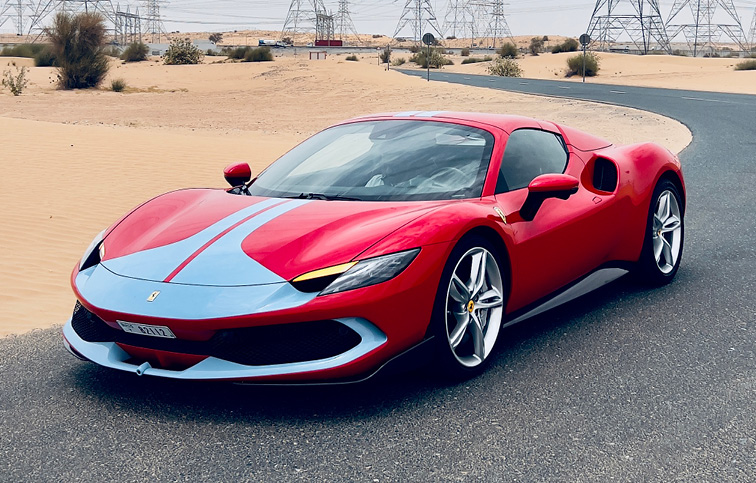

Muscat: “What is it like driving a Ferrari?,” a friend asked after he saw my recent post on Instagram. I was invited to the United Arab Emirates (UAE) by Ferrari to experience two of its stunning models — the 296 GTB and 296 GTS.
‘It’s madly extravagant but be wary; once you’ve tried it, nothing else is like it,” I replied to my friend.
The two models dance so exquisitely to your tune. It gives you that adrenaline rush and the feeling of driving the car in front of the iconic Burj Al Khalifa — it’s a sheer driving pleasure.
Read More
- Top Autos LLC – A Saud Bahwan Group Company and Geely Auto sign distribution agreement to relaunch Geely in Oman
- Four customers win JETOUR X90 Plus SUVs in Jetour Campaign lucky draw
- MHD ACERE reinforces commitment to Oman’s sustainable energy and future-ready e-mobility
- Arab Sealine Trading & Contracting Partners with Mitsubishi FUSO Oman
- Mitsubishi Motors Oman launches Summer Service Campaign
The 296 GTS uses the new 663 cv 120° V6, coupled with an electric motor capable of delivering a further 122 kW (167 cv), which debuted on the 296 GTB. This is the first 6-cylinder engine installed on a road-going spider sporting the Prancing Horse badge; it unleashes its class-leading 830 cv total power output to deliver previously unthinkable performance levels and an innovative, exhilarating and unique soundtrack, further enhanced by the fact that it can be relished with the top down.
The car’s name combines its total displacement (2992 l) and number of cylinders with the GTS (Gran Turismo Spider) acronym in Ferrari tradition, to underscore this new engine’s epoch-changing importance to Maranello. It is not simply the living, beating heart of the 296 GTS, but it also ushers in a new V6 era that has its roots deep in Ferrari’s unrivalled 75-year history. The very first Ferrari V6 featured a 65° architecture and debuted on the 1957 1500 cc Dino 156 F2 single-seater. This was followed in 1958 by larger displacement versions on the front-engined sports prototypes – the 196 S and 296 S – and the 246 F1 car which powered Mike Hawthorn to the F1 Drivers’ Championship title the same year.
The 296 GTS’s plug-in hybrid (PHEV) system guarantees it is an incredibly usable car as well as cutting pedal response times to zero and delivering a 25km range in all-electric eDrive mode. The car’s compact dimensions and the introduction of innovative dynamic control systems as well as meticulously honed aero ensure that the driver will instantly be impressed by its astonishing agility and responsiveness to commands. Its sporty, sinuous design and extremely compact dimensions also visually underscore its unique and modern forms, while skilfully referencing the likes of the 1963 250 LM, the perfect marriage of simplicity and functionality.
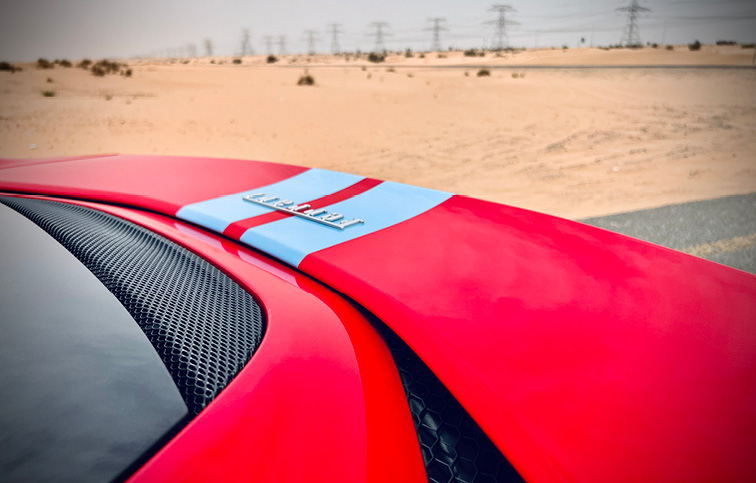
The RHT (retractable hard top) guarantees exceptional occupant comfort. With the roof stowed it features a sleek, sporty design and with the roof up, the silhouette remains very similar to that of the 296 GTB. The lightweight RHT takes a mere 14 seconds to retract or deploy at speeds of up to 45km/h. The separation line between the car’s body and the roof is above the B post. As a result, the folding roof splits into two sections that fold flush over the front of the engine, thus maintaining the engine bay’s thermal dissipation characteristics and the balance of the overall design. This also allowed the designers to introduce a window in the rear section of the engine cover through which the new V6 is clearly visible. When the top is retracted, the cabin and the rear deck are separated by a height-adjustable glass rear screen which guarantees optimal passenger comfort even at high speeds.
Power terrain
The 296 GTS is the first Ferrari road-going spider to sport a V6 turbo with a vee with an angle of 120° between the cylinder banks, coupled with a plug-in electric motor. Presented for the first time in 2021 on the 296 GTB, the V6 has its turbos installed inside the vee. Aside from bringing significant advantages in terms of packaging, lowering the centre of gravity and reducing engine mass, this particular architecture helps deliver extremely high levels of power. The result is that the Ferrari V6 set a new specific power output record for a production car of 221 cv/l.
As the V6 turbo is integrated with an electric motor at the rear, the 296 GTS’s combined maximum power output is 830 cv, putting it at the top of the rear-wheel-drive spider segment. The hybrid element not only makes the car extremely versatile in terms of day-to-day driving with a full-electric mode range of 25 km, but also benefits the driving experience by providing instant and consistent response at all engine speeds.
The powertrain assembly comprises the turbo-charged V6 that feeds power to the rear wheels via the 8-speed DCT and E-Diff, and the MGU-K located between the engine and the gearbox. A clutch is set between the ICE and the electric motor to decouple them in electric-only eDrive mode. Lastly, there is a high-voltage battery and an inverter which powers the electric motor.
Stunning exterior
The 296 GTS further emphasises the clean, sophisticated lines of the 296 GTB. When the top is down, it is the peerlessly elegant epitome of the open-air hybrid concept. Its unprecedented architecture for a spider, in fact, opens a whole new chapter in the marque’s story. The designers’ goal of retaining the 296 GTB’s main characteristics required a period of meticulous analysis of the dimensions of its technical components. There was, of course, a clear focus on minimising the impact of any modifications on the exterior bodywork and also on introducing a clear, instantly recognisable theme that would encapsulate the complexity of the design whilst translating it into accomplished linear forms.
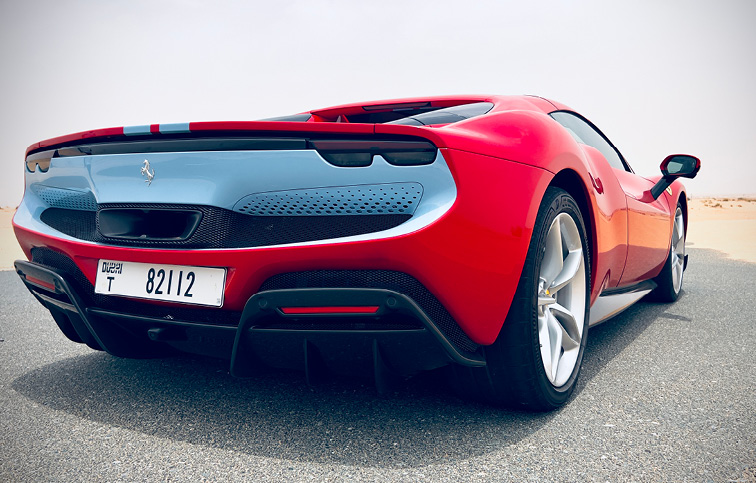
The need to stow the RHT (Retractable Hard Top) inside the engine compartment inspired the Ferrari Styling Centre’s team under Flavio Manzoni to create a new tonneau cover design, the geometries of which have produced styling elements very different to Ferrari spiders of the recent past. While on the 296 GTB the engine bay is completely horizontal and dominated by two flying buttresses in a nod to the 250 Le Mans archetype, the 296 GTS’s tail is absolutely unique.
As is the case with the 296 GTB, the dominant feature of the new car’s architecture is the signature ‘aero bridge’. The overall effect is of an extremely compact cabin effortlessly integrated with the wings and flanks. The buttress theme is further enhanced by contrasting sculpted extensions that frame the engine cover screen and integrate the novel fuel filler and battery charge covers, avoiding architectural disharmony.
Digital Cockpit
The 296 GTS’s cockpit was developed around the new concept of an entirely digital interface. This interior layout draws on the latter’s stylistic coherence for its forms. While with the SF90 Stradale the designers wanted to highlight the presence of the advanced technology and underscore a clear break with the past, in the case of the 296 GTS, the idea was to clothe that technology to sophisticated effect. The result is a pure, minimalistic connotation characterised by a powerful elegance that, on an aesthetic level, perfectly mirrors the design of the exterior.
The 296 GTS’s cabin raises the concept of the formal purity of the functional elements to new heights. From a formal perspective, when the engine is off, the onboard instruments go black, underscoring the minimalist look of the cabin. Exclusive Italian leather trim to the seats and trim is further enhanced by the noble technical materials used on the functional components. Aerodynamic flaps have been integrated into the rear trim structure to reduce buffetting and increase comfort in open-top driving.
The sculptural door panel is a seamless continuation of the dashboard in terms of both materials and colour. On the central medallion, the styling cue is a deep lozenge-shaped scoop, a three-dimensional element. This type of architecture makes the entire door panel look extremely light and integrates the theme that connects it to the rear trim. The tunnel incorporates the modern take on the classic gear-shift gate and a compartment for stowing the ignition key with its characteristic Prancing Horse badge. The tunnel has also been redesigned, so that rather than being open as on the 296 GTB, it has a closing oddments compartment, which further emphasises the continuity between mats and tunnel. For the 296 GTS, the designers created specific diapason-style seats using contrasting grooves which coordinate aesthetically with the edge strip of the instrument cluster.
Electric motor
This is the first ever Ferrari spider with a rear-wheel drive-only PHEV (Plug-in Hybrid Electric Vehicle) architecture in which the ICE is integrated with a rear-mounted electric motor producing up to 122 kW (167 cv) derived from the Formula 1 application from which it also inherits the MGU-K (Motor Generator Unit, Kinetic) moniker. The electric motor and ICE communicate via the Transition Manager Actuator (TMA) which allows them to be used both together to produce a combined power output of 830 cv, or decouples them to allow the electric motor to run solo.
Driving experience
You may need to invent some new phrases to express what the 296 feels like from behind the wheel. It is by far the best supercar in the world and a perfect next step in Ferrari’s journey.
Photos by Shaheen Taha





