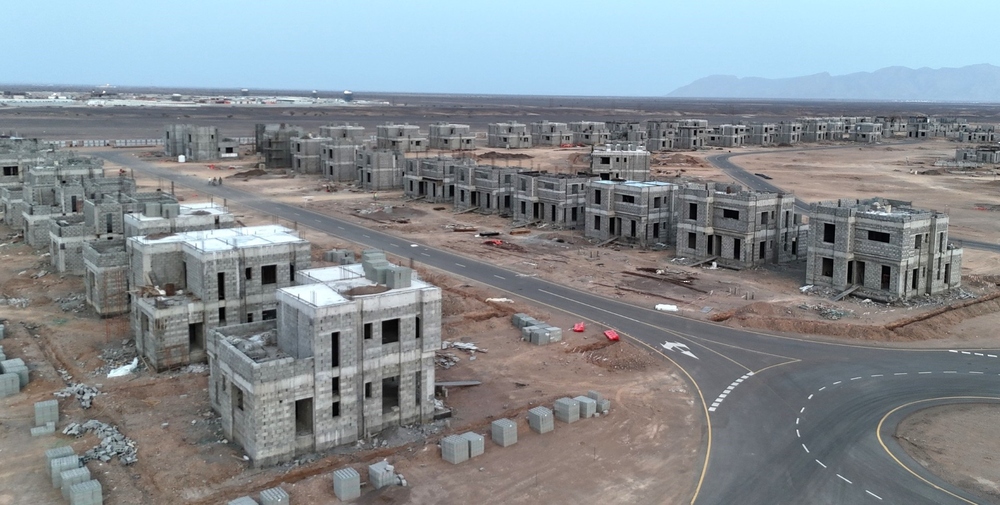

Muscat: North Al Sharqiyah Governorate is witnessing a major expansion in housing and urban development in 2026, with new residential land, social housing projects, integrated neighbourhoods and digital services being rolled out to support population growth and improve quality of life.
Ali bin Saeed Al Rujaybi, Director General of Housing and Urban Planning in North Al Sharqiyah, said figures for the first half of the year showed that 580 plots of land for various uses were created, 455 residential plots were provided and 628 plots were approved under the “Plan Your Land” initiative.
The measures are aimed at meeting growing demand for residential land while ensuring that future urban expansion follows organised planning principles.
Read More
- Al Buraimi backs rural women in Oman with new income-generating projects
- Oman’s Information Ministry reviews digital evaluation progress for 2026 Media Excellence Competition
- Oman urges citizens, students travelling to India to secure comprehensive health insurance
- Asyad Group moves 159-tonne heavy-lift cargo to Yanqul, strengthening Oman’s mining logistics
- Oman, US discuss stronger defence coordination in Washington
Al Rujaybi said the social housing sector provided 152 housing assistance cases worth around RO 4.4 million in 2025, while 124 cases worth approximately RO 3.5 million were provided in 2026.
Several housing projects are also under implementation across the governorate.
In Al Rahibat in the Wilayat of Al Qabil, work is continuing on a project comprising 45 housing units, a mosque and a majlis, at a total cost of around RO 2.44 million.
Meanwhile, a project comprising 49 housing units in Hail Al Kafuf in the Wilayat of Dima Wa Al Taiyyin has been completed at a cost of approximately RO 2.43 million.
Work is also continuing on 24 housing units in Hail Al Qash in Dima Wa Al Taiyyin, with the project valued at around RO 1 million.
Another project comprising 19 housing units in Buwad in the Wilayat of Wadi Bani Khalid has been completed at a cost of approximately RO 1.16 million.
Construction of a mosque in Hail Al Kafuf is also continuing at an estimated cost of RO 185,000.
Al Rujaybi said the projects form part of the social housing system designed to provide suitable homes for eligible citizens while supporting family stability and the development of residential communities with essential services and facilities.
The governorate is also progressing with integrated residential neighbourhoods under the “Surooh” projects, which aim to create modern urban communities equipped with infrastructure, public services and facilities.
These include Al Sumou neighbourhood in Al Mudhaibi, Al Ala neighbourhood in Bidiya and Saih Al Rafie in Wadi Bani Khalid.
The Al Sumou neighbourhood project is valued at around RO 15 million, while the Al Ala neighbourhood project is estimated at approximately RO 5 million.
The developments are designed to create integrated residential communities connected to road networks, public facilities and essential services.
Alongside physical development, North Al Sharqiyah is expanding digital services in the housing and urban planning sector.
More than 28 electronic urban planning services have been introduced, helping simplify procedures, accelerate transactions and improve services for beneficiaries.
Al Rujaybi said legislative and regulatory developments are also improving land management, urban planning and the use of geospatial data in decision-making.
The measures are expected to support more effective planning of population centres, improve the distribution of public services and facilities and ensure better use of available land.
Urban planning efforts are also being linked to economic and investment development through the allocation of land for productive, commercial and service activities across the governorate.
Al Rujaybi said this approach would help strengthen integration between residential and economic development while supporting investment opportunities available in North Al Sharqiyah.
Flood protection has also been identified as an important part of long-term urban development.
Among the key projects is a flood protection dam in Samad Al Shan in Al Mudhaibi, aimed at reducing risks posed by heavy rainfall and wadi flows and protecting residential areas and public infrastructure.
Al Rujaybi said the ongoing projects reflected a broader shift towards a more integrated housing and urban development system combining residential land, housing units, modern neighbourhoods, digital transformation, regulated land use and geographic data.





