

Muscat: With abundant sunshine throughout the year, the Sultanate of Oman is increasingly turning to renewable energy as a practical and economic alternative for productive sectors. Farmers and project owners across the country are now witnessing the tangible benefits of adopting solar energy systems, particularly amid rising conventional electricity costs.
Engineer Mohsen bin Mohammed Al-Mufarji, renewable energy engineer at the Ministry of Agriculture, Fisheries and Water Resources, said the ministry continues to encourage farmers, livestock breeders and investors to partially shift toward solar energy as part of broader efforts to enhance environmental sustainability and resource efficiency.
He explained that solar energy is now being used to operate irrigation pumps, cooling systems and crop drying units in agricultural projects, improving operational continuity and product quality. In livestock farms, it powers ventilation, cooling systems and water pumps, while fish farming projects are using solar-powered pumps and aeration systems, especially in remote areas lacking electricity grids.
Read More
- Oman’s Urban October event draws over 60,000 visitors, records more than 230 deals
- Oman condemns Saudi airport attacks, urges restraint
- Oman convenes global experts to advance AI innovation in mental healthcare
- HH Sayyid Theyazin chairs International Financial Centre of Oman board meeting
- Oman participates in Interpol Anti-Drug Conference in Czech Republic
Al-Mufarji stressed that the transition can begin gradually by operating essential systems first before expanding further, making it a flexible and economically viable solution that also contributes to lowering carbon emissions and supporting Oman’s sustainability and food security goals.
One of the leading national examples is the photovoltaic solar energy project by Al Safa Foods at its farm in Thumrait.
Badr bin Abdullah Al Rashidi, Marketing Manager at the company, said the project reflects a practical commitment toward sustainability and production efficiency within the food sector.
Spread across a 65-square-kilometre farm, the solar system itself covers around 91,000 square metres and has a production capacity of up to 7 megawatts. The project uses a smart sun-tracking system to maximise solar capture and energy output.
According to Al Rashidi, the facility includes 12,824 photovoltaic panels and 20 transformers with a capacity of 330 kilowatts each. The project is expected to reduce carbon dioxide emissions by nearly 6,250 tonnes annually while supporting clean energy adoption and food security in Oman.
Farmers across Oman are also reporting major savings after adopting solar solutions.
Wael bin Rabee Al-Rubaie, a farmer from Al Suwaiq in North Al Batinah Governorate, said many farms possess unused land that can be utilised for solar panel installations, allowing farmers to benefit from both energy generation and land use.
He noted that Oman’s long summer sunshine hours provide a rich source of renewable energy capable of powering irrigation systems, desalination plants, pumps and lighting systems, significantly reducing electricity expenses and improving farm sustainability.
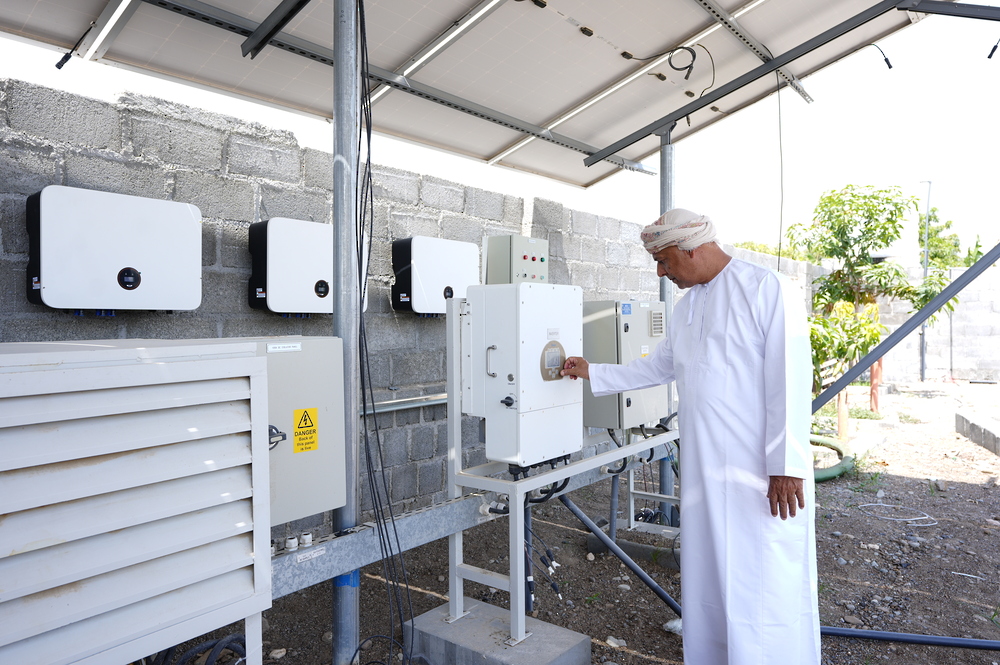
Meanwhile, Rashid bin Salem Al-Suhaimi, owner of Al-Shater Orchard in Al Suwaiq, shared his experience after installing a 25-kilowatt solar system with support from the Ministry of Agriculture, Fisheries and Water Resources.
He said solar energy now covers between 60 and 70 per cent of the farm’s energy needs, powering both agricultural and fish farming activities. The switch has reduced his monthly electricity bill from nearly RO 350 to between RO 120 and RO 150, dramatically improving the project’s economic feasibility.
Al-Suhaimi added that high electricity costs had previously been one of the biggest challenges facing fish farming operators, but reduced operational expenses are now making such projects more profitable and sustainable.
In North Sharqiyah Governorate, poultry farm owner Mansour bin Nasser Al Sunaidi from Ibra highlighted how solar power transformed his production operations, which require continuous cooling, hatching and ventilation systems.
He said the project involved establishing two solar power stations with a capacity of 30 kilowatts each, helping reduce electricity consumption by nearly 30 per cent throughout the year.
One station powers air conditioning systems around the clock to maintain stable temperatures for egg hatching, while the second operates hatching machines and water pumps continuously.
Al Sunaidi said there are plans to fully transition the project to solar energy in the future, supported by advances in battery storage technologies capable of storing energy for up to four days without sunlight.





