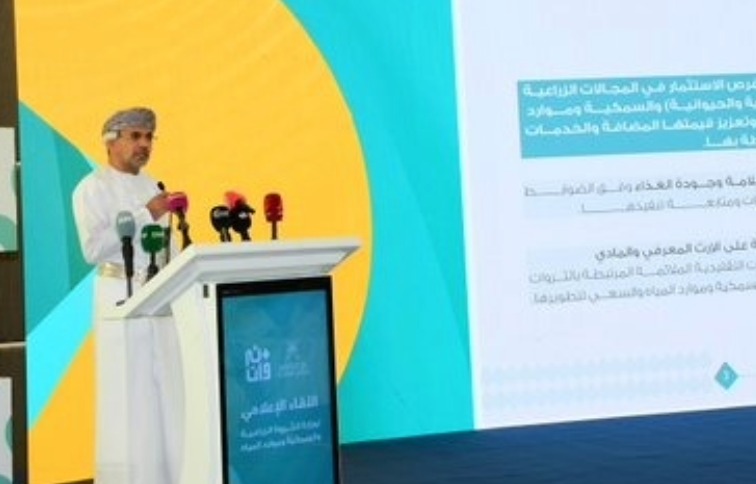

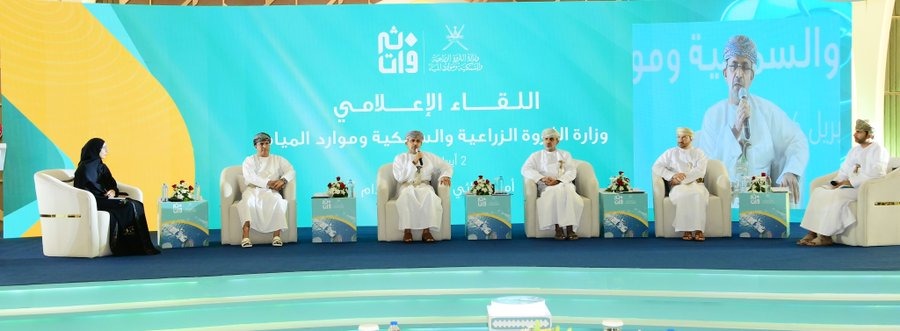
MUSCAT – Announcing the figures during a media briefing on Thursday, His Excellency Dr. Saud bin Hamood Al Habsi, Minister of Agriculture, Fisheries and Water Resources, detailed a strategic expansion that has seen the nation achieve over 146 percent self-sufficiency in fish and significant gains across dairy and poultry sectors.
His Excellency highlighted Oman’s environmental and climatic diversity, noting that the Sultanate has 5.5 million acres of agricultural or arable land, representing 7.5 percent of total land area. The total area of agricultural holdings stands at 355,000 acres, with cultivated land reaching approximately 312,000 acres by the end of 2024. He also highlighted 3.2 million acres of natural grazing land in the north and south of the country, supporting 4 million heads of farm animals.
The Minister outlined the country’s infrastructure for plant production, including 26 research centres, stations, and nurseries, 21 agricultural quarantine facilities, and six specialized beekeeping units. Oman also operates 35 laboratories for food safety and quality, including 12 municipal and 23 private laboratories.
Oman has achieved high self-sufficiency rates for key commodities: 146 percent for fish, 99 percent for dates, 96 percent for fresh milk, 95 percent for table eggs, 79 percent for vegetables, 62 percent for poultry meat, 45 percent for red meat, and 24 percent for fruits excluding dates.
In environmental performance, Oman’s ranking improved from 149 in 2022 to 54 globally in 2024. The Sultanate ranked first in the Gulf for fisheries management, fifth in the Arab world, fourth in the Middle East, and 17th globally. In water resources, Oman ranked second in the Gulf and Arab world, third in the Middle East, and ninth globally.
The fisheries sector encompasses 24 ports and landing sites, 62 fish markets, 36 commercial ships, 1,200 fishing vessels, 27,320 licensed fishing boats, 1,220 marketing outlets, 4,117 fish marketing licenses, more than 60,000 Omani fishermen, and 119 operational fish factories. Oman possesses a large and diverse stock of fish and marine life along its coasts.
Water resources infrastructure includes 14 desalination plants, 4,173 aflaj (3,050 active), seven protection dams with 148.3 million cubic metre capacity, 71 aquifer recharge dams with 108.78 million cubic metre capacity, 117 surface storage dams, 67 treatment plants producing 119.5 million cubic metres, 92 main desalination plants producing 455.36 million m³, and 89 bottled water factories producing 8,335.5 cubic metres daily.
The Ministry also reported that total agricultural, animal, and fish production from 2020 to 2025 reached approximately 5.61 million tons, reflecting a growth rate of 5.2 percent.
Read More
- Major Muscat traffic alert: Five-day partial road closure near Al Ansab bridge from October 4
- 168 product violations flagged in Oman market inspections
- His Majesty Sultan Haitham to begin state visit to Kazakhstan on October 5
- 29 companies from Oman to showcase national industry at ‘Made in the Gulf 2026’ in Bahrain
- Oman’s Duqm spaceport completes second successful rocket launch





