
Muscat: The proceedings of the first International Conference on the Archaeology of the Oman Peninsula commenced today at Sultan Qaboos University, with the participation of approximately 100 scientists, researchers, and archaeology specialists from both within and outside the Sultanate of Oman.
During the event, 60 researchers and academics are presenting scientific papers across six primary themes. The opening ceremony was held under the auspices of Sayyid Ibrahim Said Al Busaidi, Minister of Heritage and Tourism.

The three-day conference is a joint initiative organized by the Ministry of Heritage and Tourism and Sultan Qaboos University to celebrate the Golden Jubilee of the Journal of Oman Studies (1975–2025). The conference aims to provide a scientific platform for dialogue and the exchange of expertise, discuss contemporary issues in archaeological research, site management, and heritage protection, and explore horizons for scientific cooperation. These efforts seek to build a robust knowledge base that supports heritage preservation and cultural development.
Read More
- Oman’s TRA launches public consultation on physical security regulation
- Muscat hosts regional Air Traffic Management coordination meeting with experts from 19 countries
- Oman issues new regulations for management of Arabian Oryx Reserve; outlines prohibitions and fines
- Ramadhan in Oman likely to start on February 19, 2026
- Oman to host ICAO forum to boost airspace safety and coordination
In his keynote address, Eng. Ibrahim Said Al Kharousi, Undersecretary of the Ministry of Heritage and Tourism for Heritage, emphasized that the Sultanate of Oman is a land with roots deeply embedded in history and a living witness to civilizational and human interaction across the ages. He noted that archaeological discoveries serve as material evidence reflecting human lifestyles and the interaction between humans and their environment over thousands of years. He further explained that these findings have proven the grandeur of ancient Omani civilization and its vital role in global trade and cultural networks, connecting the civilizations of Mesopotamia, the Indus Valley, and East Africa due to Oman’s geographic location and its maritime and terrestrial legacy. He pointed out that systematic archaeological research, which began in the 1950s, evolved institutionally with the establishment of the Ministry, contributing to the organization of surveys, excavations, and the protection of archaeological sites.

He highlighted prominent sites dating back to the third millennium BCE that reflect Oman’s historical status as a major center for copper mining and export in the ancient world under the name “Magan,” noting that modern discoveries have revealed sites spanning from the Neolithic period through the Bronze and Iron Ages to the Islamic eras, confirming continuous human settlement in Oman over millennia.
Dr. Nasser Al Jahwari, Chairman of the Organizing Committee, stated that holding this conference as a specialized international scientific event reflects the civilizational importance of the region. He added that it aims to consolidate Oman’s position as a hub for scientific dialogue in archaeology and heritage while enhancing research partnerships.
He also noted the development of the Journal of Oman Studies into an open-access publication in cooperation with the international publisher “Archaeopress,” as part of an effort to include it in international databases.
Regarding the launch of the journal’s website, Sultan Saif Al Bakri from the Ministry of Heritage and Tourism, who oversees the archaeological missions program and heritage publications, confirmed that the launch represents a strategic step toward digital transformation in academic publishing and expands access to knowledge. He emphasized the journal’s commitment to the highest standards of scientific peer review and open-access policies to support researchers and enhance the presence of Omani research on the international scientific stage.

The opening program included a documentary film about the Golden Jubilee of the Journal of Oman Studies, the unveiling of a commemorative postage stamp in cooperation with Oman Post, and the launch of the journal’s website in collaboration with “Archaeopress” Oxford.
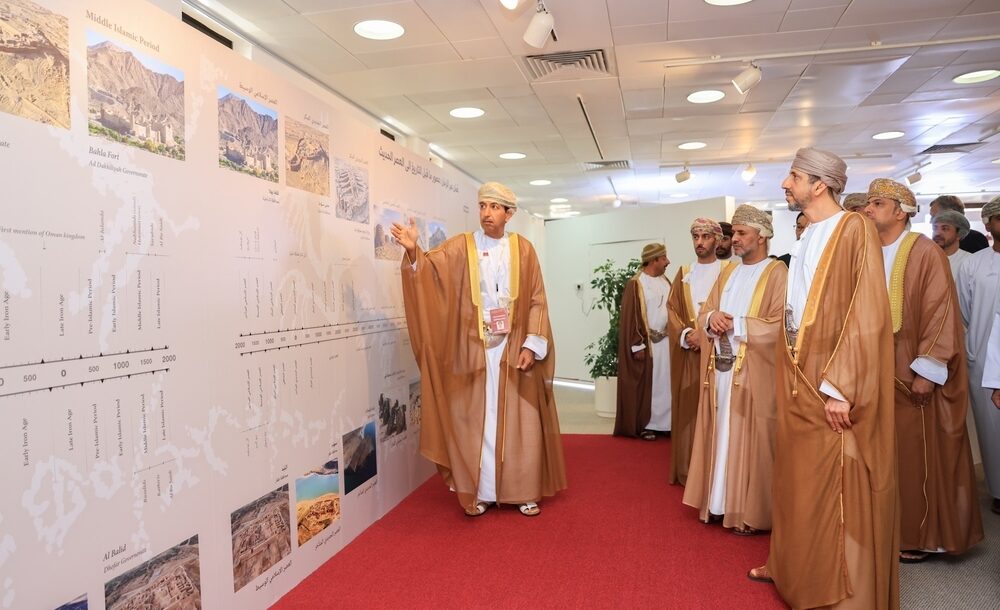
Additionally, an accompanying exhibition was inaugurated featuring photographs, archaeological artifacts, a chronological timeline of Oman’s history, and introductory sections for the Ministry of Heritage and Tourism, Sultan Qaboos University, and the Department of Archaeology at the College of Arts and Social Sciences.
The first day featured six specialized scientific sessions discussing research papers on prehistoric eras, the Stone and Iron Ages, paleoenvironments, human settlements, tool manufacturing, coastal archaeological heritage, and various archaeological sites in the Sultanate of Oman.





