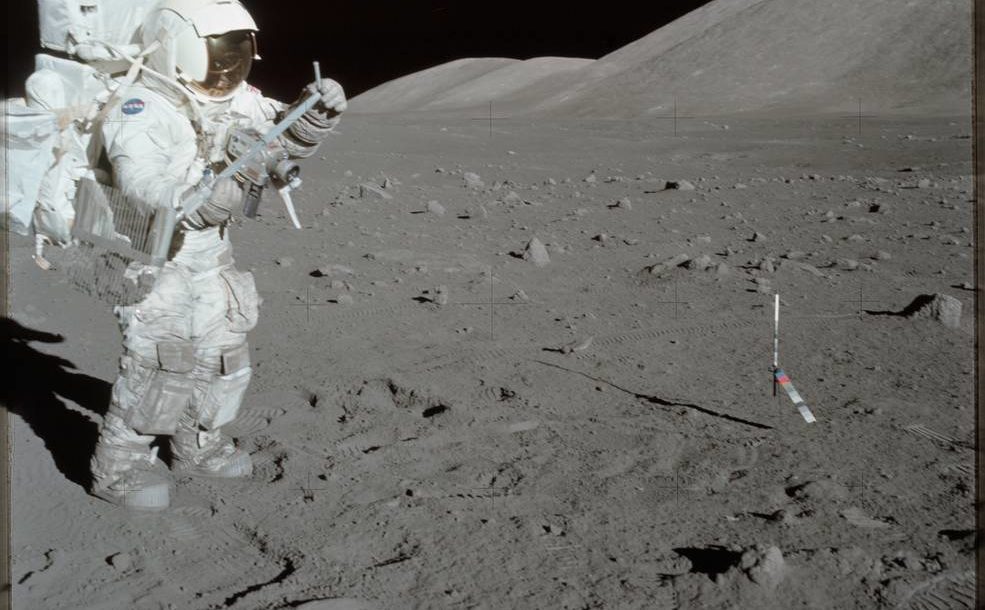
Nearly 50 years after NASA collected Moon rocks and soil during Apollo, the agency is set to look at them with new eyes. And nine special teams selected will receive unopened samples from Apollo 17 to study them with the latest technology.
“By studying these precious lunar samples for the first time, a new generation of scientists will help advance our understanding of our lunar neighbour and prepare for the next era of exploration of the Moon and beyond,” said Thomas Zurbuchen, Associate Administrator for NASA’s Science Mission Directorate in Washington, DC.
“This exploration will bring with it new and unique samples into the best labs right here on Earth,” Thomas added.
Read More
- Oman fines two foreigners, hands suspended jail terms for disturbing nesting turtles
- His Majesty Sultan Haitham ratifies OIC charter amendment, visa waiver agreement with Rwanda
- GCC remittances hit record $161 billion in 2025, highest globally
- Oman police warn of blackmail risks as children face growing threats on gaming platforms
- Oman authorities apprehend three citizens over illegal hunting of protected gazelles
Six of the nine teams will look at one of the three remaining lunar samples, from Apollo missions 15, 16, and 17, which have never been exposed to Earth’s atmosphere.
The particular sample these teams will study came to Earth vacuum-sealed on the Moon by the Apollo 17 astronauts Harrison Schmitt and Gene Cernan in 1972.
The Apollo 17 sample comprises about 800 grams (1.8 pounds) of material, still encased in a “drive tube” that was pounded into the lunar regolith to collect a core of material.
That core preserves not just the rocks themselves but also the stratigraphy from below the surface so today’s scientists can, in a laboratory, study the rock layers exactly as they existed on the Moon.
The core has been carefully stored at NASA’s Johnson Space Center in Houston, Texas, since December 1972.
Other teams will be studying samples that have also been specially curated, some from Apollo 17 that were brought to Earth and then kept frozen, and samples from the Apollo 15 mission which have been stored in helium since 1971.
NASA has only collected samples from a few places on the Moon so far, but NASA knows from the remote sensing data that the Moon is a complex geologic body. From orbit, the agency has identified types of rocks and minerals that are not present in the Apollo sample collection.
“Returned samples are an investment in the future. These samples were deliberately saved so we can take advantage of today’s more advanced and sophisticated technology to answer questions we didn’t know we needed to ask,” said Lori Glaze, acting director of NASA’s Planetary Science Division in Washington, DC.
The samples won’t be opened right away. First, the teams will work together and with the curation staff at NASA Johnson to determine the best way to open the sample to avoid contaminating them and maximize the science to be gained.
The teams for the Apollo Next-Generation Sample Analysis grants were selected by the Planetary Science Division and will be funded by the Lunar Discovery and Exploration Program.
NASA is going to the Moon and on to Mars, in a measured, sustainable way. The direction from Space Policy Directive-1 builds on the hard work NASA is doing on its SLS and Orion spacecraft, agency efforts to enable commercial partners, its work with international partners at the International Space Station in low-Earth orbit, and what NASA learns from its current robotic missions at the Moon and Mars





