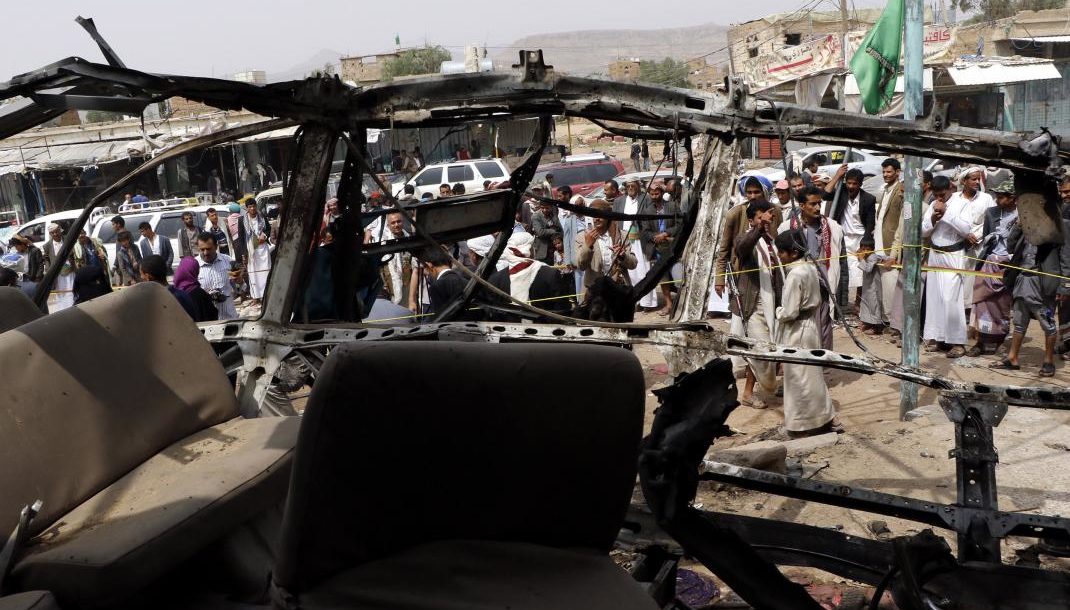
Yemen was first attacked by Saudi-led coalition in a bid to ‘curb terrorism’ in 2015 March. Now, when only a few more days are left to ‘mark’ the fourth anniversary, the catastrophe caused by the ‘civil war’ is beyond imagination.
The armed conflict in Yemen has killed and injured thousands of Yemeni civilians since it began.
As of November 2018, around 6,900 civilians had been killed and 10,768 wounded, the majority by Saudi Arabia-led coalition airstrikes, according to the Office of the United Nations High Commissioner for Human Rights (OHCHR).
Read More
- Oman fines two foreigners, hands suspended jail terms for disturbing nesting turtles
- His Majesty Sultan Haitham ratifies OIC charter amendment, visa waiver agreement with Rwanda
- GCC remittances hit record $161 billion in 2025, highest globally
- Oman police warn of blackmail risks as children face growing threats on gaming platforms
- Oman authorities apprehend three citizens over illegal hunting of protected gazelles
The actual civilian casualties are likely much higher. Thousands more have been displaced by the fighting and millions suffer from shortages of food and medical care.
In September 2014, Houthi forces and forces loyal to former president Ali Abdullah Saleh took control of Yemen’s capital, Sanaa, and much of the country.
On March 26, 2015, the Saudi-led coalition attacked Houthi-Saleh forces in support of Yemeni President Abdu Rabbu Mansour Hadi.
The US supported coalition attacks with targeting intelligence and air refuelling.
As the war has continued, alliances have fractured. Houthi forces killed Saleh in December 2017 after clashes broke out in Sanaa.
In January 2018, fighting broke out between Yemeni government forces and United Arab Emirates (UAE)-backed Yemeni forces in Aden. Across the country, civilians suffer from a lack of basic services, a spiraling economic crisis, and broken governance, health, education, and judicial systems.
Parties to the conflict have exacerbated what the UN has called the world’s largest humanitarian catastrophe, including by unlawfully impeding delivery of desperately needed humanitarian aid.
The armed conflict has taken a terrible toll on the civilian population. The coalition has conducted scores of indiscriminate and disproportionate airstrikes killing thousands of civilians and hitting civilian objects in violation of the laws of war, using munitions sold by the United States, United Kingdom, and others, including widely banned cluster munitions.
Houthi forces have used banned antipersonnel landmines, recruited children, and fired artillery indiscriminately into cities such as Taizz and Aden, killing and wounding civilians, and launched indiscriminate rockets into Saudi Arabia.
Both sides have harassed, threatened, and attacked Yemeni activists and journalists. Houthi forces, government-affiliated forces, and the UAE and UAE-backed Yemeni forces have arbitrarily detained or forcibly disappeared scores.
Houthi forces have taken hostages. Forces in Aden beat, raped, and tortured detained migrants.
Despite mounting evidence of violations of international law by the parties to the conflict, efforts toward accountability have been woefully inadequate.
Unlawful Airstrikes
Since 2015, Human Rights Watch has documented about 90 apparently unlawful coalition airstrikes, which have hit homes, markets, hospitals, schools, and mosques. Some of these attacks may amount to war crimes.
In 2018, the coalition bombed a wedding, killing 22 people, including 8 children, and in another strike bombed a bus filled with children, killing at least 26 children. Human Rights Watch has identified remnants of US-origin munitions at the site of more than two dozen attacks, including the 2018 attacks on the wedding and the bus.
Indiscriminate Artillery Attacks
Houthi forces have repeatedly fired artillery indiscriminately into Yemeni cities and launched indiscriminate ballistic missiles into Saudi Arabia. Some of these attacks may amount to war crimes. Houthi attacks have struck populated neighborhoods in Yemen, having a particularly devastating impact on Taizz, Yemen’s third largest city.
Banned Weapons
Landmines have killed and maimed civilians, disrupted civilian life in affected areas, and will pose a threat to civilians long after the conflict ends. Houthi forces have used landmines in governorates across Yemen, killing and wounding civilians and preventing their return home. Yemen is a party to the 1997 Mine Ban Treaty. The Saudi-led coalition has used at least six types of widely banned cluster munitions produced in Brazil, the US, and the UK. Yemen, Saudi Arabia, and other coalition states are not party to the 2008 Convention on Cluster Munitions.
Enforced Disappearances
Houthi forces, the Yemeni government, and the UAE and UAE-backed Yemeni forces have arbitrarily detained people, including children, abused detainees and held them in poor conditions, and forcibly disappeared people perceived to be political opponents or security threats. Yemeni human rights groups and lawyers have documented hundreds of cases of arbitrary detention and enforced disappearance.
Since late 2014, Human Rights Watch has documented dozens of cases of the Houthis and forces loyal to the late president Saleh carrying out arbitrary and abusive detention, as well as forced disappearances and torture. Houthi officials have used torture and other ill-treatment. Former detainees described Houthi officers beating them with iron rods and rifles, and being hung from walls with their arms shackled behind them.
The Houthis have also taken hostages, which is a war crime. Human Rights Watch documented 16 cases in which Houthi authorities held people unlawfully primarily to extort money from relatives or to exchange for people held by opposing forces. The Houthis have released only some of those held.
Human Rights Watch has also documented the UAE, UAE proxies, and Yemeni government forces arbitrarily detaining, torturing, and forcibly disappearing scores of people in areas of southern Yemen, which is nominally under government control.
In Aden, guards tortured, raped, and executed migrants and asylum seekers, including children, from the Horn of Africa in a detention center. The authorities denied asylum seekers an opportunity to seek refugee protection and deported migrants en masse to dangerous conditions at sea.
The government shut down the facility where Human Rights Watch documented abuse, but Human Rights Watch continued to receive information of migrants and asylum seekers being arbitrarily and abusively detained in both the north and south of the country.
In 2018, the UN Group of Eminent Experts on Yemen concluded that the Houthi, Yemeni, Saudi, and UAE forces were credibly implicated in detainee-related abuse that might amount to war crimes. The UAE has run informal detention facilities in Yemen, but has not acknowledged any role in detainee abuse nor conducted any apparent investigations. Senior officials implicated in abuse remain in positions of authority across the country.
Attacks on Civil Society
One cost of Yemen’s war has been the closing of space for civil society. Yemeni activists, journalists, lawyers, and rights defenders worry about arrest, harassment, targeted violence, and joining the list of Yemen’s “disappeared.” The risk is greatest when the target of criticism is a party to the conflict, who often retaliate.
The Houthis have detained students, human rights defenders, journalists, perceived political opponents, and members of the Baha’i religious community. A group of local journalists have been detained in Sanaa for more than three years. In January, a Sanaa court sentenced a Baha’i man to death on charges related to his religious beliefs. After Houthis killed former president Saleh, Houthi authorities cracked down further on dissent in areas under their control.
The Saudi-led coalition and Yemeni government forces have also harassed, intimidated, and arrested activists and journalists. Since May 2017, the coalition has restricted travel routes for journalists and international human rights organizations, including Human Rights Watch, to areas of Yemen under Houthi control, including via UN flights. The coalition has kept Sanaa International Airport closed since August 2016.
Blocking Humanitarian Access
The UN considers Yemen to be the world’s largest humanitarian crisis, with 14 million people at risk of starvation and repeated outbreaks of deadly diseases like cholera. This crisis is linked to the armed conflict.
The Saudi-led coalition’s restrictions on imports have worsened the dire humanitarian situation. The coalition has delayed and diverted fuel tankers, closed critical ports, and stopped goods from entering Houthi-controlled seaports. Fuel needed to power generators to hospitals and pump water to homes has also been blocked.
Houthi forces have blocked and confiscated food and medical supplies and denied access to populations in need. They have imposed onerous restrictions on aid workers and interfered with aid delivery.
As thousands of civilians were displaced as fighting moved up Yemen’s western coast in 2017 and 2018, Houthis and UAE-backed fighters restricted the flight of some families seeking to flee frontline areas.
Aid workers have been kidnapped, arbitrarily detained, and killed while conducting humanitarian operations in Yemen.
Children and Armed Conflict
Houthi forces, government and pro-government forces, and other armed groups have used child soldiers. In 2017, the UN verified 842 cases of recruitment and use of boys as young as 11, nearly two-thirds of which were attributable to Houthi forces. Under Yemeni and international law, 18 is the minimum age for military service.
In June, the UN secretary-general released his annual “list of shame” for violations against children in armed conflict. This list included many of Yemen’s warring parties—the Houthis, Al-Qaeda in the Arabian Peninsula, pro-government militias, and UAE-backed Yemeni forces, but the Saudi-led coalition was treated differently.
The secretary-general placed the coalition on a special list for countries that put in place “measures to improve child protection,” despite noting that the coalition continued to kill and maim children and attack schools and hospitals. In October, the UN Committee on the Rights of the Child found that children “are being killed, maimed, orphaned, and traumatized” by the coalition’s military operations, “aggravated by an aerial and naval blockade” that had made many children food insecure.
In October, Yemen endorsed the Safe Schools Declaration, thereby committing to do more to protect students, teachers, and schools during conflict, including by implementing the Guidelines for Protecting Schools and Universities from Military Use During Armed Conflict.
Terrorism and Counterterrorism
Both Al-Qaeda in the Arabian Peninsula (AQAP) and the Islamic State in Yemen have claimed responsibility for suicide and other bombings. Until 2016, AQAP controlled major swathes of territory and, at times, governed cities.
The US continued to carry out drone attacks in Yemen against both groups. The US has also worked closely with the UAE, which leads coalition efforts in southern Yemen, including by supporting Yemeni forces carrying out security campaigns. Human Rights Watch has documented abuses by the UAE and UAE proxy forces, including arbitrary detentions, forced disappearances and torture.
Women’s and Girls’ Rights
Women activists have played a prominent role during the conflict advocating for better rights protection and protesting mistreatment. Some have been threatened, subjected to smear campaigns, beaten and detained in retaliation.
Women in Yemen face severe discrimination in law and practice. Violence against women in Yemen has increased—an estimated 3 million women and girls were at risk of violence by 2018, according to the UN.
Forced marriage rates, including child marriage, have increased. Yemen has no minimum age of marriage. They cannot marry without the permission of their male guardian and do not have equal rights to divorce, inheritance, or child custody. Lack of legal protection leaves them exposed to domestic and sexual violence.





