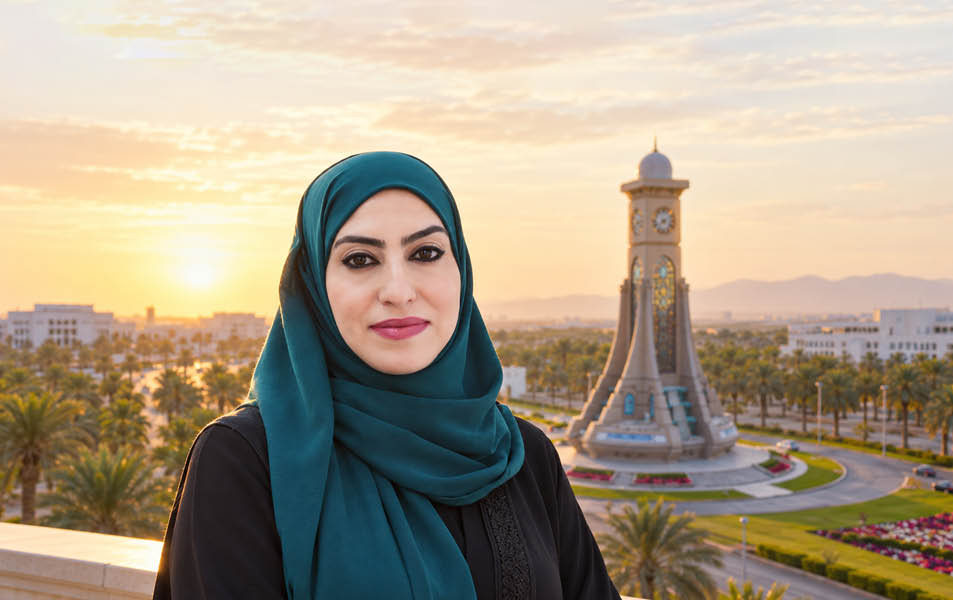

MUSCAT: Oman is seeking to turn growing international interest in its higher education sector into lasting recognition by strengthening academic standards, expanding applied research and ensuring graduates are equipped for a changing economy, according to Dr Maryam Belarab Mohammad Al Nabhani.
In an exclusive interview with The Arabian Stories (TAS), the Director General of Private Universities and Colleges at the Ministry of Education said the Sultanate’s ambitions extend beyond attracting international students and expanding academic partnerships.
“Our ambition is not simply to attract more students, but to establish Oman as a destination for high-quality education, applied research, innovation, and cross-cultural academic exchange,” she said.
The emphasis reflects a broader strategic direction under Oman Vision 2040, which prioritises a competitive, diversified, knowledge-based economy supported by skilled human capital, innovation and stronger international engagement.
According to Dr Alnabhani, the growing international interest in Oman’s higher education sector is being driven by the continuous development of academic programmes, expanding international cooperation, the adoption of digital technologies and a stronger focus on research, entrepreneurship and graduate employability.
The Sultanate’s political stability, strategic geographical location, cultural heritage and welcoming environment also provide a foundation for attracting international students, academics, researchers and institutional partners.
However, translating these advantages into lasting international recognition will require institutions to demonstrate consistent academic standards, deliver relevant qualifications and produce research and innovation with tangible economic and societal value.
Quality Assurance:
Quality assurance is emerging as one of the defining priorities in Oman’s higher education strategy, particularly as private universities and colleges seek to strengthen their international standing and respond to changing labour-market demands.
Dr Alnabhani stressed that maintaining academic standards must go hand in hand with ensuring that programmes remain relevant to the needs of students, employers and the wider economy.
“Quality assurance is fundamental to the sustainable development of Oman’s higher education sector,” she said.
The Ministry’s approach encompasses stronger institutional quality assurance systems, programme accreditation, periodic curriculum reviews and the continuous evaluation of learning outcomes. Academic programmes are also expected to align with recognised international benchmarks while remaining responsive to Oman’s economic and social priorities.
“We also believe that quality must be measured through outcomes, not processes alone,” Dr Alnabhani said, stressing that the focus is increasingly on the results delivered by the institutions rather than the processes they follow.
Graduate employability, employer satisfaction, student experience, research performance and contributions to innovation and economic development should all inform assessments of institutional effectiveness, she added.
This approach places greater responsibility on institutions to demonstrate the real-world value of their academic offerings. It also signals a shift towards a culture in which quality assurance is not treated merely as a regulatory requirement, but as a continuous process of improvement.
“Ultimately, our objective is to develop a culture of continuous improvement in which quality assurance becomes a driver of innovation, accountability, and international competitiveness,” she said.
The involvement of employers and industry representatives in programme design and review is another important element of this strategy. By strengthening links between academia and the workplace, institutions can better equip graduates with the technical, digital, analytical, communication and problem-solving skills increasingly demanded by employers.
Work-integrated learning, internships, applied research and professional certifications can further bridge the gap between academic knowledge and practical workplace requirements.
For Oman, the challenge is not simply to expand access to higher education, but to ensure that qualifications translate into meaningful career opportunities and contribute to national economic development.
International Partnerships:
As Oman seeks to attract international students and strengthen its regional education profile, the Ministry is encouraging private universities and colleges to pursue deeper academic partnerships rather than relying on conventional cooperation agreements.
Dr Alnabhani described internationalisation as a strategic driver of institutional excellence and sustainable development, with an emphasis on partnerships that generate measurable academic, research and economic outcomes.
These include joint academic programmes, student and faculty exchanges, collaborative research projects, international conferences and partnerships with reputable universities, research centres and industry leaders.
Institutions are also being encouraged to explore joint research funding, establish innovation centres and collaborate on regional and global challenges.
“We are particularly interested in partnerships that strengthen institutional capabilities, enhance research productivity, facilitate knowledge transfer, and contribute to national development,” she said.
The objective is to ensure that international engagement translates into tangible benefits for students, institutions, communities and the wider economy.
Attracting international students, meanwhile, requires more than promoting Oman as a safe and attractive destination. Institutions must also offer internationally competitive programmes, effective student support services, diverse learning environments and clear pathways to professional development.
Such an approach could help Oman strengthen its appeal as a destination for academic exchange and research collaboration while ensuring that internationalisation contributes directly to the quality and capacity of its higher education institutions.
Preparing for an AI-Driven Economy:
The rapid transformation of technology and industry is placing new demands on higher education systems worldwide. In Oman, private universities and colleges are expected to play a central role in preparing graduates for emerging sectors and supporting the economic diversification objectives of Oman Vision 2040.
Dr Alnabhani identified artificial intelligence, cybersecurity, renewable energy, logistics, advanced manufacturing, financial technology and healthcare among the fields requiring proactive responses from higher education institutions.
Meeting these needs will require continuous curriculum renewal, interdisciplinary learning, stronger industry engagement and the integration of digital competencies across academic disciplines.
However, she cautioned against viewing transformation simply as the introduction of new courses or technologies.
“The transformation we seek goes beyond introducing new courses or adopting new technologies. It requires rethinking how students learn, how knowledge is produced, and how academic programmes contribute to economic and social value,” she said.
The Ministry is encouraging institutions to incorporate AI literacy, data analysis, critical thinking, creativity, entrepreneurship, ethical decision-making and lifelong learning into their educational offerings.
At the same time, applied research, technology transfer, business incubation and industry collaboration are expected to help turn academic knowledge into practical solutions.
The broader ambition is to develop graduates who can do more than fill existing vacancies. They must also be capable of creating opportunities, adapting to technological change and contributing to new areas of economic activity.
“An important priority is to ensure that graduates are not simply prepared for existing jobs, but are equipped to create new opportunities, respond to emerging challenges, and contribute to the diversification of Oman’s economy,” Dr Alnabhani said.
This places private higher education institutions in a strategically important position, connecting education and research with industry needs and the development of new economic sectors.
Sustainability is a Strategic Priority:
Beyond academic quality and technological transformation, institutional sustainability is set to become a defining feature of Oman’s higher education agenda over the next five years.
Dr Alnabhani’s vision places sustainability alongside global competitiveness, research and innovation, internationalisation and future-ready human capital as one of five strategic priorities for the sector.
The emphasis extends to the long-term capacity of universities and colleges to maintain effective governance, diversify funding, strengthen industry partnerships and increase their contributions to communities and national development.
This institutional dimension is critical to ensuring that progress in higher education can be sustained over time, rather than depending solely on short-term expansion or isolated initiatives.
Stronger industry partnerships can help institutions connect academic programmes and research activities with practical economic needs. Diversified funding and effective governance, meanwhile, can support institutional resilience and create opportunities for continued investment in teaching, research and innovation.
Sustainability also has a wider societal dimension. By strengthening research capacity, encouraging entrepreneurship and developing solutions to national and global challenges, higher education institutions can contribute to economic diversification and the long-term wellbeing of communities.
“The future of higher education will depend on our ability to connect these priorities within an integrated and forward-looking ecosystem,” Dr Alnabhani said.
Achieving this, she added, will require close collaboration between government, higher education institutions, industry, research organisations and international partners.
The emphasis on an integrated ecosystem underscores the need to view higher education as more than a provider of qualifications. Its institutions must also serve as centres of knowledge creation, innovation, enterprise development and solutions-oriented research.
Five-Year Vision:
Looking ahead, the Ministry’s priorities point towards a higher education sector that is more internationally connected, accountable for its outcomes and closely aligned with the needs of a changing economy.
The first priority is to raise quality and global competitiveness through stronger academic standards, institutional performance, international engagement and continuous improvements in educational outcomes.
The second is to make universities and colleges more active contributors to research, technological development, entrepreneurship and economic diversification.
The third is to expand meaningful international partnerships, attract students and researchers, and create more opportunities for joint programmes, collaborative research and academic exchange.
The fourth is to develop future-ready human capital through flexible, interdisciplinary and digitally enabled programmes that respond to emerging industries and evolving labour-market needs.
The fifth is to strengthen institutional sustainability and societal impact through diversified funding, effective governance, industry partnerships and stronger contributions to national development.
Taken together, these priorities outline a shift towards a higher education model in which international recognition is supported by demonstrable quality, research capability, economic relevance and long-term institutional strength.
For Oman, the measure of success will therefore extend beyond the number of international partnerships secured or students attracted. It will also depend on whether institutions can produce skilled graduates, generate knowledge, support innovation and contribute meaningfully to a diversified economy.
Dr Alnabhani articulated that ambition in clear terms.
“Our ultimate ambition is for Oman to be recognised not only as a destination for quality higher education, but also as a regional contributor to knowledge, research, innovation, and sustainable development,” she said.
“We want our higher education institutions to be places where talent is developed, knowledge is created, innovation is translated into economic value, and solutions are generated for the challenges facing Oman and the world.”
That vision captures the strategic direction Oman is pursuing: building a competitive, diversified, and knowledge-based Omani economy.
Read More
- Oman warns of legal action over online posts offending countries, their leaders
- GCC tourism revenue rises 9.7% to $131.9 billion in 2025
- Three expats arrested with crystal meth and marijuana in Oman’s Al Musannah
- Corporate table bookings open for HerStory Oman Summit & Awards 2026
- Oman prepares online food delivery rules after customers raise price concerns





