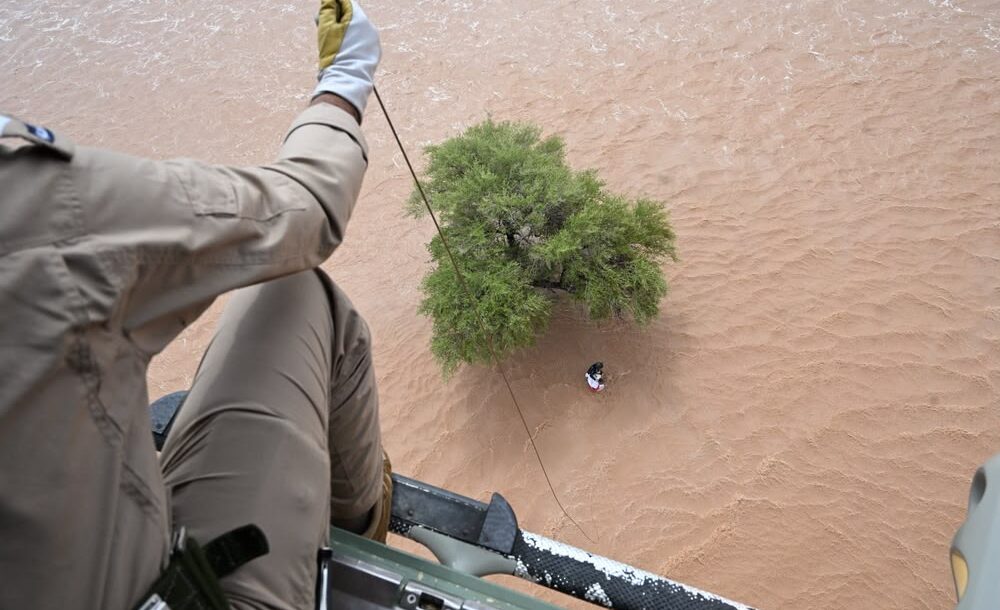

MUSCAT : Oman is strengthening emergency planning and measures to protect essential services from cyclones, floods and other hazards, officials said, as the country marks the International Day for Disaster Risk Reduction.
A national framework for institutional risk management governance is scheduled to be launched on Tuesday by the National Risk Register in cooperation with the Ministry of Labour, Oman News Agency reported.
The framework will establish common principles and requirements for risk management across government bodies, helping them anticipate threats and prepare coordinated responses.
Read More
- Oman Air boosts winter flights, triples Zurich capacity and expands codeshare network
- Over 700 non-compliant cosmetics, toys and supplements seized in Muscat markets
- Muscat Municipality signs agreement to unify municipal services across Oman
- Travelling to the Philippines from Oman? New e-visa system takes effect
- Oman’s tourism ministry launches Itqan digital platform and 14 e-services
An English-language edition of the register’s community guide is also scheduled for release, giving residents and visitors access to information on potential hazards and advice on prevention and emergency response. The community edition was first launched in October 2025.
Mansoor bin Talib Al Hinai, chairman of the Authority for Public Services Regulation and head of the essential services sector within Oman’s emergency management system, said preparedness must cover prevention, planning, response and recovery.
The sector assesses risks to roads, electricity, telecommunications, water, wastewater, fuel and waste management, taking account of how disruption to one service can affect others, he told the agency.
Oman’s experience with cyclones and severe weather has reinforced the need for early preparation, reliable supply chains and backup arrangements to maintain services, he said.
The public services regulator issued two regulations in March 2026 covering risk management and business continuity in the electricity and water and wastewater sectors. The Telecommunications Regulatory Authority has also issued emergency management requirements for licensed operators.
The measures require operators to establish risk management systems and business continuity plans, test and update them regularly, and submit annual reports on risk assessments, exercises and corrective action, Al Hinai said.
Preparations include alternative arrangements for electricity and water supplies, mobile and technical solutions for telecommunications, and measures to maintain fuel and waste services during disruptions.
An essential services operations centre works around the clock during emergencies, coordinating with the National Centre for Emergency Management to exchange information and support decisions, he added.
Colonel Zayed bin Hamad Al Junaibi, head of the National Centre for Emergency Management, said Oman assesses readiness through indicators including early warning capabilities, response times, equipment availability and the results of joint exercises.
Recent emergencies, including the Al Masarrat weather system, highlighted the importance of advance planning, rapid information exchange and clear channels for coordination, he said.
Oman is preparing a “National Readiness 2026” exercise simulating an aircraft crash outside an airport perimeter. A previous national exercise, held at Wadi Dayqah Dam on Dec. 23–24, 2025, tested responses to severe weather, evacuation and search-and-rescue scenarios.
The country also participated in the regional Indian Ocean tsunami exercise “IO Wave” in 2025 and conducted a health emergency simulation with the World Health Organization in 2026.
Al Junaibi said future exercises should increasingly test overlapping emergencies, such as flooding accompanied by utility outages, or incidents requiring simultaneous medical, security, rescue and shelter operations.
The aim is to assess how the national system shares information, allocates resources and makes decisions under pressure, he said.
Authorities are also exploring the use of artificial intelligence and data analysis to improve risk forecasting and process information more quickly, while strengthening information sharing between agencies.
Al Junaibi urged the public to follow official information, respond promptly to warnings, comply with evacuation instructions and avoid taking risks in affected areas.
He said the effectiveness of public awareness campaigns should be measured by how people respond to safety instructions, rather than solely by audience reach or online views.
Roberta Boscolo, head of climate and energy at the World Meteorological Organization, told the agency that international sharing of weather and hydrological data is essential to improving forecasts and helping countries issue early warnings.
Oman’s National Risk Register identifies and assesses potential threats to guide planning and investment. Officials said priorities include strengthening infrastructure, reducing the likelihood and duration of service interruptions, and restoring affected services as quickly as possible.
For all the latest news from Oman and GCC, follow us on Twitter, Instagram and LinkedIn, like us on Facebook and subscribe to our YouTube page, which is updated daily.





