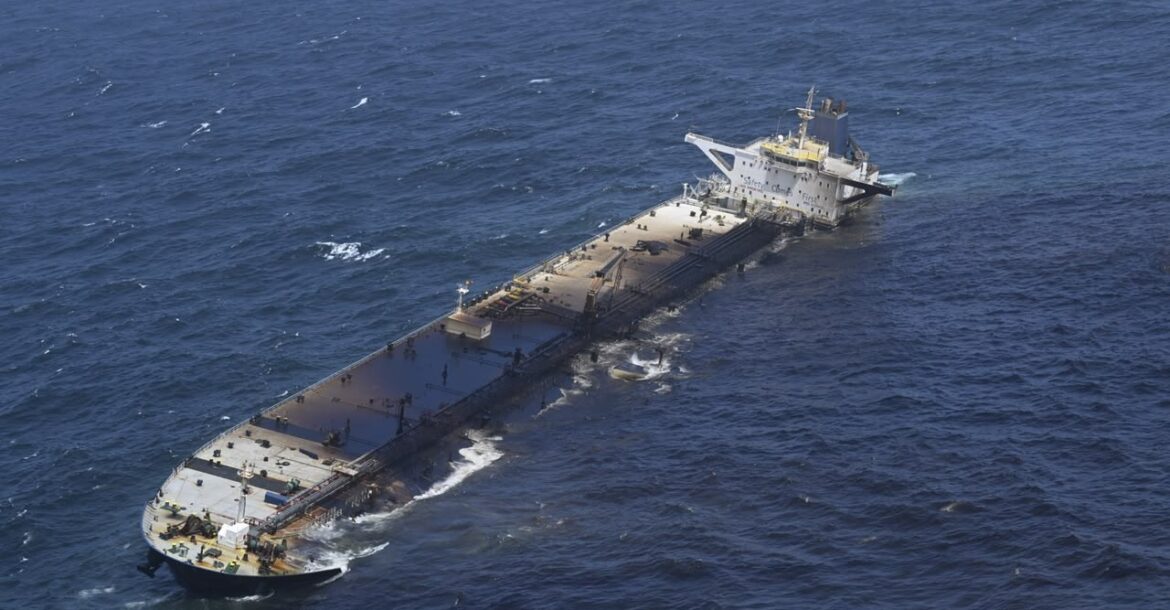

MUSCAT: The ministry said it is working with relevant national authorities, the Environment Authority, British maritime risk company Ambrey and international specialists to limit the potential environmental impact of the incident and prepare for the next stages of the salvage operation. Recent reports have also confirmed that Ambrey is coordinating containment work involving specialist equipment, vessels and aircraft.
Mohammed bin Abdullah Al Rawahi, Director General of Maritime Affairs at the ministry, said authorities have been working from the outset to reduce the potential environmental consequences of the grounding. Specialist oil-spill response companies have been brought in to support containment and cleanup operations, while pollution-control equipment and materials have been mobilised for deployment when weather and sea conditions allow.
The response has been complicated by the harsh conditions during the Khareef season, with winds sometimes reaching about 40 knots and waves rising to around four metres. These conditions have made it extremely difficult and potentially hazardous for support vessels and teams to approach the grounded tanker by sea. The spill has already reached Oman’s coastline, while authorities continue to monitor its movement and environmental impact.
Al Rawahi said the waters around the vessel are shallow and rocky, while accurate marine and hydrographic information is needed to identify safe routes and operating areas. This has created additional navigational challenges for vessels and equipment supporting the response.
The condition of the tanker itself presents further difficulties. The vessel is grounded on a rocky area and is tilted by about 17 degrees, with water entering a substantial part of one side. Oil and seawater on the deck, combined with strong winds and waves, have made some working areas slippery and unsafe.
The tanker also lacks a reliable power source to operate essential equipment, meaning cargo transfers and heavy operations cannot proceed until minimum safety requirements are met and the relevant areas on board are secured.
According to Al Rawahi, the immediate priority is to establish a safe working environment for technical teams. This includes cleaning and preparing work areas, carrying out safety checks and gas and oxygen measurements, identifying locations for equipment, and transporting generators, technical equipment and rescue gear to the vessel.
Because some equipment cannot currently be transported safely by sea, authorities are using air support to move experts and equipment to the tanker’s deck, allowing technical and preparatory work to continue while they wait for safer maritime conditions.
At the same time, technical teams are assessing options to reduce the continuing leakage and maintain the stability of the vessel and its cargo. One option under consideration is transferring oil internally from damaged tanks to intact tanks where the vessel’s condition and safety requirements allow.
Any such transfer would require the installation of power systems, pumps and other support equipment, alongside continuous checks on the vessel’s stability, tank condition and overall operating environment.
Marine and hydrographic surveys are also being carried out around the tanker and its approaches to establish accurate information on water depths, seabed conditions and navigational hazards. The data will be used to identify safe routes and locations for rescue and support vessels before deeper-draft vessels can approach the grounded tanker.
The longer-term objective is to create the conditions for the transfer of the tanker’s oil cargo to another vessel equipped for the operation. Authorities said this stage will only proceed after the working environment is secured, necessary equipment and power sources are available, risks associated with the damaged tanks are addressed and safe marine access has been established.
Al Rawahi said the operation is being advanced in phases based on ongoing technical assessments and safety considerations. Protecting response teams, limiting environmental damage and preventing further deterioration of the tanker remain the authorities’ main priorities.
Read More
- His Majesty Sultan Haitham arrives in Kazakhstan
- Shura Council discusses Omanisation challenges in healthcare, shortage of rare specialties
- Oman signs aviation agreements covering airports, aircraft maintenance and training
- His Majesty Sultan Haitham departs for Kazakhstan on two-day state visit
- The Arabian Stories honoured by Oman’s Ministry of Transport for media contribution





