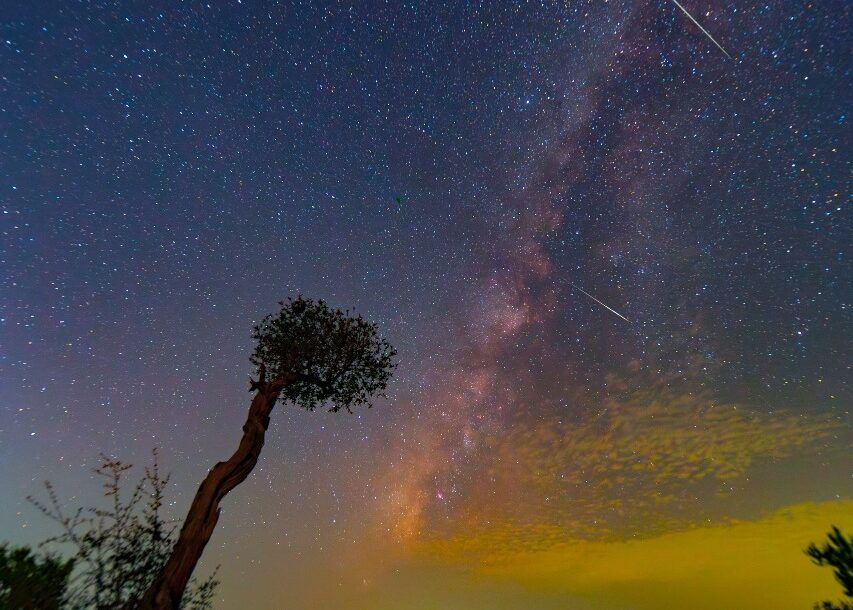

MUSCAT – Known as one of the most spectacular astronomical events of the year, the shower can be observed with the naked eye across Oman’s governorates, especially in dark areas away from city lights.
The Perseids, which began around July 17 and will continue until August 24, are popular among astronomy enthusiasts and photographers worldwide for their bright, fast-moving meteors. The shower is expected to peak on the night of August 12 into the morning of August 13, with up to 100 meteors per hour visible under ideal conditions.
It is one of the most attractive astronomical phenomena for astronomical observation and photography enthusiasts around the world.
Amjad bin Ja’ad Al Rawahy, a member of the Oman Society of Astronomy and Space, explained that meteor showers occur when Earth, in its orbit around the sun, passes through debris left by comets. In the case of the Perseids, the source is Comet Swift-Tuttle, which completes an orbit around the sun approximately once every 133 years. Its nucleus measures about 26 kilometres in diameter.
Read More
- Oman condemns deadly church shooting in Jordan
- Online shoppers have a right to an invoice, Oman consumer authority says
- Oman and UK unveil £1 billion-plus AI data centre plan for Salalah
- Oman plans 84 digital economy initiatives by 2030, expands focus on private sector
- His Majesty Sultan Haitham returns home after UK state visit
“When the Earth passes close to its remnants, dust particles and small pieces—some no larger than a grain of sand—enter the atmosphere at a tremendous speed of up to 72 kilometres per second. They collide with air molecules and burn, generating bright streaks of light across the sky,” he added.
He noted that the Perseids are particularly known for producing ‘fireballs’, which are exceptionally bright meteors that outshine others. Studies show the Perseids produce more fireballs than any other annual meteor shower.
Al Rawahy advised that the best time to view the meteor shower is after midnight until just before dawn, when the radiant point, located in the Perseus constellation in the northeastern sky, is highest. Observing from high, dark locations away from light pollution significantly improves visibility.
However, he cautioned that this year’s peak coincides with a waning gibbous moon, with about 84 percent illumination, which could obscure fainter meteors. However, he noted that bright meteors, or those appearing far from the moon, will remain visible to the eye.
He also encouraged viewers to allow their eyes 20 minutes to adjust to the darkness for optimal visibility. In addition to the meteor shower, observers may also spot Jupiter, Saturn with its rings, the bright star Capella, and summer star clusters, offering additional delights for skywatchers and astrophotographers.
Al Rawahy concluded by saying: “Watching meteor showers, especially the Perseids, doesn’t require any special equipment. It’s an amazing visual experience that anyone can enjoy with the naked eye, provided they choose the right place and time.
It’s an opportunity to contemplate the beauty and vastness of the universe, and a reminder of just a small part of the constant movement of celestial bodies around us.”





