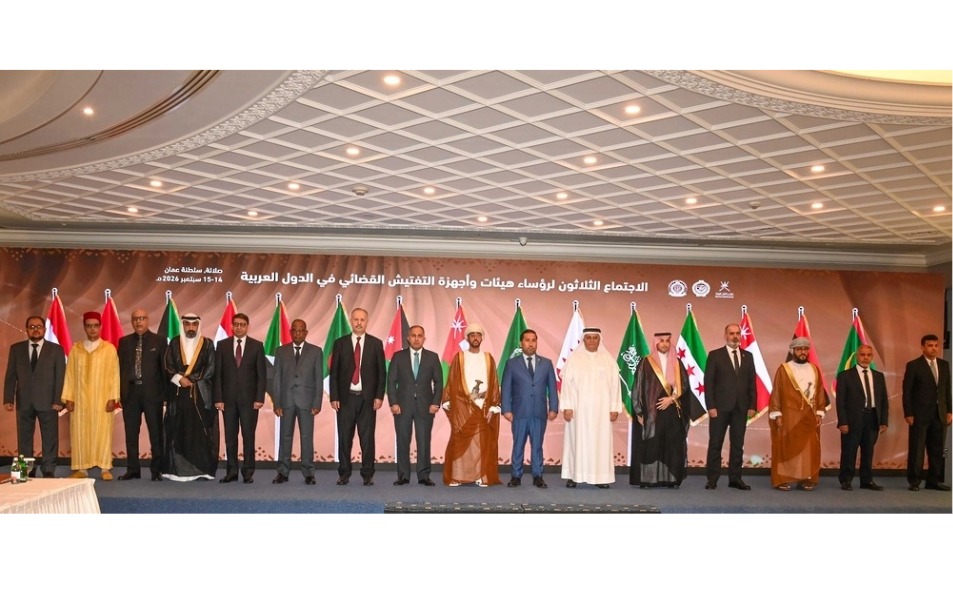

Muscat: Judicial leaders from 14 Arab countries have concluded the 30th meeting of heads of judicial inspection bodies and agencies in Dhofar Governorate, calling for greater use of artificial intelligence, unified inspection standards and stronger performance-based evaluation across Arab judicial systems.
The two-day meeting brought together senior judicial officials to discuss the future of judicial inspection, the quality of court rulings and the role of modern technology in improving efficiency while safeguarding judicial independence.
His Eminence Sheikh Dr. Yaqoub bin Mohammed Al-Saidi, Head of the General Directorate of Judicial Inspection at Oman’s Supreme Judicial Council, stressed the importance of developing monitoring and evaluation tools and making greater use of modern technologies to improve performance.
Read More
- ‘We stand on solid ground for joint investments with Botswana,’ Oman Investment Authority chief says
- Minister appoints Oman Chamber of Commerce and Industry elections committee
- His Majesty Sultan Haitham to visit Botswana and Angola from September 16
- Oman says some government digital services temporarily disrupted after power outage
- Two arrested over multiple thefts in Oman’s North Al Batinah
He emphasised that technological advancement must go hand in hand with protecting the independence of the judiciary.
Counselor Dr. Youssef Al-Sabaawi, Vice President of the Arab Center for Legal and Judicial Research and Director of its Judicial Training Academy, also highlighted the need to build a common Arab vision for developing judicial inspection systems and promoting the exchange of expertise between countries.
During the meeting, Oman’s Supreme Judicial Council presented a working paper titled “Artificial Intelligence and Judicial Inspection: Towards an Arab Index for the Quality of Judicial Rulings.”
The paper explored the use of modern technologies to analyse judicial rulings and generate quantitative and qualitative indicators measuring legal reasoning, consistency in judicial interpretation and the speed of resolving cases.
It stressed that artificial intelligence should be used as a support tool for judges and judicial inspectors rather than as a substitute for human judgement.
Participating countries, including Iraq, Lebanon, Syria, Algeria and Kuwait, also presented papers examining the transition from traditional inspection to preventive and performance-based oversight.
Discussions covered court performance evaluation, the use of smart technologies in legal research and data processing, as well as concerns surrounding algorithmic bias and the protection and confidentiality of judicial files.
Participants also discussed the preparation of a unified Arab model for assessing the quality of judicial rulings and the development of a guiding manual suited to the different judicial systems across the Arab world.
The meeting also approved standards and controls for the Arab Prize for Judicial Inspection Work.
Among the key recommendations was the adoption of the Arab Award for Judicial Inspection Work project and the unification of procedural inspection standards across Arab countries.
Participants also called for judicial inspection methodologies to shift from traditional monitoring towards systems based on performance and quality indicators.
The recommendations stressed the importance of strengthening the independence of judicial inspection bodies and developing monitoring and evaluation mechanisms that enhance transparency, improve efficiency and reinforce the principles of integrity and justice.
The meeting further recommended adopting a balanced system for evaluating judges through objective and measurable standards, with evaluation results linked to continuous training and professional development programmes.
Artificial intelligence was also recommended as an auxiliary tool for analysing the quality of judicial rulings and inspection work, provided that clear legislative and ethical frameworks are put in place to govern its use.
Participants also adopted several themes for the 31st meeting in 2027, including total quality management in judicial institutions, balancing judicial independence with performance evaluation, smart justice and the development of a unified Arab framework for measuring the quality of judicial rulings and judicial inspection.





