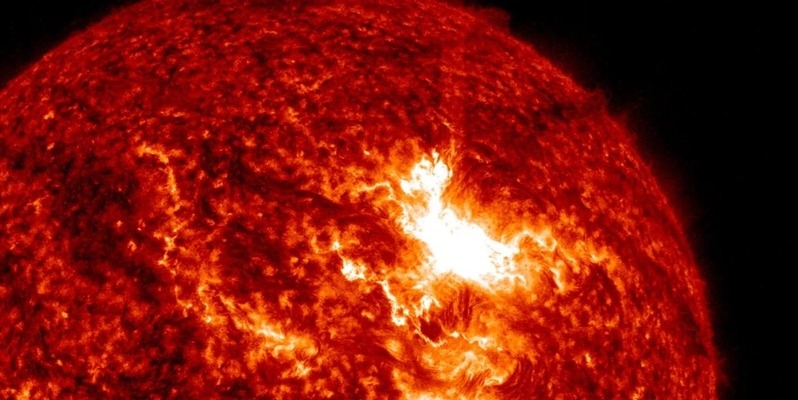

Muscat: Ibrahim bin Mohammed Al-Mahrouqi, Vice Chairman of the Board of Directors of the Omani Society for Astronomy and Space, explained that the explosion occurred at 1:49 pm Oman time and lasted approximately 28 minutes, classifying it as a long-duration event. Such events, he noted, indicate the release of a large amount of solar energy, with part of its effect expected to reach Earth.
The flare released a coronal mass ejection (CME) aimed toward Earth, expected to arrive on November 12, potentially causing G1–G2 level geomagnetic disturbances in the planet’s magnetosphere. This could result in the appearance of auroras across high-latitude regions such as Canada, Scandinavia, and Alaska.
Al-Mahrouqi added that the explosion also caused temporary radio blackouts (R3 level) across parts of Africa and Europe, along with a mild radiation storm (S1) due to elevated levels of charged particles, expected to persist for several hours.
Read More
- His Majesty Sultan Haitham returns home after UK state visit
- Oman participates in London Press Club awards, presents Journalist of the Year honours
- His Majesty Sultan Haitham concludes UK state visit as investment and trade ties deepen
- Oman Meteorology: Moderate chance of tropical activity in Arabian Sea, no direct impact expected
- Oman’s TRA to host public dialogue on child online safety
Regarding Oman, Al-Mahrouqi reassured that the impact will be minimal, possibly limited to minor disruptions in satellite navigation or high-frequency communications. “It poses no danger to daily life or vital systems,” he emphasized.
He further stated that the Omani Society for Astronomy and Space continues to collaborate with international institutions, including the Space Weather Prediction Center (SWPC), to closely monitor the situation. Al-Mahrouqi highlighted that such tracking supports Oman Vision 2040’s goals of advancing science, technology, research, and innovation.





