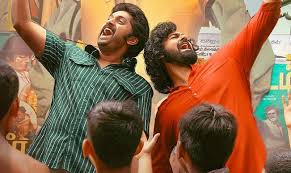

Cast members – Dhyan Sreenivasan, Pranav Mohanlal, Nivin Pauly, Aju Varghese, Basil Joseph, and Kalyani Priyadarshan
Director – Vineeth Sreenivasan
A special note as we head to the review – A warm welcome back to Nivin Pauly (Nithin Molly) after a back-to-back flop here he is back to save a film single-handedly, despite the ensemble cast in a cameo appearance, he subtly exposed the current direction of Indian filmmaking and gave a standout performance with bold desperation. And we are sure the character’s sensational dialogue of “ottaku vazhi vetti vannavana njan, body shaming cheyunno da…” and favouritism and nepotism dialogue will be a blockbuster shot that will have a promising last on reels and shots for the next few ages.
Unlike other films like The Dirty Picture, Heroin, Woh Lamhe, etc., Varshangalku Shesham’s plot is not the focus of the pitfall of the cinema industry; rather, it centres on the lives of two ambitious individuals whose choices, whether good or bad, influence their career and personal lives, keeping friendship as the bond on the front as we like to address it as “Bromance” in the new age language, also, special credit to the cameo appearance depicting the new age nepotism practices. Still, the irony is that the majority of the cast in this film is anything but nepotism products.
Read More
- Superstar Rajinikanth’s ‘Jailer 2’ sets Oman cinemas on fire with over 20 shows a day
- Veteran Indian actor Nana Patekar dies at 75
- Ayushmann Khurrana and Sara Ali Khan bring the energy to Chandigarh ahead of Udta Teer
- One Feeling at a Time: Talwiinder begins his ‘Paiinted Feeliings’ journey with ‘Assay Passay’
- Avengers: Endgame Encore opens in Oman as Kuwait cancels cinema release
The friendship between musician Murali (Pranav Mohanlal) and aspiring screenwriter and filmmaker Venu (Dhyan Sreenivasan) is central to the narrative. With aspirations of taking names in the cinema industry, they travel to chase their unsettling passion as artists.
The movie starts when they first meet in the 1960s and chronicles their journey as they grow closer, move to Kodambakkam in Madras to pursue their dreams, run into difficulties, eventually become well-known, succeed, endure arguments, drift apart, face setbacks in their careers, reach their lowest point, make amends, and eventually start a new chapter in their relationship.
This is Vineeth Sreenivasan’s sixth feature film, and, based on his extensive expertise, he seems to be well aware of the criticism he will face following the release of the film. He responds to such jabs with a bit of uncommon self-satire in Varshangalkku Shesham. However, don’t let it dash hopes that Vineeth would choose a different route. After he had taken all the jabs at himself, he retreated to his comfort zone and put up in Chennai, the LA of south India, back then, striking a nostalgic and upbeat mood.
But Nivin Pauly’s performance as Nithin Molly in the second part knocks the movie up another level, even though he just had a brief cameo; the moment when he walks off with the claps is the highlight of the movie. With his narcissistic performance, which catches everything from body-shaming to trolling to nepotism and has you laughing endlessly, the gifted actor kills it.
There are many pleasant characters, such as the assistant director, played by Basil Joseph, who treats a huge celebrity in a hilariously swift manner, and the producer, portrayed by Aju Varghese in a double role, who cracks jokes about Kattan Chai and daringly shaving off half his moustache (a popular bet action promised if one lost the bait).
Not to mention Vineeth’s effort at a cringe-worthy comedic conclusion that involved a classic modernization of his father’s cheesy quips
Speaking about Kalyani Priyadarshan’s role, Annie. She seemed like Murali’s love interest, who might play a huge role in building his character, but she doesn’t. Annie’s problem lies in the fact that her past is too rich for this kind of film, and it also ended far too quickly, making it an emotionally wrenching sequence. The way Annie and Murali enter and exit the script occasionally ends up setting up a conflict, leaving a senseless script. The movie is still a disorganized jumble of scenes that don’t quite fit together. Well then, let’s just call this unwanted sequence with this pairing just a marketing stunt pulled after the success of Hridhyam and an attempted recycle of a tribute to their parent’s hit jodi of Mohanlal and Lissy.
Also, another area of focus was the dynamic between Pranav and Dhyan, which, too, aimed to imitate the chemistry observed in the movies starring their fathers, Mohanlal and Sreenivasan, which went for a toss.
Particularly with Murali, the characters’ purported problems aren’t conveyed very well. He claims that he wants to write ghazals and get away from this competitive field. However, he wants to own the moment and become recognized as a composer when one of his songs becomes popular. And he disappears when this doesn’t take place. This character deserves significantly more depth and darkness in this storyline, which involves his reappearance as a composer and another incident of disappearing than the writer is prepared to give it. As the flashbacks never told the story of who and what Murali is other than Venu’s close friend whom he picked up drunk post “Madhu pakaroo.”
Soundtrack
Vineeth has always had a fantastic ear for music. In a recurrent hymn, “Nyabagam”, the verse says, “Oru murai en pizhai marandhu nee vandhidu,” which is about remembering and forgiving. It is true that artists and music lovers convey their emotions to one another through music and its lyrics, which hold a special way to one’s weak point. Music can kill, heal, mean or break anything, and especially when it comes to films, a lot can happen over a song; an entire concept can be reintroduced through songs.
The movie also shows how difficult it is for outsiders to get into the film industry and how every Friday is a talent assessment. It also emphasizes how well-aware the industry’s top brass is of the struggles faced by outsiders and how audiences perceive such prejudice, or better addressed as “favouritism”, exists.





