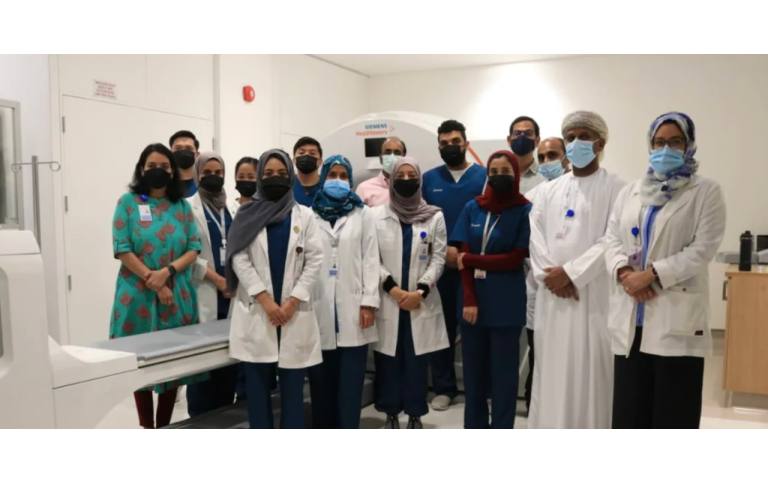

MUSCAT: The Sultan Qaboos Integrated Center for Cancer Treatment and Research has launched an imaging service for prostate cancer and neuroendocrine glands using radioactive isotopes produced in special generators available at the centre.
The centre’s nuclear medicine team was able to perform diagnostic imaging for a number of cancer patients through this service, which will enable prostate and neuroendocrine cancer patients to obtain regular examinations.
Diagnostic imaging begins with injecting the patient with radioactive isotopes, and after the tumour cells absorb the material sufficiently, the tumour is imaged using a digital PET/CT machine to determine the location of the cancerous tissue and the extent of its spread.
Read More
- Oman voices solidarity with Saudi Arabia, rejects targeting of civilian facilities
- International Financial Centre of Oman nears operational readiness by 2027
- Oman targets $66mn investment to build aviation hub
- Oman targets quality French investments in priority sectors
- Oman’s Thawani makes Forbes Middle East fintech list for third year
Dr. Kholoud Al Riyami, a nuclear medicine consultant, said in a statement, “The radioactive isotope ‘Ga68DOTATATE’ is used to diagnose neuroendocrine tumours, and ‘Ga68PSMA’ is used to study the spread of prostate cancer. As these materials are characterised by their high sensitivity to detect cancer cells for these types of cancers compared to routine diagnostic imaging.”
She added, “This service allows the medical team to diagnose the patient’s condition, determine the stage of the disease and develop an appropriate treatment plan, in addition to the possibility of evaluating the patient’s eligibility for treatment with radioactive material directed to the affected cells, which we are working to make available in the centre in the near future.”
For his part, Dr. Rashid Al-Sakiti, Head of the Radiology and Nuclear Medicine Department, said, “The team took all measures to ensure the safety and security of these radioactive materials before injecting the patient with them,” expressing his happiness with activating this examination for cancer patients, which will undoubtedly contribute to the speedy diagnosis of patients and the start of their treatment program instead. About sending them abroad to conduct these checks and the subsequent delay.





