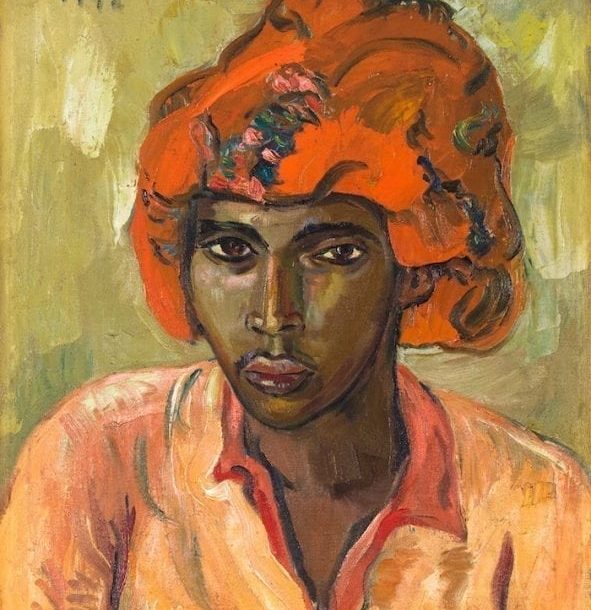
South African artist Irma Stern’s painting of an Omani man fetched more than USD 1 million in an auction, according to Oman’s embassy in South Africa.
The painting is of an Omani man dressed in traditional garments of Saidi Musar, Dishdasha and Bisht.
And according to the embassy, “The painting dates back to the reign of Sultan Khalifa bin Harib bin Thwaini Al Said and was painted on the island of Zanzibar in 1939.”
Read More
- His Majesty Sultan Haitham arrives in Kazakhstan
- Shura Council discusses Omanisation challenges in healthcare, shortage of rare specialties
- Oman signs aviation agreements covering airports, aircraft maintenance and training
- His Majesty Sultan Haitham departs for Kazakhstan on two-day state visit
- The Arabian Stories honoured by Oman’s Ministry of Transport for media contribution

Do you know who is Irma Stern?
Irma was a South African artist, whose expressive portraits rendered in saturated colours were among her most widely known pieces.
The painter and sculptor travelled throughout Africa to capture not only likenesses but also landscapes that are unique to the continent.
She had said “it is only through personal contact that one can get a few glimpses into the hidden depths of the primitive and childlike yet rich soul of the native, and this soul is what I try to reflect in my pictures of South Africa.”
Stern was born in 1894 in Schweizer-Reneke, a frontier town in the former South African province of Transvaal.

Child of Jewish-German parents
The child of Jewish-German parents, Stern’s father made his fortune as a cattle farmer and goods trader to South African gold miners, and Irma and her brother Rudi grew up in relative comfort.
Her peaceful childhood came to an abrupt end with the internment of her Boer-leaning father during the South African War (1899-1902).
Though he was soon released, the Sterns nonetheless relocated briefly to Germany. In subsequent years the family farming and business enterprises flourished, affording them a lifestyle which included constant travel between South Africa and Germany.
It was on these journeys that Stern first experienced the allure of foreign cultures, which left a lasting impression.
Influenced by Expressionist painter
On the eve of the First World War, Stern was in Germany with her family, unable to return to South Africa. It was here that her formal art studies began, both privately in Berlin and at the Academy in Weimar.
During this time, she met and was greatly encouraged by Max Pechstein, the German Expressionist painter and founding member of the November Group.
His influence would prove of vital importance to her development as an artist of Africa and Europe.
After the war, the family returned to South Africa. ‘She was already writing, in cold, rather desperate Berlin, about how she was longing to be back in South Africa, remembering all the colours and textures — the whole atmosphere,’ Peter says.
But it soon became clear that the Africa of Stern’s childhood was not to be found or seen in Cape Town.
At the same time, her avant-garde artistic tendencies failed to receive the same recognition in conservative colonial circles that they had in Germany.
First solo in 1916
In 1916, she had her first solo show with the help of German painter Max Pechstein, and her exposure to Expressionism would figure heavily as an influence on her career.
Her work was not well received upon her return, but eventually drew acclaim and she is considered one of the foremost South African artists.
In search of African subject matter, Stern decided to visit the Eastern Cape, Swaziland and Natal, where she continued to draw and paint.
The work she produced there, first exhibited in Cape Town in 1922, ‘was an absolute shock to the establishment’, which couldn’t comprehend her images of ‘sensual brown figures lying under trees’.
In the 1930s the rise of Nazism made it impossible for Stern to return to Germany. Instead she travelled widely across Africa, visiting Senegal in 1938, Zanzibar in 1939, and Congo in 1942.
The Watussi Chief
‘I shall want to paint the Watussi,’ she wrote in a letter to her friend Richard Feldman, of her desire to paint the queen and other women of the royal family. A 1942 exhibition of her Congo pictures in Johannesburg included almost 200 works from that trip.
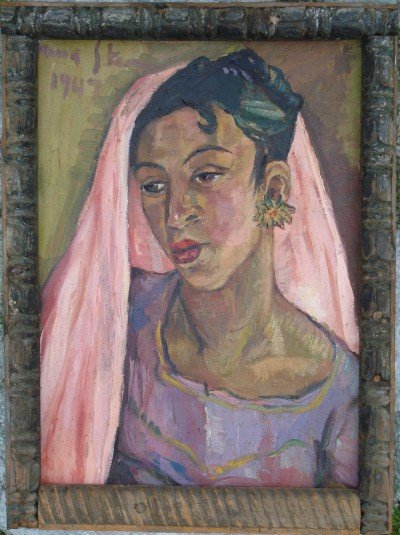
In 1946, Stern made a second trip to Congo where she painted The Watussi Chief’s Wife (whose real-life subject was probably the Rwandan queen Rosalie Gicanda). With its elongated, liquid forms, the work has ‘a strange simplicity, with colours that speak volumes of Irma’s skill’, Peter says.
It was during the period of The Watussi Chief’s Wife, when she was alone in Africa, that ‘she really came in to her own’, says Peter, who describes the paintings executed in those years as ‘compelling and magical’.
The Watussi Chief’s Wife travelled to Paris in 1947, where it was featured in a critically acclaimed exhibition of Stern’s work, alongside a second portrait of the same sitter.
The catalogue was written by the first director of the Musée National d’Art Moderne, Jean Cassou, who purchased a piece for the museum (now in the collection of the Centre Pompidou). With these works, Cassou noted, Stern had arrived at a perfect synthesis of technique and subject, resulting in the most eloquent production of her career.
By the time of her death in August 1966, Stern had achieved the level of national recognition she had long sought.
London galleries
But what she had truly desired was to exhibit in London: this, she was convinced, would make her international career. In 1967, a posthumous exhibit of Stern’s work was mounted at London’s Grosvenor galleries.
As stipulated in her will, Stern’s estate was placed in the care of trustees who established the University of Cape Town Irma Stern Museum in 1971.
In recent years, Stern’s works have repeatedly set records for South African artists at auction. Between 2000 and 2011 the record price for a painting by Stern leapt from 1.7 million South African rand to 34 million (roughly £3 million at the time).
According to Christopher Peter, director of the University of Cape Town Irma Stern Museum, it’s a fitting legacy. ‘Stern was a prolific painter,’ he says, ‘and at her finest, she is incomparable.’
Stern died on August 23, 1966 in Cape Town, South Africa. In 1971, her home—known as “The Firs”—was made the Irma Stern Museum by the University of Cape Town.
“Irma’s epic life spans the most extraordinary South African years — and the most extraordinary years of the 20th century,” Peter says.
(Inputs from chrities.com)





