
On Diwali morning, Keerthi found her mother unpacking a suitcase.
“Amma, we’re moving this evening. Why are you putting everything back?”
Nirmala folded a sari and returned it to the cupboard.
Read More
“You go ahead. I’ll come later.”
“You said that yesterday.”
“This house needs looking after.”
“We’re moving twenty minutes away.”
Her mother reached for another sari.
Outside, a neighbour was hanging a string of lights. The smell of ghee drifted through the open window. Usually, Nirmala would have finished making sweets by now, warning Keerthi not to touch them before they cooled.
This year, the ingredients lay unopened.
The house belonged to Nirmala. She and her husband, Ravi, had built it with two salaries, a housing loan, and a long disagreement about the kitchen windows. For thirty years, she had taught English at the nearby school. Former students still stopped at the gate and called, “Teacher!”
She had retired two years ago. Ravi had died the following year.
Since then, Keerthi often found her mother sitting in the veranda long after her evening tea had gone cold.
An MBA graduate working for a leading company, Keerthi had recently bought her first flat. Before choosing her own furniture, she had arranged her mother’s room: bookshelves, a reading desk, and a place beside the window for the old cane chair.
Until a week ago, Nirmala had been enthusiastic. She had chosen curtains and measured kitchen shelves.
Now she would not pack.
“Is something wrong with your room?” Keerthi asked.
“No.”
“Then what is it?”
Nirmala placed the sari on the bed.
From the bottom drawer of the cupboard, she took out a brown file.
“I found this while sorting your certificates.”
Keerthi recognised her mother’s handwriting on the cover.
Her own name.
“I should have shown you these papers years ago.”
“What papers?”
Nirmala sat down.
“Your father and I adopted you.”
Keerthi remained standing.
She waited for her mother to say something else—something that would mean she had misunderstood.
“We found you on a train.”
Keerthi sat on the edge of the bed.
Her mother began slowly.
They had been returning from a wedding. Towards morning, after several passengers had got off, they heard a baby crying on the opposite lower berth.
“You were wrapped in a yellow shawl. At first, we thought whoever was with you had gone to the washroom.”
“How old was I?”
“They estimated about ten months.”
Ravi had walked through the coach. They had questioned the remaining passengers and called the ticket examiner. Nobody could tell them who the baby was travelling with.
At the next station, railway police officers met the train.
“Did anyone come looking for me?”
“Not that we were ever told.”
“So someone left me there.”
Nirmala leaned forward.
“We don’t know what happened, Keerthi.”
“Was there anything with me?”
“Only the shawl.”
Nirmala explained the enquiries, the visits, and the months of formalities before they were able to adopt her and bring her home.
Keerthi opened the file.
Old documents. Official stamps. A small photograph of a baby with solemn eyes.
“Is this me?”
“Yes.”
She held the photograph closer.
“Why didn’t you tell me?”
“We should have.”
“Why didn’t you?”
“When you were little, we kept saying we would tell you when you were older. You grew up. We still couldn’t find the courage.”
“So other people knew something about me that I didn’t know myself.”
Nirmala lowered her eyes.
“Yes.”
“Why are you telling me now?”
“You’ve made a place for me in the home you bought. My books, my chair… you’ve thought of everything.”
Her voice faltered.
“I couldn’t come with you while I was still hiding this.”
Keerthi closed the file.
“I need some time.”
Her mother nodded.
Keerthi went out to the veranda.
Across the lane, a little girl was drawing a rangoli. Whenever her younger brother stepped too close, she chased him away.
Keerthi watched without really seeing.
Then she remembered another Diwali.
She had been eight. The moment her first sparkler caught, she had panicked and dropped it. Her father had stamped it out. Her mother had checked her hands repeatedly, although she had not been burned.
Later, when she refused to go outside again, Ravi had sat with her on this veranda, eating sweets until Nirmala discovered them.
Other memories followed.
Her mother staying awake beside her through a fever.
Her father running behind her bicycle.
The day her MBA admission came through, when he returned with three boxes of sweets because he could not remember which kind she liked best.
She remembered leaving for her first job. Her mother had reminded her about her tickets, her purse, her medicines. Only after the bus moved had Keerthi seen her turn towards Ravi and begin to cry.
These memories had not changed.
But something had shifted beneath them, and she needed time to understand it.
She thought of her father’s final days.
In the hospital, whenever Nirmala stepped out, Ravi would reach for Keerthi’s hand.
“Look after Amma.”
“I will, Acha.”
Later, he would say it again.
Had he been afraid of this too?
She sat with that thought for a while. Then she remembered how he had watched the door whenever her mother was late returning. He had been leaving the woman he loved. Perhaps that had been enough to frighten him.
When Keerthi went inside, Nirmala was still beside the suitcase.
“Is this why you want me to move alone?”
“I thought you might want some distance.”
“Have I asked for that?”
“No.”
“I asked for time.”
Her mother nodded.
Keerthi pulled a chair closer.
“Acha kept asking me to look after you. In the hospital.”
Nirmala pressed her lips together.
“I promised him,” Keerthi continued. “But that isn’t why I made you a room.”
Her mother looked up.
“I wanted you there.”
Nirmala’s eyes filled.
Keerthi took her hands.
“I’m angry, Amma. I wish you’d trusted me enough to tell me.”
“I’m sorry.”
“And I have questions. Tomorrow I may have more.”
“I’ll answer whatever I can.”
Keerthi looked at the familiar hands in hers: the slight bend in one finger, the small scar near the thumb.
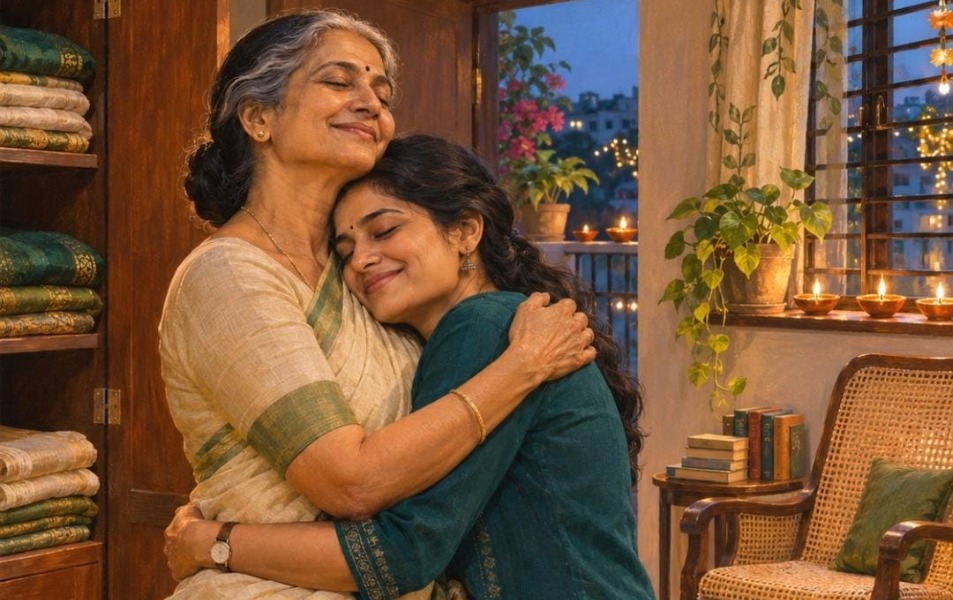
Then she leaned forward and hugged her mother.
For a moment, Nirmala remained still. Then her arms closed around her daughter.
They held each other for a long time.
Eventually, Keerthi drew back and wiped her face.
“I don’t know how to feel about everything yet.”
“You don’t have to.”
“But I know I don’t want to leave you here.”
Nirmala nodded, unable to speak.
Keerthi reached for the suitcase.
“Where’s the green sari?”
“Second shelf.”
They packed together.
Sometimes Keerthi stopped to ask a question. Sometimes she grew quiet and returned to folding.
Nirmala did not hurry her.
Around noon, Keerthi asked whether the yellow shawl had been kept.
“No, my dear. I’m sorry.”
She nodded. She had wanted it suddenly, though she could not have said what she would do with it.
After a while, she asked another question.
“If I ever want to find out more, will you help me?”
“Yes.”
This time, her mother answered without hesitation.
By evening, they reached the new flat.
Most of the furniture had arrived the previous day. Now Nirmala stood at the doorway holding the brass lamp while Keerthi struggled with a bag, two keys, and a box of sweets.
“Give me something,” her mother said.
“I’ve got it.”
The keys fell.
Nirmala looked at her.
Keerthi handed over the sweets.
“Don’t say anything.”
“I haven’t.”
“You’re thinking it.”
For the first time that day, they laughed together.
The old cane chair stood beside the window in Nirmala’s room. On the desk was a photograph from Keerthi’s graduation.
Ravi wore a shirt far brighter than anything he would have chosen.
“He hated that shirt, didn’t he?” Keerthi asked.
“You bought it. He wore it until the collar frayed.”
Keerthi touched the frame.
Outside, the building was alive with voices. Children hurried along the corridor in new clothes. A neighbour arrived with a plate of laddus and stayed to explain which lift usually stopped working.
At their doorway, Keerthi knelt to draw a small rangoli.
Nirmala watched.
“That side is crooked.”
“You’re retired, Amma.”
“My eyesight hasn’t retired.”
Keerthi handed her the bowl of coloured powder.
“Then help.”
They finished it together.
Afterwards, they arranged clay lamps along the balcony. They placed one beside Ravi’s photograph.
“He would have complained about the parking,” Keerthi said.
“And told everyone his daughter had bought a flat.”
Nirmala struck a match. Keerthi cupped her hands around the flame.
Together, they lit the lamps.
Later, while her mother made tea, Keerthi began moving towels from one shelf of the wardrobe to another.
Nirmala arrived with two cups.
“What are you doing?”
“Making room for the rest of your saris.”
“Those can stay at the old house.”
Keerthi looked at her.
Her mother set the cups down.
“We’ll bring them next Sunday,” she said.
“And your books.”
“We may need another vehicle.”
“We’ll get one.”
Keerthi folded the green sari and placed it on the cleared shelf.
Nirmala glanced at the open suitcase.
Then she took out another sari.
This time, she did not put it back.
She stood beside her daughter and began filling the wardrobe.





