
Every small town has someone everybody knows and nobody particularly enjoys arguing with.
In a quiet town near Aluva, Kerala, that man was Varghese.
He was fifty-eight, with a thick moustache, a permanently serious expression and faded shirts that always carried traces of engine oil. His automobile workshop stood beside Rajan’s tea shop.
Read More
The neighbourhood called him Thunder Varghese.
He was an excellent mechanic, honest with his customers and quietly generous with those who struggled to pay. His kindness, however, came wrapped in a frightening voice.
“Can you give me a discount?”
“Why? Did I damage your car?”
“When will my vehicle be ready?”
“When I finish repairing it!”
Even his compliments sounded like complaints.
Outside the workshop hung a sign:
No credit. No arguments. No unnecessary conversation
Rajan, his friend of thirty years, once suggested another line: Smiling strictly prohibited.
Varghese did not laugh. Rajan laughed enough for both of them.
Every morning, Rajan brought him tea without sugar. Every morning, Varghese complained that it tasted terrible.
And every morning, he finished it.
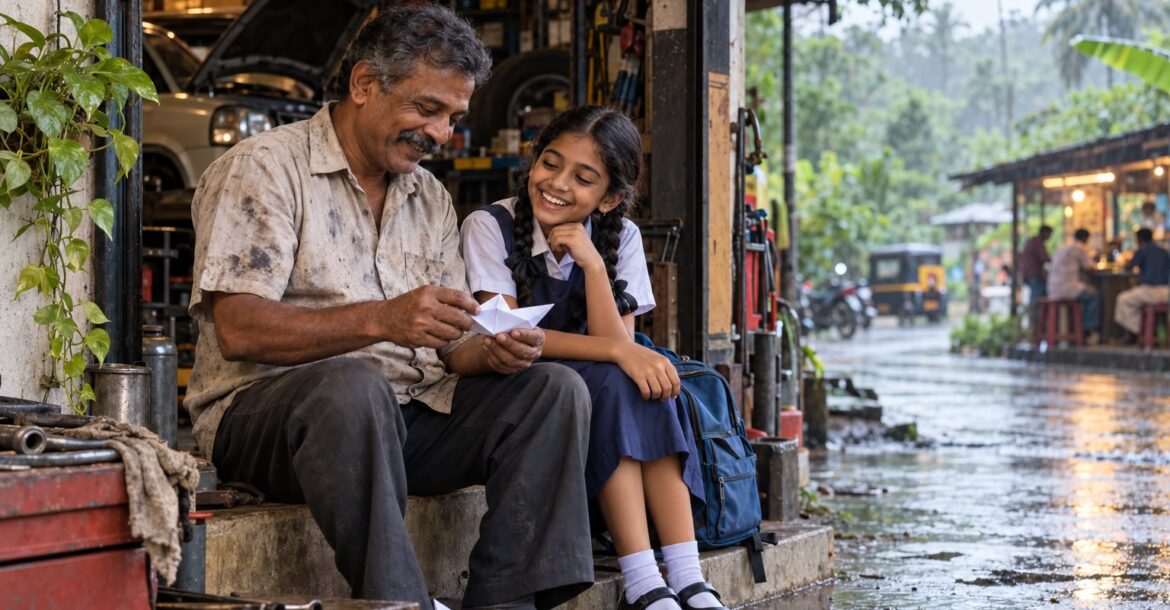
That was life at Varghese Auto Works until a rainy Monday afternoon, when a girl appeared at the entrance carrying a blue schoolbag and a folded piece of paper.
“Are you Varghese Uncle?”
He looked up from an engine.
“Yes. Bicycle puncture?”
“No.”
“Then what do you want?”
“My name is Diya.”
“Very good. Now go home before it rains again.”
She held out the paper.
There was a telephone number and a handwritten message:
If you ever need help and cannot reach anyone, call Varghese. He may shout, but he will never turn you away.
Below it was a name.
Anitha.
He read the note twice.
“Where did you get this?”
“From my mother’s diary.”
“Where is your mother?”
Diya lowered her eyes.
“She died three months ago.”
Varghese put down his spanner.
Years earlier, Anitha had worked at Rajan’s tea shop. When debts overwhelmed him and he had almost stopped looking after himself, she had continued leaving lunch at his workshop.
“Too much salt,” he would complain.
“Then learn to cook.”
He never learned. But he never forgot her.
Diya explained that her father worked in Dubai and was arranging for her to join him. Until then, she was staying with her aunt, a hospital employee who worked shifts.
That afternoon, her aunt had been called in unexpectedly. Alone at home, frightened by the rain and a power cut, Diya had remembered the note.
Varghese pulled a chair away from the tools.
“Sit there. We’ll call your aunt.”
Then he looked at her again.
“Have you eaten?”
She shook her head.
“RAJAN! TWO LUNCHES!”
“Uncle, I don’t eat much.”
“Excellent. I’ll eat whatever you leave.”
She smiled.
Over the following weeks, Diya began spending some afternoons at the workshop when her aunt was on duty. Her aunt spoke to both men, exchanged telephone numbers and made arrangements for collecting her.
Diya settled into an old plastic chair, spread her schoolbooks across a wooden table and asked questions.
“Uncle, why is that car making such a noise?”
“Because something is wrong.”
“What is wrong?”
“That’s what I’m trying to find out.”
“Can I help?”
“Yes. By keeping quiet.”
She managed twenty seconds.
One afternoon, after watching him scold a mechanic, she asked why he was always angry.
“I’m not angry.”
“But you’re shouting.”
“That’s my normal voice.”
“Then what happens when you’re really angry?”
From the tea shop, Rajan called out: “We close the shop!”
Everyone laughed. Varghese bent over the engine, but Diya thought she saw the corner of his mouth move.
Soon, she began bringing him a portion of her lunch.
“Why?” he asked.
“Because you don’t eat properly.”
“Who told you that?”
“Rajan Uncle.”
“RAJAN!”
Rajan disappeared behind his counter.
Diya pushed the lunchbox closer.
“Just eat, Uncle. You don’t need to turn everything into an argument.”
For once, he had nothing to say.
Other things began arriving: a money plant in a plastic pot, a calendar decorated with puppies, reminders about his medicine.
“Plants attract mosquitoes,” he objected.
“Cars attract dust. You still keep them.”
The plant stayed. So did the calendar.
Then came a drawing of an enormous man with a huge moustache standing beside a tiny girl.
Above them, Diya had written:
My friend varghese
“You’ve spelled my name incorrectly.”
“Your name is too long.”
“Then write Uncle.”
“No. You don’t look like an uncle.”
“What do I look like?”
She studied him.
“A very angry coconut.”
Rajan laughed so hard he spilled his tea.
Varghese threatened to throw them both out. That evening, after everyone had left, he carefully taped the drawing inside his office cupboard.
Beside it was an old photograph of a young woman holding a baby.
He stood looking at the two pictures for a long time.
Diya noticed the photograph one afternoon.
“Uncle, who’s that baby?”
“Someone I knew.”
“Your daughter?”
He closed the cupboard.
She asked no more questions.
Later, Rajan told her that Varghese’s wife and little daughter had died in a road accident twenty-five years earlier.
Afterwards, he had gradually stopped attending family gatherings and celebrating festivals. He kept the workshop open, paid his workers and helped people who needed him. But few were allowed close.
“Was he always like this?” Diya asked.
“No, my dear. There was a time when your Varghese Uncle laughed more than anyone here.”
That evening, she was unusually quiet.
“What happened?” Varghese asked. “No questions today? Are you sick?”
She shook her head.
“Do you know how to make paper boats?”
“Paper boats?”
“My mother used to make them when it rained.”
He looked at her, then reached for an old newspaper.
His fingers folded it carefully while she watched.
“You know how!”
“Of course. I was a child once.”
“A very long time ago?”
“Go and finish your homework.”
Instead, they took the boat outside and set it in a puddle. Diya crouched beside it, nudging it away from a stone. Varghese stood over her, holding an umbrella.
Neither mentioned the photograph.
A few weeks later, she brought an invitation from school.
“Can you come on Friday? It’s Family Day.”
“Ask your father.”
“He’s in Dubai.”
“Your aunt?”
“Hospital duty.”
“Rajan?”
“He says the whole town will go without tea if he closes.”
Varghese sighed.
“What am I supposed to do?”
“Sit and watch.”
“I can do that.”
“And please don’t shout at anyone.”
“Now you’re asking too much.”
On Friday, he appeared in a freshly ironed white shirt and polished shoes.
Rajan insisted on a photograph.
“You look as though you’re attending your own wedding.”
“Open your tea shop.”
At school, Diya found him in the third row. She waved enthusiastically. He raised a hand, briefly, then inspected the programme.
He had arrived twenty minutes early.
During the event, a teacher invited children to speak about someone special in their lives.
Diya stepped up to the microphone.
“Today, I want to tell you about my friend. His name is Varghese Uncle. Everybody calls him Thunder Varghese.”
A few parents laughed.
“He shouts a lot. Even his good morning sounds angry.”
Varghese stared at the floor.
“But I don’t think he’s really angry.”
She straightened the paper in her hands.
“Last month, when I was sick, my aunt took me to hospital. Varghese Uncle came too. He stayed until morning.”
She looked towards the third row.
“He thought I was sleeping. But I saw him checking through the door to see whether I was all right.”
Her voice softened.
“My mother used to say that good people don’t always speak gently. Sometimes, you have to look at what they do.”
She folded her paper.
“I think she was right.”
The hall filled with applause.
Varghese searched his pocket for a handkerchief.
On the drive home, Diya asked whether he had liked her speech.
“Too long.”
“It was two minutes!”
“Still too long.”
“You cried, didn’t you?”
“Something got into my eye.”
“What?”
“Dust.”
“Inside the auditorium?”
“Very dusty school.”
She laughed. Then, after a while, she spoke again.
“Rajan Uncle told me about your daughter. I hope you don’t mind.”
Varghese kept his eyes on the road.
For a long time, there was only the sound of the engine.
“Her name was Maria,” he said at last.
“Was she naughty?”
“Very.”
“Like me?”
He glanced at her.
“Worse.”
“Impossible!”
He laughed.
Diya smiled and settled back in her seat. For the rest of the journey, she let him talk.
Her father called regularly from Dubai, often speaking to Varghese to thank him. Eventually, the arrangements for her move were complete.
One evening, she arrived with a small cardboard box.
“I’m leaving on Sunday.”
Varghese stopped tightening a bolt.
“Good. You’ll be with your father.”
“Aren’t you happy?”
“Of course.”
“Then why are you looking at that engine as though it owes you money?”
“The owner hasn’t paid me.”
She laughed and opened the box.
Inside was a wooden nameboard she had made with her aunt’s help:
Varghese auto works.





