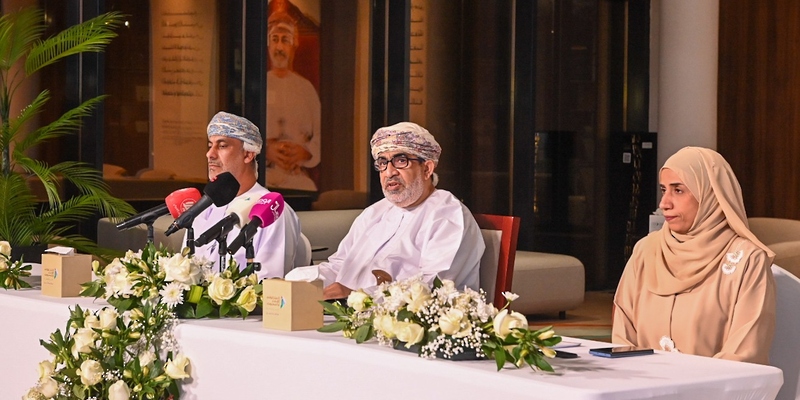

MUSCAT — The Sultanate of Oman has launched the results of an artificial intelligence-powered Household Income and Expenditure Survey, marking what officials described as a first-of-its-kind achievement globally and a major shift in how the country produces official statistics.
The project, unveiled at the headquarters of the National Centre for Statistics and Information (NCSI) in Muscat, uses artificial intelligence to improve the efficiency, sustainability and accuracy of household income and expenditure statistics. NCSI’s earlier household survey work has provided data used for economic planning, national accounts, the Consumer Price Index and inflation measurement. NCSI Portal
NCSI Chief Executive Officer His Excellency Dr. Khalifa bin Abdullah Al Barwani said the initiative represents a “qualitative shift” in the production of official statistics in Oman, reducing the time, effort and resources required by traditional survey methods while maintaining high standards of quality and statistical reliability.
Read More
- His Majesty Sultan Haitham returns home after UK state visit
- Oman participates in London Press Club awards, presents Journalist of the Year honours
- His Majesty Sultan Haitham concludes UK state visit as investment and trade ties deepen
- Oman Meteorology: Moderate chance of tropical activity in Arabian Sea, no direct impact expected
- Oman’s TRA to host public dialogue on child online safety
The new data show that the average monthly income of an Omani household rose to RO1,839.3 in 2025, up 18.5 percent from RO1,552.6 in 2018.
For expatriate households, average monthly income reached RO 717.2, compared with RO 668.6 in 2018, an increase of 7.3 percent. Across all households, the average monthly income increased to RO1,392.8, from RO1,173.7 in 2018, representing growth of 18.7 percent.
Household spending also increased during the period. The average monthly expenditure of an Omani household reached RO1,058.8 in 2025, up 13.7% from RO931.4 in 2018.
Average monthly expenditure for expatriate households rose to RO402, compared with RO362 in 2018, an increase of 11 percent. Overall, average monthly household expenditure increased to RO798, from RO 687.5 in 2018, a rise of 15.9 percent.
His Excellency Al Barwani said the project provides more comprehensive data on household consumption patterns and their relationship with demographic characteristics. The information will also support the calculation of expenditure weights used in the Consumer Price Index, helping measure inflation more accurately.
The data are expected to support economic policymaking by providing a clearer picture of household living conditions, consumption behaviour and income patterns, while also meeting statistical requirements for Oman’s national accounts system.
His Excellency Al Barwani attributed the achievement to the work of Omani national talent and institutional collaboration, saying it represents the beginning of a wider effort to deploy artificial intelligence across other areas of official statistics.





