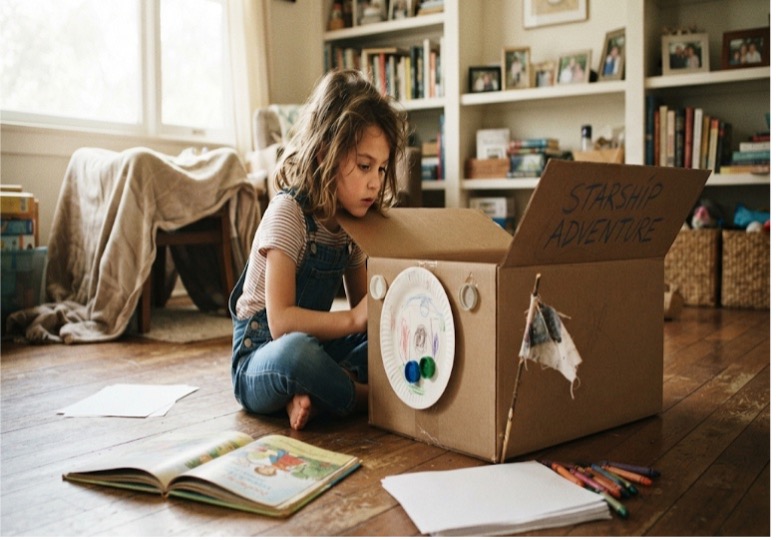

In a world where entertainment is available at the touch of a screen and information reaches us within seconds, boredom has quietly become something we try to eliminate. When a child says, “I’m bored,” our immediate response is often to offer a phone, switch on the television, suggest a game or find another activity. We want our children to remain happy, engaged and productive. But perhaps, in our effort to keep them occupied, we are taking away something far more valuable than the opportunity to discover what their own imagination can create. Could boredom be the beginning of creativity?
For many of us, childhood was filled with moments that might be described as “boredom” today. There were long afternoons when nothing was planned, journeys without screens and evenings when children simply sat together and invented games. A cardboard box could become a house, a spaceship or a shop. A stick could become a cricket bat. An empty notebook could become the beginning of a story. We were not constantly waiting for someone to entertain us; we learned to create our own worlds. Those seemingly ordinary moments taught us to imagine, explore, negotiate, experiment and sometimes simply dream.
Today’s children are growing up in a very different environment. Digital platforms, online games, short videos and social media provide an endless stream of stimulation. Technology itself is not the problem. In fact, it has transformed education into remarkable ways, giving children access to knowledge, creativity and experiences that were once unimaginable. Concern arises when technology becomes the automatic answer to every moment of silence or boredom. If a child reaches for a screen every time there is nothing to do, do we risk losing the ability to be comfortable with our own thoughts?
Read More
- The Strength of Belief
- Consistent daily movement yields the highest long-term health benefits
- Before MBAs and marketing: Timeless business lessons from Prophet Mohammed
- What Shakespeare knew about economics before economists did
- Respect is earned, not expected: Rethinking the teacher-student relationship
Boredom is not necessarily emptiness. It can be an invitation. When a child has nothing immediately available to entertain them, a simple question appears: What can I do? That question can become the starting point for creativity. A child may draw, build, write, explore, read, invent a game or simply begin asking questions. The important difference is that the child is no longer just consuming an experience created by someone else; the child is creating an experience of their own. In that space between “I have nothing to do” and “I wonder what I can make,” imagination begins to grow.
For parents, allowing children to experience boredom can be surprisingly difficult. Modern parenting comes with enormous expectations. Parents want their children to succeed academically, develop talents, participate in sports, learn new skills and make the most of every opportunity. As a result, childhood can become highly structured, with school, tuition, homework, extracurricular activities and digital entertainment filling much of the day. Yet children do not need every minute to be productive. They need time to play without instructions, to talk without an agenda, to explore without being evaluated and to discover their interests independently. The next time a child says, “I’m bored,” perhaps instead of immediately offering a screen, we could simply ask, “What would you like to create?” It may seem like a small change, but it places responsibility back in the child’s hands.
The first response may be frustration. A child might say, “There is nothing to do.” But that is precisely the moment when we should resist the urge to rescue them. Given a little time, children often surprise us. They may find an old book, start drawing, build something from recycled materials, create a game with a sibling or begin writing a story. What starts as boredom can become curiosity, and curiosity can become creativity. More importantly, the child begins to understand, “I can find something to do. I can create something myself.” That is the beginning of independence.
The value of boredom also extends into the classroom. Education today rightly focuses on engagement, innovation and interactive learning. Digital tools and artificial intelligence can make teaching more personalized and provide students with extraordinary resources. However, an engaging classroom does not have to be one in which every second is filled with activity. Sometimes, silence can be educational. A teacher can ask a thought-provoking question and give students time to think. A story can stop before its ending and allow students to imagine what happens next. A problem can be presented without immediately providing the solution. A blank page can be placed before a student with one simple instruction: Create. These moments encourage children to move beyond finding answers and begin developing their own ideas.
This becomes particularly important in the age of artificial intelligence. AI can write a story, generate an image, explain a concept, suggest ideas and provide answers within seconds. Used responsibly, it can become a powerful learning partner. But if children turn to AI before they have had the opportunity to think for themselves, we may unintentionally replace the creative struggle that produces original thought. Children need to experience the satisfaction of developing an idea, making mistakes, trying again and finding their own solutions. AI should expand imagination,not replace it. In a future where machines can generate increasingly sophisticated answers, human qualities such as curiosity, creativity, empathy, critical thinking and judgement will become even more valuable.
Boredom also has an emotional dimension. Children need to learn that not every uncomfortable feeling needs an immediate solution. Boredom is a small and manageable form of discomfort, and learning to sit with it can develop patience, resilience and self-reliance. A child who learns to say, “I’m bored, but I can find something to do,” is developing an important life skill. They are learning that they have the ability to respond to their circumstances rather than always waiting for someone else or a device to provide the answer.
Adults also need to look at our own behaviour. Children learn from what they observe. If we reach for our phones whenever there is silence, check notifications during conversations or feel uncomfortable without constant stimulation, children notice. We cannot expect children to develop a healthy relationship with technology while modelling the opposite. Sometimes, putting the phone away during dinner, taking a walk without a device, reading together or simply having an uninterrupted conversation can teach children more about balance than any rule we create for them.
The answer is not to remove technology from children’s lives, nor is it to romanticize the past. Technology is an important part of the world they are growing up in, and children need the skills to use it wisely. What they also need is balance. They need technology, but they also need nature. They need structured learning, but they also need free play. They need guidance, but they also need independence. They need information, but they also need imagination. Most importantly, they need moments when nobody tells them what to do next.
Because boredom is not always the absence of something to do. Sometimes, it is the beginning of something waiting to be imagined. In a world where technology is becoming increasingly skilled at capturing our children’s attention, perhaps one of the greatest gifts we can give them is the freedom to sit in an empty moment and discover what they can create within it.
Sometimes, nothing to do is exactly where something extraordinary begins.





