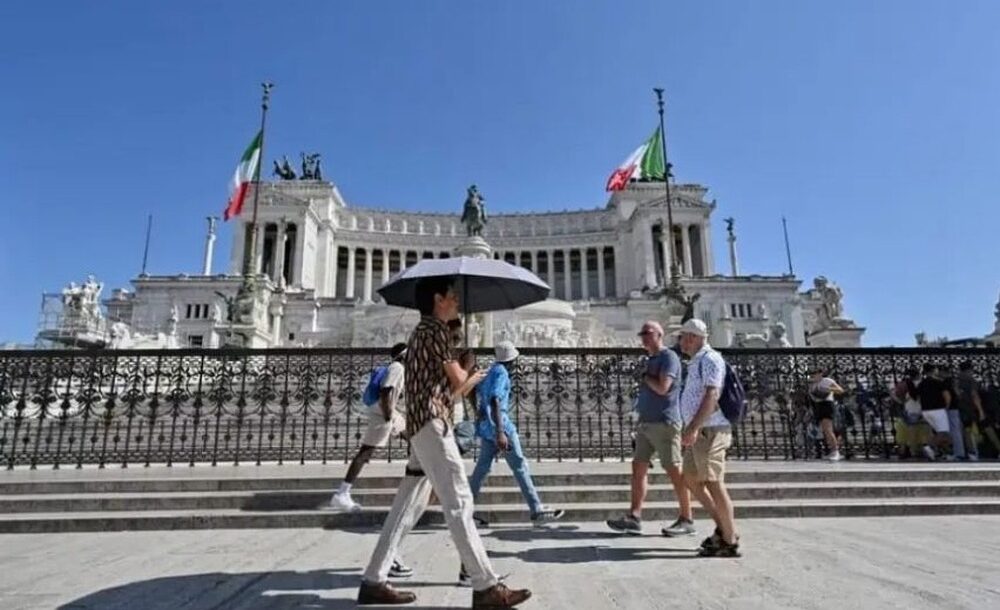

ROME : Italy took the unprecedented step of placing all its major cities under a red heat alert as prolonged high temperatures posed a serious health risk to the entire population. The warning stretched from Palermo in Sicily to Bolzano in the mountainous north.
Temperatures climbed above 40°C in several parts of the northern Emilia-Romagna region, reaching 42.8°C in Bagnacavallo near Ravenna.
In Assisi, pilgrims gathering for Pope Leo’s visit to mark the 800th anniversary of the death of St. Francis were sprayed with water to help them cope with the scorching conditions. Meanwhile, tourists in Rome sought shade under umbrellas, cooled themselves at fountains and avoided venturing outdoors during the hottest hours.
Read More
- Trump, Xi to meet in Washington for crucial talks
- Dubai mourns passing of Sheikh Ahmed bin Rashid Al Maktoum; 10 days of mourning declared
- OpenAI CEO Sam Altman to brief UNSC amid growing calls for AI safeguards
- Middle East leaders head to New York for UN General Assembly
- UN chief sounds alarm over growing risks to peacekeeping missions
The extreme conditions are part of a wider heatwave gripping Europe, the world’s fastest-warming continent. France and Spain have been among the countries hardest hit this summer by destructive wildfires and record temperatures.
The European Union is expected to urge member states to increase spending on wildfire prevention measures, with experts estimating that the economic damage caused by this summer’s fires has already exceeded €15 billion ($17.3 billion).
Bulgaria became the latest EU country to battle major wildfires, with the Trakia highway closed in both directions after strong winds carried flames across the road about 70 kilometres southeast of Sofia.
The heatwave is also placing mounting pressure on Europe’s energy systems.
Hungary switched off decorative and non-essential lighting at state institutions, including its parliament, much of Buda Castle and the Chain Bridge, in an effort to conserve electricity. Record-low water levels in the Danube have severely affected operations at the country’s sole nuclear power plant, which relies on river water for cooling.
Neighbouring Romania was preparing to sink four rock-filled barges into the Danube to divert water towards its only operating nuclear reactor and extend its ability to generate electricity. Authorities in Bucharest have also reduced the intensity of street lighting by a third and switched off lights at museums and landmark buildings overnight.
In Moldova, where temperatures exceeded 38°C, Prime Minister Vasile Tofan urged residents to reduce electricity consumption, warning that rolling blackouts could follow if demand remained high.
Low river levels are causing disruption beyond the energy sector. On Germany’s Rhine, an important transport artery for grains, coal, minerals and oil products, many cargo vessels can carry only partial loads, pushing up freight costs.
Amid temperatures around 40°C in Bosnia and Herzegovina, visitors have turned to the UNESCO-listed Vjetrenica cave for relief. Located about 25 kilometres north of Dubrovnik, the cave maintains a constant temperature of around 11°C throughout the year.
For all the latest news from Oman and GCC, follow us on Twitter, Instagram and LinkedIn, like us on Facebook and subscribe to our YouTube page, which is updated daily.





