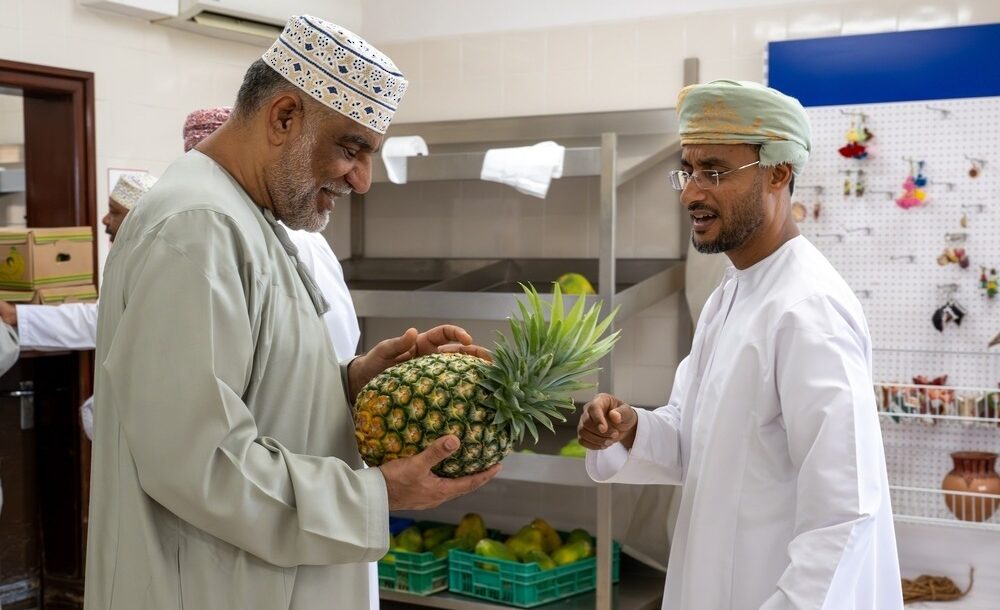

Muscat: The farm, which operates under the Royal Court Affairs, launched the initiative to study whether Oman’s local environment could support pineapple cultivation, a crop known for its economic and nutritional value.
At Razat Royal Farm, cultivation began with small-scale container trials before expanding into field planting under tree shade and controlled greenhouse environments. The crop adapted well to Dhofar’s climate, particularly during the Khareef season, which provides mild temperatures and high humidity from July to December.
According to the farm, pineapple plants reach full vegetative growth after around six months, while the fruit becomes ready for harvest about 12 months after planting. The fruit is harvested when its lower portion turns a distinct golden-yellow colour.
Read More
- Indian Navy’s INS Sudarshini docks in Salalah on final overseas stop of transoceanic voyage
- ‘Serving Oman is an honour we cherish’: PDO’s Managing Director Dr Aflah Al Hadhrami reflects on Royal recognition
- Muscat Municipality trains SQU students in meat safety and veterinary inspection
- Dedicated ambulance service launched for bedridden patients in Muscat
- Struggling to pay electricity bills? Nama Supply offers flexible payment plans
Eng. Suhail Said Al Mashani, Senior Agricultural Engineering Specialist at Razat Royal Farm, described the project as a pioneering success for Omani agriculture.
“Growing pineapples at Razat Royal Farm is a pioneering success in Omani agriculture. We have trialed several varieties — Queen, Mauritius and MD-2 — with the latter now emerging as the most commercially viable worldwide,” he said.
He noted that the MD-2 variety produces large fruits weighing between two and more than four kilograms, and is known for its sweetness and strong market appeal.
Al Mashani also highlighted that pineapples require significantly less irrigation compared to many other tropical crops. He added that tissue-culture techniques played a key role in producing large numbers of uniform, disease-free seedlings, supporting the success of the project and paving the way for possible large-scale expansion.





