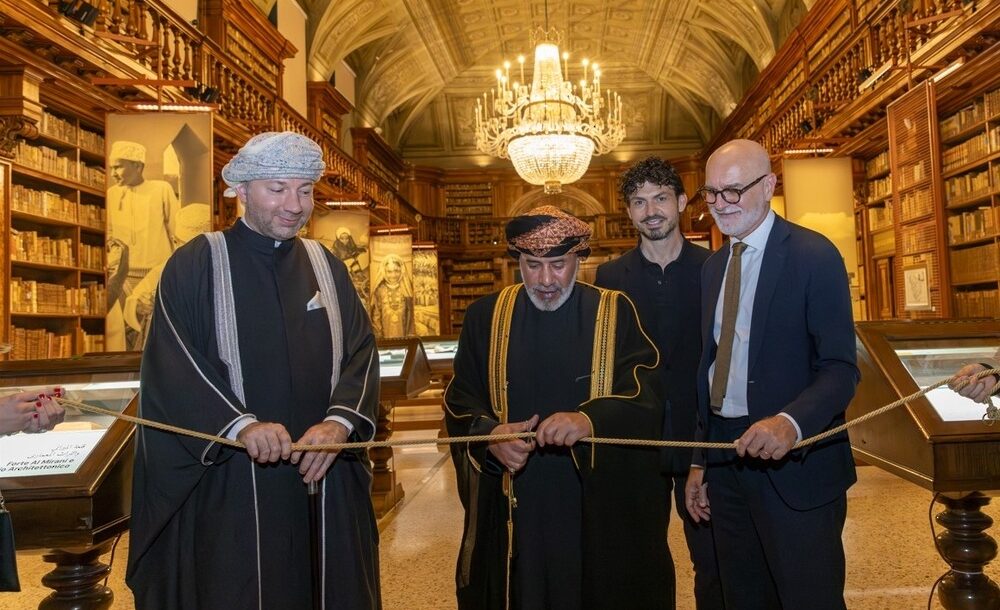

Milan: Titled “Oman and Italy: Two Thousand Years of Cultural Encounter,” the exhibition opened at the prestigious Brera Grand Museum and will run until September 13.
The exhibition, organised by Oman’s National Museum as part of its “Oman Day” initiative, showcases the deep-rooted connections that have linked the two civilizations through trade, knowledge, exploration and cultural exchange. Through archaeological discoveries, travel literature, historical maps, manuscripts and artworks, visitors are offered a unique glimpse into a shared legacy that spans the Mediterranean Sea and the Indian Ocean.
According to the National Museum, the initiative aims to introduce Oman’s rich civilizational, historical, cultural and scientific heritage to international audiences through one of Italy’s most prominent cultural institutions.
Read More
- His Majesty Sultan Haitham arrives in Angola for two-day state visit
- Oman strongly condemns attacks targeting Mecca, backs Saudi Arabia
- New traffic diversion announced on 18 November Street in Muscat
- Oman, Botswana affirm commitment to strengthening partnership
- His Majesty Sultan Haitham concludes Botswana State Visit, heads to Angola
His Excellency Jamal bin Hassan Al-Mousawi, Secretary General of the National Museum, described the exhibition as the first museum initiative of its kind organised by Oman in Italy. He noted that Italian scholars, travelers and thinkers have played a significant role over the centuries in documenting Oman’s history, architecture, geography, customs and traditions, helping to preserve and share valuable insights about the Sultanate with the wider world.
The exhibition explores shared archaeological heritage and cultural interactions between the two nations, highlighting themes such as Oman’s ancient aflaj water management system, known in Sicily by its Arabic name “al-qanawat,” and the historic significance of frankincense in religious and commercial life.
His Highness Sayyid Nizar bin Al Julanda Al Said, Oman’s Ambassador to Italy, said the exhibition reflects over 2,000 years of cultural exchange between the two countries and demonstrates how maritime trade routes, the Frankincense Trail and intellectual engagement enriched both civilizations. He added that the exhibition reinforces the strategic depth of modern Omani-Italian relations and the enduring friendship between the two peoples.
Among the exhibition’s highlights are rare artifacts from the National Museum of Oman, including a Bronze Age snake sculpture discovered in Al Hamra, Roman-era artifacts unearthed on Mahout Island, and inscriptions linked to the ancient frankincense trade. Visitors can also explore engineering parallels between Oman’s aflaj systems and historical water channels in Sicily through manuscripts such as the Daftar Falaj Al-Azizi dating back to 1891.
The exhibition further showcases Oman’s contributions to science, navigation and medicine through rare manuscripts, including A Poem on the Anatomy of the Eye by Sheikh Dr Rashid bin Amira Al Rustaqi, travel writings by Italian physician Angelo Legrenzi, and The Great Nuniyah by renowned Omani navigator Ahmed bin Majid Al Saadi, which was inscribed on UNESCO’s Memory of the World Register in 2025.
Religious and intellectual traditions also feature prominently, with displays of rare Omani Qur’anic manuscripts, important Ibadi legal works such as Bayan Al Shar’ and Qamus Al Shari’a, and early translations of the Holy Qur’an into Swahili. These are presented alongside European scholarly works on Qur’anic studies, including an Italian translation published in Padua.
The exhibition also traces centuries of commercial and cultural interaction with the Republic of Venice through historical travel accounts, gold Venetian coins discovered in Oman and artistic works inspired by Venetian craftsmanship. A special collection of rare sixteenth-century maps belonging to the late Sultan Qaboos bin Said is also on display.
Adding further depth to the narrative, the exhibition highlights accounts from European travelers including Marco Polo, Ludovico di Varthema and Pietro Della Valle, who documented Oman’s strategic ports and maritime influence. It also features Orientalist artworks by Italian painters Giuseppe Signorini and Gustavo Simoni.
Hosted at the renowned Pinacoteca di Brera complex in Milan, one of Italy’s leading cultural institutions, the exhibition underscores Oman’s growing efforts to strengthen international cultural dialogue and showcase its rich heritage on the global stage.
The Brera complex, whose origins date back to 1776, today stands as one of Italy’s most important museums and cultural centres.





