

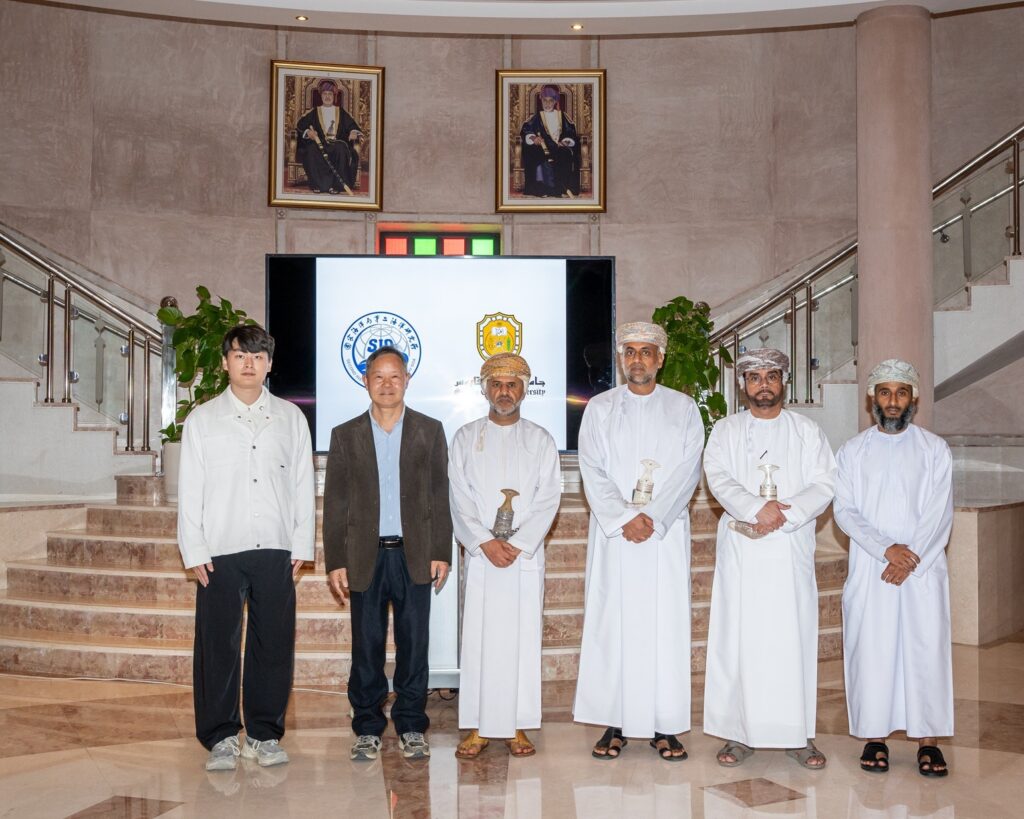
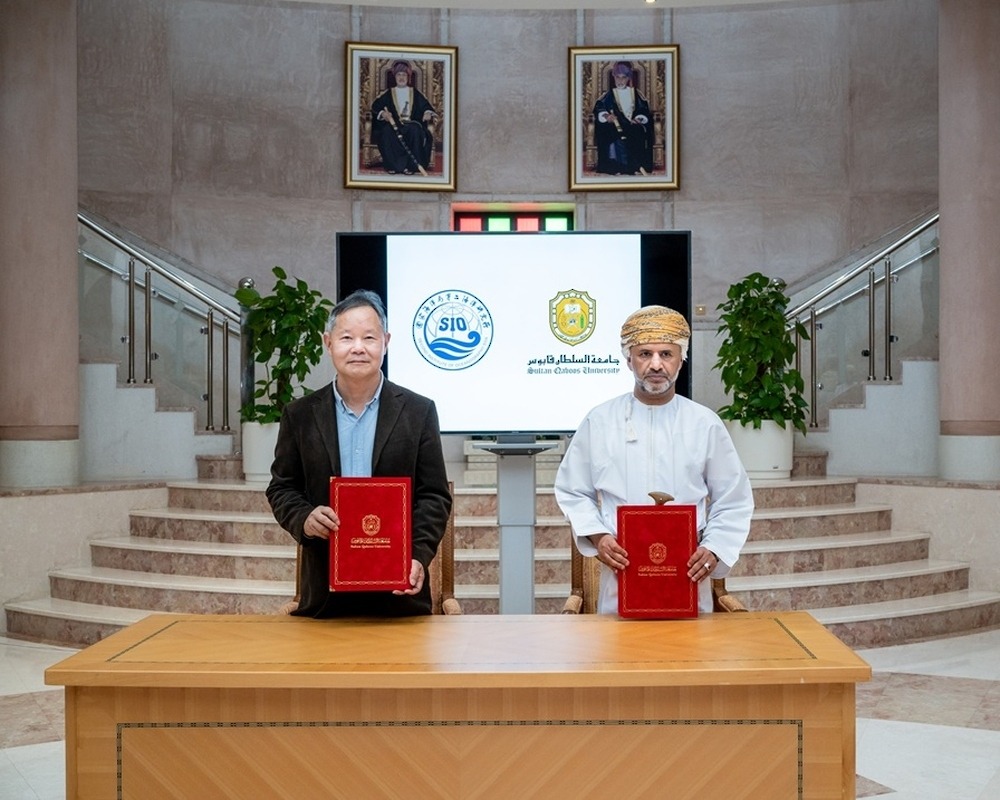
MUSCAT : The signing ceremony was held under the auspices of His Highness Dr. Fahd Al Julanda Al Said, SQU’s Vice Chancellor, and in the presence of Professor Zihua Mao, representing the Chinese institute.
In this context, Dr. Yaseen Ahmed Al Mulla, Director of the Remote Sensing and Geographic Information Systems Research Center at Sultan Qaboos University and Project Manager of the Satellite Image Receiving Ground Station, spoke about the station and its importance, stating that satellite image receiving ground stations have become an essential part of the scientific infrastructure of any country seeking to enhance its capabilities in various fields such as the environment, climate, and natural resource management. He explained that these stations are not merely antennas that receive images from space, but rather advanced centers for transforming space data into practical knowledge that supports national decision-making.
He pointed out that in a world that increasingly relies on geographic information, with precise spatial and temporal data, countries capable of receiving data directly have become more independent and faster in responding to natural and economic challenges.
According to Dr. Yaseen, the importance of ground stations lies in their ability to provide countries with immediate access to satellite data without the need to wait for processing or distribution through external servers. This allows scientists, researchers, and operators to analyse data in real time, develop more accurate local models, and produce information tailored to the country’s specific needs.
He added that possessing a national space receiving infrastructure enhances cybersecurity, reduces reliance on external sources, and elevates scientific and technological sovereignty. He also emphasized that these stations serve as advanced training and research platforms, enabling universities and research centers to develop national expertise in remote sensing, big data analytics, artificial intelligence, and ecosystem modelling. With the increasing importance of these fields in the global economy, investing in space infrastructure is a direct investment in human and intellectual capital.
Dr. Yaseen explained that the project to establish a ground station to receive satellite images is at this stage more specialized in the oceans, as these satellites provide continuous measurements of sea surface temperature, biological productivity, ocean current movement, sediment spread, and water quality.
From a research perspective, he pointed out that the station allows Omani researchers access to raw data and the development of accurate local algorithms, instead of relying entirely on ready-made products from abroad, which enhances scientific innovation.
He stressed that the project is in line with the goals of Oman Vision 2040, which focuses on innovation, the knowledge economy, environmental sustainability and contributing to the emergence of specialized services in the fields of environmental analysis and geospatial data.
Dr. Yaseen emphasised that the station is not merely a research facility, but a strategic infrastructure that enhances the Sultanate of Oman’s scientific and technological standing and opens up broad horizons for sustainable development.
The station also serves as a future platform for collaboration with space agencies and scientific institutions specialising in remote sensing and Earth observation worldwide, thereby strengthening Oman’s presence in international scientific networks and reinforcing its role as an active partner in producing environmental knowledge on a global scale.
For all the latest news from Oman and GCC, follow us on Twitter, Instagram and LinkedIn, like us on Facebook and subscribe to our YouTube page, which is updated daily.
Read More
- Oman reviews school assessments, improvement plans for 100 schools
- Oman hotels report weaker first-half earnings as regional conflict hits bookings
- 12.8 million adolescents and youth in GCC States
- Oman warns witness tampering in human trafficking cases carries up to five years in prison
- His Majesty Sultan Haitham issues two Royal Decrees ratifying agreements with Angola





