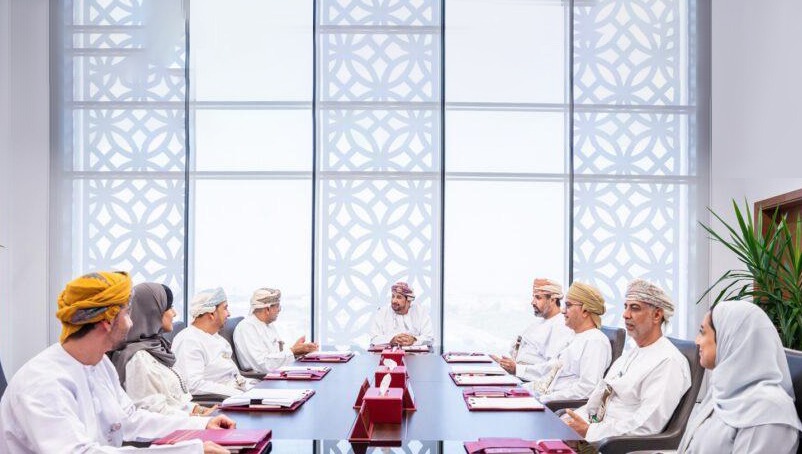

Muscat – Opening the meeting, H.E. Sayyid Khalid emphasised the RAM’s crucial role in enhancing administrative and leadership performance, drawing inspiration from His Majesty Sultan Haitham bin Tarik’s vision of investing in national competencies.
He noted the Academy’s commitment to equipping leaders with contemporary knowledge and skills through local and global partnerships and innovative programs, contributing to the realization of Oman Vision 2040.
The meeting addressed the RAM’s strategic direction since its establishment in 2022, affirming its role as a hub for executive learning and developing national leaders and a platform for thought and impactful leadership, administrative development, and knowledge foresight. The Academy aims to contribute to Oman’s socio-economic development and progress by facilitating a work environment that promotes a culture of efficiency, productivity, and civil service excellence across state administrative institutions. To empower national leaders and maximise their impact across various sectors, which is in alignment with the Oman 2040 objectives, the RAM has expanded its strategic role by creating an impactful executive education ecosystem that includes and serves growth leadership communities in Oman.
The Board reviewed RAM’s achievements in 2024, which featured structured programmes, studies, and dialogues designed to strengthen national competencies. Key studies included topics such as the role of technology in government transformation and the assessment of public-private sector partnerships. RAM’s alumni network has now surpassed 1,200, and the Academy has fostered a strong ecosystem for engagement, collaboration, and continuous learning.
One notable achievement was RAM’s successful implementation of the ‘Future of Work in Government’ programme for GCC countries, which saw participation from 65 leaders across the region. This programme has reinforced RAM’s pioneering role in advancing collaboration within the Gulf Cooperation Council; it aligns with Oman’s efforts to enhance human capital development.
Looking ahead, the Board discussed RAM’s strategic objectives for the 2025–2030 period. These include building a sustainable local ecosystem by integrating small and emerging learning enterprises; achieving zero-distance by eliminating barriers among RAM’s stakeholders, thereby fostering collaboration across diverse leadership communities; and developing innovative solutions tailored to Oman’s unique needs.
The concept of ‘Gov-preneurship’ (Government-Entrepreneurship) will also play a central role, equipping future leaders with the skills necessary for Oman’s continued growth.
The Board approved RAM’s 2025 Annual Plan, which includes a range of initiatives, projects, and studies in line with the Academy’s long-term vision. These initiatives will be driven by strategic international partnerships and cutting-edge programmes designed to empower Oman’s future leaders.
The Board of Trustees of the Academy, chaired by H.E. Sayyid Khalid Al Busaidi, includes the following board members:
• His Excellency Dr. Said bin Mohammed Al Saqri, Minister of Economy
• His Excellency Dr. Mahad bin Said Ba’owain, Minister of Labour
• Sheikh Waleed bin Khamis Al Hashar, CEO of Bank Muscat
• Khawla bint Hamoud Al Harthy, CEO of Injaz Oman
• Dr. Hatim bin Bakhit Al Shanfari, Faculty Member at Sultan Qaboos University’s College of Economics and Political Science.
Read More
- His Majesty Sultan Haitham returns home after state visits to China, Brunei
- Oman’s digital economy contributes 9% to GDP as investments reach RO 1.3 billion in 2025
- Muscat Municipality announces traffic diversion on Al Khuwair service road from November 4
- Oman clarifies expat recruitment rules after agency talks
- Oman police arrest two over vehicle theft, number plate tampering and resisting officers in Seeb