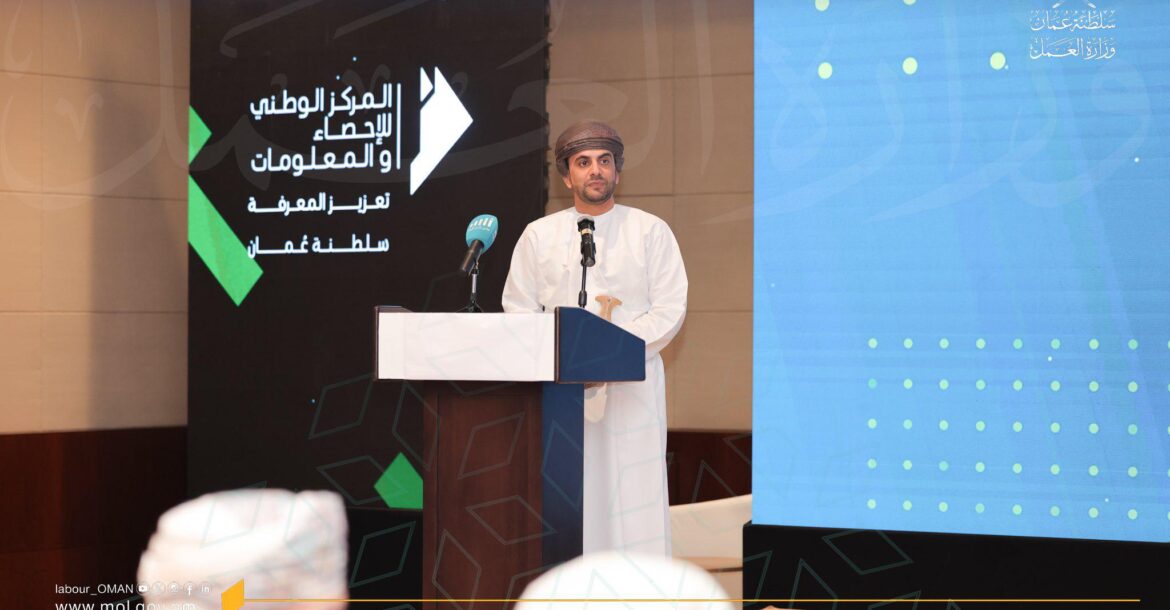

MUSCAT : Under the patronage of His Excellency Professor Dr Mahad bin Said bin Ali Baowain, Minister of Labour, and attended by key government and private sector representatives, the survey promises to reshape labour policies and align them with Oman Vision 2040 goals.
The workshop, organized by the Ministry of Labour, was attended by the Chairman of the National Center for Statistics and Information, ministry officials, and representatives from both government and private entities. The survey, supervised by the National Center for Statistics and Information and supported by the International Labour Organization, utilized advanced methodologies, including the three-dimensional stratified sampling technique. This ensured robust representation from 3,000 establishments, achieving an impressive 95% response rate.
Abdullah bin Murad Al-Malahi, Assistant Director General for Planning Affairs, emphasized that this initiative stems from the National Employment Policy, a cornerstone of Oman Vision 2040. He highlighted the survey’s potential to serve as a critical decision-making tool, providing accurate labour market data to formulate effective employment strategies.
Read More
- His Majesty Sultan Haitham returns home after state visits to China, Brunei
- Oman’s digital economy contributes 9% to GDP as investments reach RO 1.3 billion in 2025
- Muscat Municipality announces traffic diversion on Al Khuwair service road from November 4
- Oman clarifies expat recruitment rules after agency talks
- Oman police arrest two over vehicle theft, number plate tampering and resisting officers in Seeb
The survey aims to identify the current and future workforce needs, align education outcomes with labor market demands, and anticipate the skills required by industries shaped by the fourth and fifth industrial revolutions. Recommendations include focusing on high value-added industries, upgrading value chains in sectors like mining, and encouraging private sector adoption of flexible work patterns such as freelance, remote, and part-time work.
During the workshop, a detailed presentation shed light on employment trends across establishments of varying sizes, highlighting notable gender gaps in hiring practices. Employment gaps between males and females ranged from 7.5% in small establishments to 43.1% in large establishments.
The survey’s findings will guide updates to educational curricula at all levels, emphasizing technical and personal skills relevant to labor market demands. This aligns with Oman Vision 2040’s broader goals of fostering innovation and creating a globally competitive workforce.
For all the latest news from Oman and GCC, follow us on Twitter, Instagram and LinkedIn, like us on Facebook and subscribe to our YouTube page, which is updated daily.





