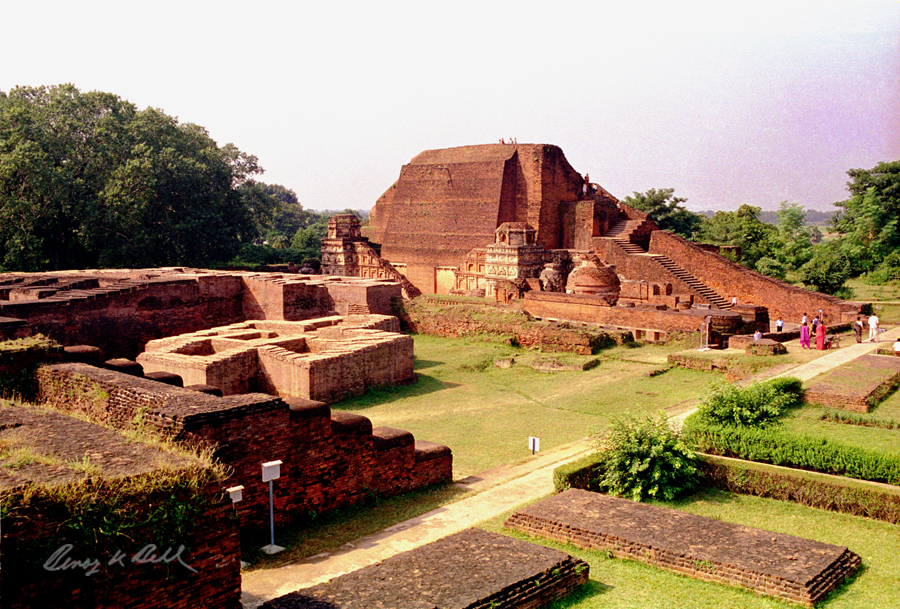

The honourable Prime Minister of India inaugurated the new campus of Nalanda University, an international university, close to the site of the ancient ruins of Nalanda, in Bihar, on the 19th of June, 2024.
The modern Nalanda University was established as an “international institution for pursuit of intellectual, philosophical, historical and spiritual studies”. The impetus to setting up this institution came under the leadership of Hon. Prime Minister Shri Narendra Modi, when a major push was given from 2014 onwards, to establishing the University as an international center of learning and scholarship, reminding the world of the 21st century of the eminence of ancient Nalanda.
This international university, apart from India, has participation of 17 other nations: Australia, Bangladesh, Bhutan, Brunei Darussalam, Cambodia, China, Indonesia, Laos, Mauritius, Myanmar, New Zealand, Portugal, Singapore, South Korea, Sri Lanka, Thailand and Vietnam.
Read More
- Three expats arrested in Muscat’s Seeb with over 166,000 psychotropic tablets
- Viksit Bharat 2047: India’s roadmap to becoming a developed nation
- India’s space sector emerges as a new engine for global partnerships
- India strengthens its role as a trusted global first responder
- India’s citizen-centric diplomacy revolutionises welfare and support for overseas diaspora
The University has 137 scholarships for international students. It offers Post Graduate and Doctoral research courses and short-term certificate courses. It has 6 schools, the School of Buddhist Studies, Philosophy & Comparative Religions; the School of Historical Studies; the School of Ecology and Environmental Studies; the School of Sustainable Development and Management; the School of Languages and Literature; and the School of International Relations and Peace Studies which is yet to commence.
A Library with a capacity to hold 3,00,000 Books and serving up to 3000 users is scheduled to be completed by September 2024. This would be in keeping with the glorious tradition of the original Nalanda University.
An ancient seat of learning
The first known, great university of the world, Nalanda was at the apex of a consortium of universities which developed in ancient and early medieval times in South and South East Asia. It was from these ancient universities that concepts of rigorous and logical study finally spread to other parts of the world, leading to the founding of universities in Europe. The consortium of universities with Nalanda at its apex, included: Vikramshila, Odantapuri, Somavihara Paharpur, Sumatra Indonesia, Takshashila, Palkh (now in Afghanistan).
Nalanda was the earliest-known University in the world and this was the first consortium. It is quite amazing to see that such study and sharing of universal knowledge took place in the First Millennium.
At the ancient university of Nalanda, there was a spirit of vibrant intellectual thought, a climate of discussion and debate. The many ‘acharyas’, or learned professors, at Nalanda authored hundreds of works on philosophy, metaphysics, psychology, logic, medicine, astrology, arts, literature and other subjects.
The study at Nalanda was of life itself and what is reality. It was based not upon faith but on unshakable logic and pursuit of the truth. The study was of our minds, our perceptions and what is knowledge itself. The intellectuals here analysed the qualities which led to Enlightenment through knowledge and sought to create a logical path which could lead us to true and lasting awareness. A path which would work for all.
Nalanda was visited by the Buddha himself. In the 3rd century BCE, Emperor Ashoka is believed to have made offerings to the chaitya of Sariputra and erected a temple here. However, the origins of the university itself are obscured in the mists of time. The medieval Tibetan historian Taranatha mentions that the great Buddhist philosopher Nagarjuna who was born in the middle of the 2nd century CE taught here.
Excavations at the Nalanda site have revealed numerous stupas, monasteries, hostels, staircases, meditation halls and other structures. These speak of the splendour of the university which was also famed for its three magnificent libraries.
The Chinese pilgrim Xuanzang of the 7th century writes that, of the myriad Buddhist establishments of India, Nalanda “is the most remarkable for its grandeur”. The priests and other residents “always reach to the number of ten thousand”.
Another Chinese traveller I-Tsing travelled in India at the end of the 7th century. He reported that in these monasteries Buddhist sutras were taught as well as Sanskrit grammar, Indian Logic and Metaphysics, fine arts and medicine.
There was a rigorous oral entry examination and only the best students were given admission. It was a residential university where the staff and students had free board and lodging. No tuition fees were charged. Xuanzang records that there were students here from Tibet, China, Korea, Japan, Sumatra, Java and Sri Lanka. It was truly an international university.
The Government of India is making a notable effort to revive the real legacy of Nalanda, so that people can see the value of this tradition and how it enriches the tapestry of global knowledge. What is more, the comparative study of the Nalanda tradition and modern science can definitely uplift our civilisation. This ancient tradition is a science of life which can help us so much.





