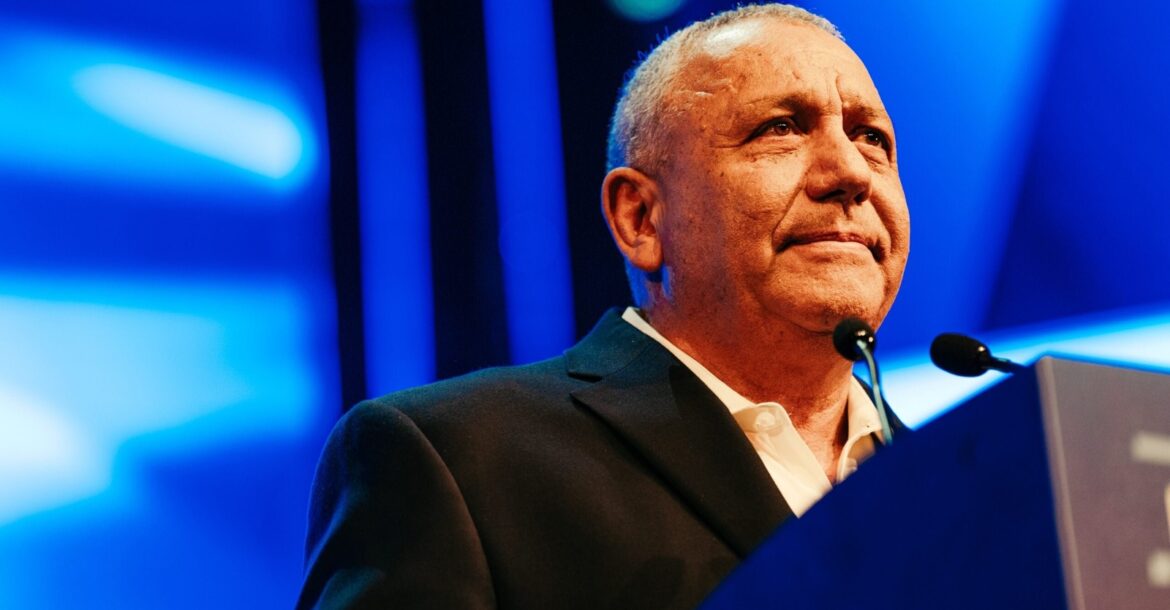

Jerusalem: Gadi Eisenkot’s Yashar party announced on Tuesday that it had reached an agreement with Avigdor Lieberman’s right-wing Israel’s Our Home party to form a coalition, marking the first such alliance since Israel’s October 27 elections.
The agreement comes as Eisenkot races against a December 6 deadline to form a new government after President Isaac Herzog tasked him with securing a parliamentary majority.
Israel has remained without a new government since the elections, with no party or alliance securing the 61 seats required for a majority in the 120-member Knesset. Parliament was sworn in on November 10, while Benjamin Netanyahu continues to serve as caretaker prime minister after losing his parliamentary majority.
Read More
- Jensen Huang returns as Nvidia CEO after unanimous board vote
- Violent storm kills 5, injures over 250 in southern Brazil
- Powerful 6.7-magnitude earthquake strikes central Peru
- Pre-school enrolment in Arab countries nearly doubles in 24 years, UNESCO reports
- UAE celebrates Oman’s National Day at Khatm Al Shikla border crossing
Eisenkot’s centre-right Yashar party won 21 seats in the election, while Lieberman’s party secured seven. Together with other coalition partners, Eisenkot’s bloc currently holds 48 seats, leaving it 13 seats short of a majority.
The agreement with Lieberman comes as a significant development, given his previous opposition to forming a government with the support of Arab parties. Lieberman has also rejected the possibility of a unity government with Netanyahu.
Lieberman, who previously served as foreign minister under Netanyahu, has since emerged as one of his strongest political critics.
Meanwhile, Netanyahu’s Likud party and its far-right and ultra-Orthodox allies performed better than expected in the elections but failed to retain their parliamentary majority. The alliance currently holds 53 seats.
Eisenkot could potentially secure the support of parties representing Israel’s Arab minority, which collectively hold 19 seats and share his opposition to Netanyahu. Their backing could prove decisive in determining whether he can form the next government.
Eisenkot has been given an initial 28-day mandate to form a government, which expires on December 6. He may request an additional 14 days if negotiations remain incomplete.
If Eisenkot fails to secure a majority, Netanyahu could be given an opportunity to form a government. Should both efforts fail, Israel could face another election next year, extending the country’s political uncertainty.