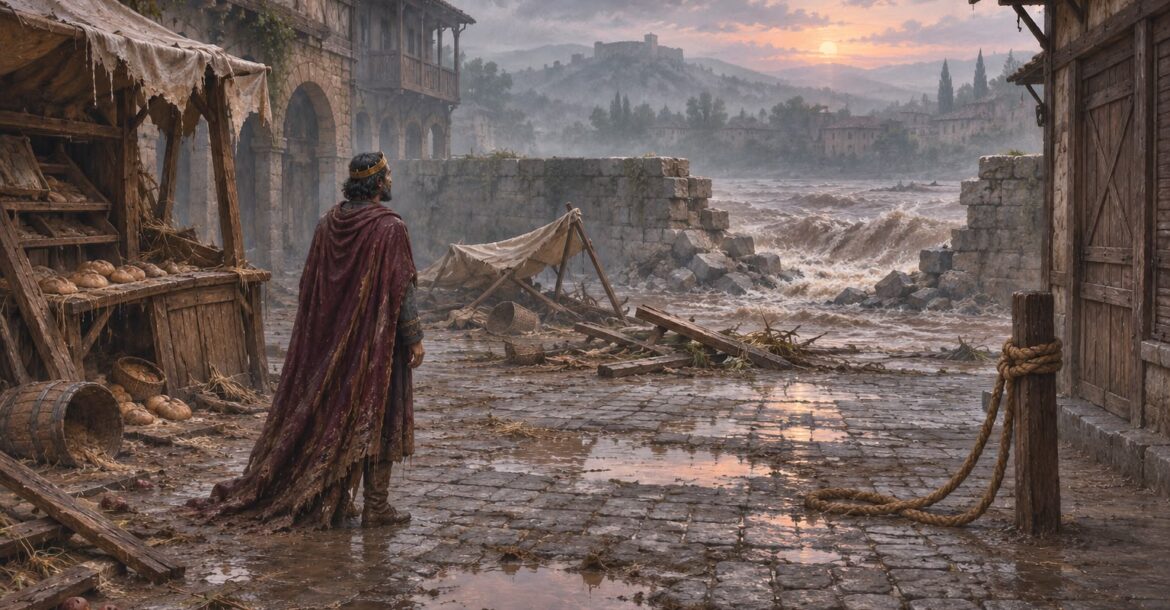

The night the eastern wall gave way, the baker’s daughter ran barefoot to the palace with a brass key in her hand.
“The water’s coming in under the back door,” she told the guard. “My mother needs help getting everyone out.”
Beside him hung a notice. The wall has been inspected. The market will open as usual tomorrow morning.
Read More
The guard told her to wait while he found someone who could authorise him to leave his post. She waited long enough to hear the market bell ring twice. Then she ran back down the hill.
Years earlier, when the king was building the market, he had sat at a mason’s kitchen table until the tea went cold.
“You’re asking me to leave a job that pays every Friday,” the mason said.
“I am,” said the king. “And if there’s ever a problem with your wages, you know where to find me.”
The mason’s wife turned around from the stove. “Will he still know where to find you when the market is finished?”
The king laughed. “I’ll be there buying bread.”
And for a while, he was. He came down before sunrise and stayed late when a boat was overdue. Once, he stood on the landing holding a lantern beside the mother of a boy making his first crossing. When the boat finally came in, the king called out the boy’s name before anyone asked about the cargo.
The people who built the market learned to rely on each other. The boatmaster knew when a change in the current meant trouble upstream. The masons knew what that current could do to a foundation. The woman who supervised the wall brought them together whenever something looked wrong. The man who kept the accounts knew which supplier would stop sending stone if another Friday went by without payment.
When they disagreed, they went down to the river and looked. Sometimes the king went with them.
By the time the baker put in a second oven, the king had appointed two advisers to help run the market.
“We are the new management,” they said at their first meeting.
By their third, the man who kept the accounts needed written permission to see the ledger he had balanced the previous evening.
“Who has the key?” he asked.
“We do,” said the younger adviser. “You can request any figures you need.”
“Who will check them before you send them to the king?”
The adviser wrote down that the accounts team had requested further clarification about its role.
After the next heavy rain, the boatmaster saw the river cutting in closer to the eastern wall. He took two masons down at first light. One lowered a weighted line from the landing while the other checked the stonework. The woman who supervised the wall recorded the measurements. A joint had opened wide enough to take the edge of her ruler.
The four of them went to the council.
“We need to lift these stones and check what’s happening underneath,” she said.
“The wall has passed inspection,” the senior adviser told them. “I walked its full length myself.”
The boatmaster remembered the walk. It had been a dry afternoon. The adviser had stopped halfway along to ask where the king ought to stand for the anniversary portrait.
“Who checked the foundation?” one of the masons asked.
“I signed the inspection.”
The other mason slid the notebook across the table. “Come down with us. We can take the measurements again before lunch.”
The younger adviser opened the rulebook. Reopening an approved inspection required the consent of the person who had signed it.
Everyone looked at the senior adviser.
He had another meeting before lunch.
That evening, one of the masons came to the palace to ask for two months’ wages. The clerk handed him an application for an audience.
“I filled one of these in last month.”
“Yes. It’s with the same person who has to approve this one.”
The mason looked past him at the stairs. Years ago, the king had walked all the way to his house to ask him to come.
“Please,” he said. “My landlord is coming tomorrow.”
“Put that in the letter,” the clerk said quietly. “And thank them for considering it.”
Upstairs, the king asked over dinner whether the wages were up to date.
“There are no approved payments outstanding, Your Majesty.”
The king went back to his soup. The applications stayed in the drawer. His advisers knew how much he appreciated a quiet dinner.
By the rainy season, the supplier had stopped sending stone. The man who kept the accounts handed in his keys after being asked to sign a statement that left out three months of unpaid invoices. The boatmaster took work upriver. One mason went home when he could no longer afford his rent. The woman who supervised the wall sent the king a map marking the shops most at risk. It came back unopened with instructions to submit it through the appropriate channel. She resigned the next morning.
At the next council meeting, the king asked why he no longer saw the people who used to come down to the landing with him.
“They all left, Your Majesty,” said the senior adviser.
“All of them?”
“Yes. We’re making arrangements for replacements.”
The younger adviser recorded that the king had been briefed on the departures. Nobody asked the clerk to bring up the letters.
Then it rained for three days.
By the time the baker’s daughter got back from the palace, she had to wade across the square. The brass key was for the side door of the grain store, where her mother had told the shopkeepers to take shelter. The girl got there just ahead of the old tailor and his wife. They were holding on to each other so tightly that neither had a hand free to take the key.
The mason arrived with a rope. He tied it to a post and went back for the baker. An apprentice who had already found work upriver was home visiting his mother. He saw what was happening and took the other end. By dawn, everyone on that row had made it out. The baker’s ovens were full of mud. The tailor’s bolt of wedding silk was caught in a tree halfway down the river.
The king came down after sunrise. He asked for the boatmaster, the masons, the man who kept the accounts and the woman who knew the wall.
“They all left,” the senior adviser said again.
This time the king asked, “What did we do before they left?”
The clerk went back to the palace. He returned carrying the unopened map, the supplier’s invoices and a drawer full of letters.
The king opened the oldest one.
Please pay me for the work I have already done. I would like to finish what we started.
It was dated six months earlier.
“Why didn’t you bring me this?”
“You had enough to worry about, Your Majesty,” said the senior adviser.
The king found the mason outside the bakery, pulling a ruined counter into the street. He took hold of the other end.
“I’ll pay you today,” he said. “Will you come back and help us rebuild?”
The mason lowered his end of the counter.
“I’ll take what you owe me, Your Majesty. I start somewhere else on Monday. They pay on Fridays.”
That evening, the council recorded that the king had resolved the outstanding wage issue.
The market never reopened.
A Lesson for Every Entrepreneur
Some businesses can only be led as a team. Good decisions depend on people with different kinds of expertise being able to compare what they see, question a decision and act while there is still time. Give them access to the information they need and a direct way to raise concerns. When a report says the wall is sound, ask who checked the foundation and what they found.
Pay people on time and keep the promises you made when you asked them to join you. When management tells you, “They all left,” speak to the people who left. Ask what they tried to tell you while they were still there.





