
MUSCAT : Venus will appear as the brightest planet in the night sky and the third-brightest celestial object visible from Earth after the Sun and the Moon.
Wisal bint Salem Al-Hinai, Head of the Community Outreach Committee at the Omani Society for Astronomy and Space, said the planet will be easily visible to the naked eye, even from areas affected by light pollution.
She explained that Venus’ exceptional brilliance during this period is caused by its relative proximity to Earth and its strong ability to reflect sunlight through its dense atmosphere.
Read More
- Oman Coast Guard apprehends 23 people attempting illegal entry by boat
- Over 1.5 million smart meters installed across Oman as rollout reaches 80%
- Royal Hospital implants Oman’s first CardioMEMS sensor to support heart failure care
- Oman records nearly 3,000 individual labour complaints in first half of 2026
- Oman opens registration for 2027 Hajj season for citizens, residents
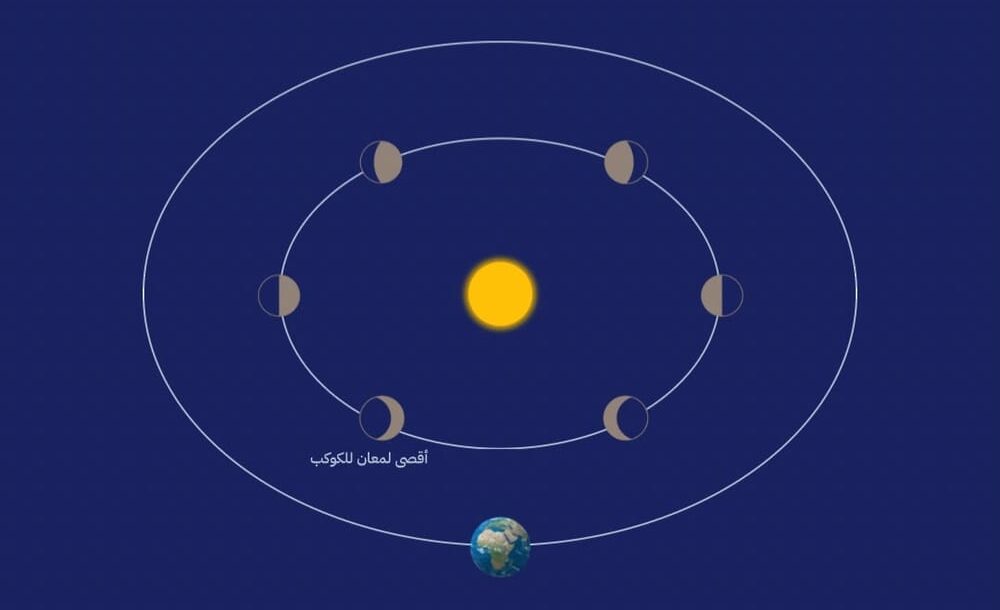
According to Al-Hinai, the planet’s maximum brightness does not necessarily occur when it is at its greatest angular distance from the Sun. Venus reached its greatest eastern elongation in August, when it was positioned at its maximum apparent distance east of the Sun and was clearly visible after sunset.
As an inner planet orbiting between Earth and the Sun, Venus displays phases similar to those of the Moon when viewed from Earth. Its brightness peaks when the planet is relatively close to Earth and appears larger in the sky while part of its surface facing Earth remains illuminated.
Interestingly, Venus is not at its brightest when its entire disk is illuminated. During its current phase, the planet will appear as a thin crescent when viewed through a telescope. Although a smaller percentage of its visible surface is illuminated, its closer distance to Earth makes the planet appear larger and exceptionally bright.
Venus will continue to be visible in the evening sky over the coming weeks, although it will gradually move closer to the Sun from Earth’s perspective and appear lower over the western horizon, reducing the time available for observation after sunset.
The planet is expected to reach inferior conjunction on October 24, when it will pass almost between Earth and the Sun and become difficult to observe because of the Sun’s glare. It will later reappear in the morning sky before sunrise.
Al-Hinai advised astronomy enthusiasts to observe Venus from locations offering a clear western horizon, away from buildings and elevated terrain that could obstruct the view. No special equipment is required to see the planet, although telescopes can reveal its distinctive crescent phase.
Venus is traditionally known as the “Evening Star” when visible after sunset and the “Morning Star” when it appears before sunrise. Its remarkable brilliance comes from sunlight reflected by its dense atmosphere.
For all the latest news from Oman and GCC, follow us on Twitter, Instagram and LinkedIn, like us on Facebook and subscribe to our YouTube page, which is updated daily.





