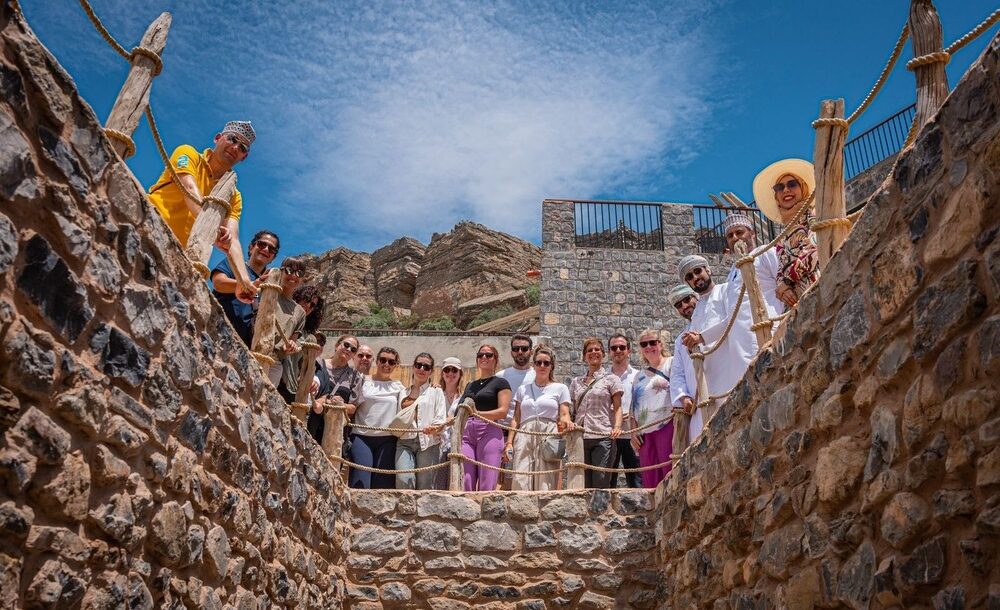

Muscat: According to the Ministry of Heritage and Tourism, more than 77,000 French tourists visited Oman in 2025, marking a 25 per cent increase compared to 2024. The upward trend has continued into 2026, with over 24,600 French visitors arriving during the first quarter, up 10 per cent from the same period last year.
Khulood bint Salem Al Kaabi, Head of the European and American Markets Department at the Ministry of Heritage and Tourism, said the sustained growth reflects the success of Oman’s promotional campaigns in France and the country’s increasing recognition among European travellers as a destination that offers a unique blend of nature, culture and authentic heritage.
She said Oman continues to enjoy a strong reputation among French tourists, supported by its stability, safety and longstanding policy of peace and openness, making it an increasingly preferred destination for international visitors.
Read More
- Oman convenes global experts to advance AI innovation in mental healthcare
- HH Sayyid Theyazin chairs International Financial Centre of Oman board meeting
- Oman participates in Interpol Anti-Drug Conference in Czech Republic
- HH Sayyid Bilarab honours former Wali of Bausher for dedicated public service in Muscat
- Oman police to review heavy vehicle safety standards and driving licence rules
Al Kaabi noted that tourism remains a key pillar of Oman’s economic diversification strategy, with the growing French market contributing to tourism activity and broader economic returns.
To strengthen its presence in France, the ministry appointed Article Ones as its tourism representative in the French market in 2025. The partnership focuses on raising awareness of Oman’s tourism offerings, organising familiarisation trips for French travel companies and implementing regular promotional campaigns targeting the French travel trade.
The ministry has also invested in enhancing visitor experiences by introducing a specialised five-month training programme, in collaboration with the Ministry of Labour, to prepare French-speaking tourist guides. The programme combined theoretical and practical training in Oman with an overseas training component in France, equipping participants with advanced language and professional guiding skills before completing field placements with tourism companies across the Sultanate.
In addition, more than 350 French tourism companies received training over the past year to familiarise them with Oman’s tourism products and competitive advantages.
Air connectivity has also supported the market’s growth, with Oman Air currently operating four to five weekly flights between Muscat International Airport and Charles de Gaulle International Airport in Paris. The ministry has further expanded its international outreach through participation in major tourism exhibitions, including luxury travel events, to showcase Oman’s tourism projects and strengthen partnerships with global travel operators.
Highlighting Oman’s cultural assets, Ibtisam bint Abdullah Al Maamari, Director of the World Heritage Department at the Ministry of Heritage and Tourism, said Oman has ratified five of UNESCO’s six cultural heritage conventions and has served three terms on the World Heritage Committee.
She said Oman is home to five UNESCO World Heritage Sites, Bahla Fort, the Archaeological Sites of Bat, Al Khatm and Al Ain, the Land of Frankincense, the Aflaj Irrigation Systems and the Historic City of Qalhat.
Al Maamari added that seven additional sites remain on Oman’s tentative list for future UNESCO inscription, including Al Rustaq Castle and Al Hazm Fort, the Daymaniyat Islands Nature Reserve, Jabal Samhan Nature Reserve, Al Wusta Wetlands Reserve, the archaeological cultural landscape of Wahda, Siya and Salut, and the Ras Al Hadd Reserve with the Ras Al Jinz Archaeological Site.
She said Oman continues to modernise the management of its World Heritage sites through partnerships with the private sector and local communities, creating an integrated model that enhances visitor experiences while safeguarding cultural values. Successful examples include developments at Bahla Fort, Wadi Dawkah and the Qalhat Historic City Visitors Centre.
Al Maamari also highlighted Oman’s longstanding contribution to UNESCO’s Maritime Silk Road initiative, including the use of the Royal Yacht Falak Al Salamah during the organisation’s pioneering maritime expedition between 1990 and 1991.
She further noted the launch of the Sultan Haitham Award for the Safeguarding of Intangible Cultural Heritage, an international award established jointly by Oman and UNESCO to recognise outstanding global efforts in preserving and promoting intangible cultural heritage.





