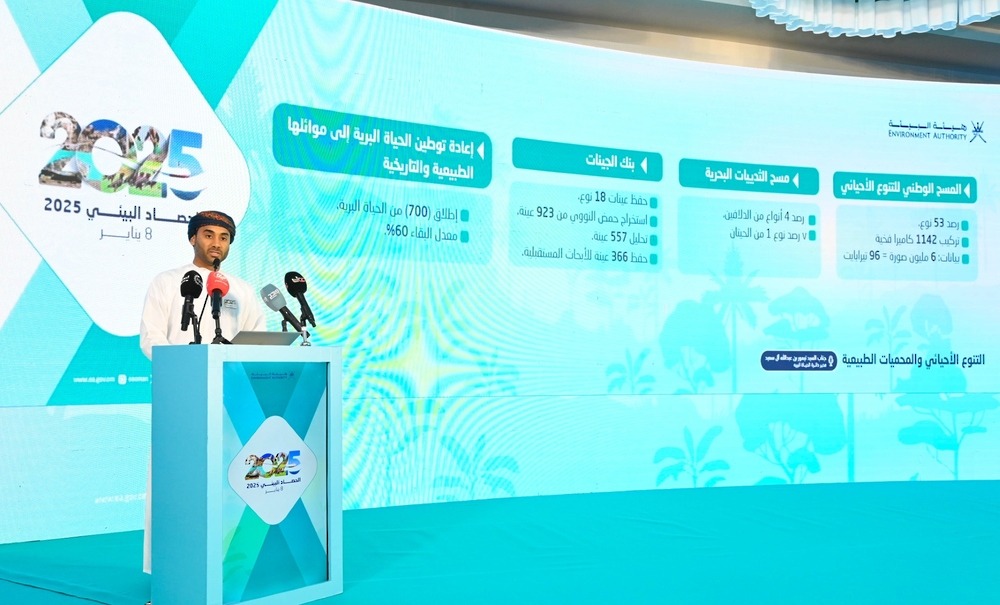

Muscat: At a media conference held today, the Environment Authority reviewed the environmental harvest of key projects, initiatives and performance indicators, highlighting achievements that underscore Oman’s commitment to sustainability and environmental protection. The Authority also announced that Oman has received the Arab Excellence Award in recognition of its efforts in sustainability and environmental conservation.
During the past five years, 589 environmental projects were implemented, alongside the declaration of 32 nature reserves by 2025, including 13 terrestrial reserves, five marine reserves and 13 combined terrestrial and marine reserves. This has expanded Oman’s total protected area to 17,839.57 square kilometres.
As part of the national initiative to plant 10 million trees, the Authority reported the planting of 856,142 wild trees, the distribution of 652,241 wild tree seeds, the planting of more than 59.1 million seeds, and the cultivation of 11.38 million mangrove trees. Total vegetation cover has now reached 10.8 million trees, contributing to improved air quality and climate change mitigation. Efforts to protect biodiversity also included the elimination of 1.63 million invasive birds.
Read More
- Indian Navy’s INS Sudarshini docks in Salalah on final overseas stop of transoceanic voyage
- ‘Serving Oman is an honour we cherish’: PDO’s Managing Director Dr Aflah Al Hadhrami reflects on Royal recognition
- Muscat Municipality trains SQU students in meat safety and veterinary inspection
- Dedicated ambulance service launched for bedridden patients in Muscat
- Struggling to pay electricity bills? Nama Supply offers flexible payment plans
More than 60 ambient air quality monitoring stations have been established across various governorates, while the Environmental Protectors Initiative raised awareness among 99,174 people, deterred over 70,000 harmful practices, rescued nearly 29,400 small turtles, and removed 2,572 vehicles from green spaces.
In the field of research and enforcement, 22 scientific papers were published in peer-reviewed journals, 103,382 environmental permits and licences were issued, and 203,912 field and periodic inspections were carried out. Authorities recorded 4,721 environmental violations, received 367 reports through the Environmental Emergency Centre, conducted over 4,200 awareness campaigns, and welcomed more than 550,000 visitors to nature reserves.
Major biodiversity projects included a national wildlife survey that monitored 53 species using 2,400 camera traps, generating six million images, while marine surveys tracked 56 marine mammal species through extensive sea trips and field surveys. Genetic conservation efforts preserved 18 wildlife species, with DNA samples secured for future research, and around 700 wild animals were released back into their natural habitats.
Investment in nature reserves also gathered momentum, with nine contracts signed worth a combined RO 44 million, supporting the green economy. Along Oman’s coastline, surveys showed an average seawater quality of 96 per cent, alongside coral reef rehabilitation through the establishment of an underwater museum. The Biodiversity Index Red List score improved from 0.89 to 0.98, and dozens of Arabian oryx and gazelles were reintroduced into the wild.
Additional initiatives covered coastal erosion studies in North and South Al Batinah, a nationwide early warning system for radiation monitoring with full data flow, updated plans for persistent organic pollutants, groundwater and wastewater quality monitoring, and marine pollution assessments, all showing high compliance with national standards.
The Authority also reported progress in waste management, with 39 per cent of solid waste now recycled through 85 recycling plants, and the rollout of national initiatives such as the Omani Tree Gardens project. New standards for classifying sustainable buildings and cities were approved at the Gulf level, further reinforcing Oman’s environmental framework.
Concluding the conference, the Environment Authority announced that Haima, Mahout, Duqm and Al Jazir in Al Wusta Governorate had won the “Green State” competition.





