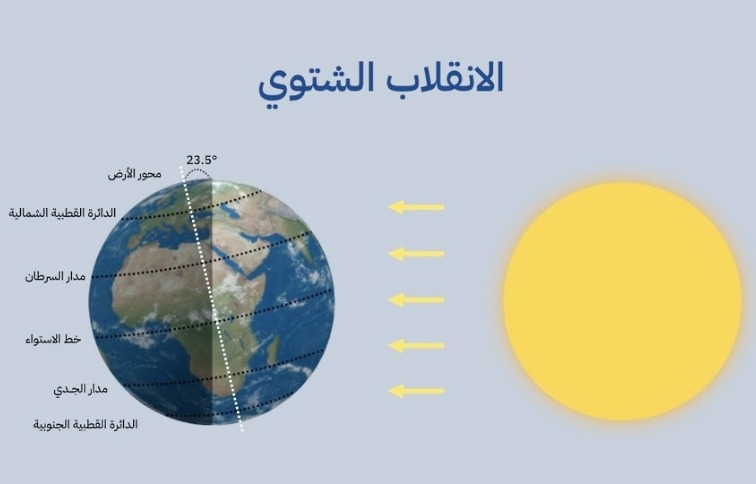

MUSCAT : According to Ma’ather bint Khamis Al-Wahibiyah, Head of the Community Outreach Committee at the Oman Astronomy and Space Society, the sun will rise in Muscat at 6:44 am and set at 5:25 pm, making the total length of the day 10 hours and 41 minutes. She explained that this date marks the first astronomical day of winter, which will last for 88 days, 23 hours and 42 minutes.
Al-Wahibiyah explained that the winter solstice is caused by the tilt of the Earth’s axis at an angle of 23.5 degrees as it orbits the sun, resulting in alternating exposure of the northern and southern hemispheres to sunlight. She clarified that seasonal changes are not caused by the Earth’s distance from the sun, noting that the planet is actually closest to the sun during winter in the northern hemisphere, a point that dispels the common misconception linking winter cold to distance.
During the solstice, the sun reaches its southernmost position in the sky, while the North Pole is tilted away from the sun. As a result, some regions experience extreme daylight conditions. Areas north of the Arctic Circle remain in continuous darkness, while regions within the Antarctic Circle experience uninterrupted daylight, a phenomenon known as the midnight sun.
Read More
- Indian Navy’s INS Sudarshini docks in Salalah on final overseas stop of transoceanic voyage
- ‘Serving Oman is an honour we cherish’: PDO’s Managing Director Dr Aflah Al Hadhrami reflects on Royal recognition
- Muscat Municipality trains SQU students in meat safety and veterinary inspection
- Dedicated ambulance service launched for bedridden patients in Muscat
- Struggling to pay electricity bills? Nama Supply offers flexible payment plans
She added that the winter solstice is characterised by sunrise from the far southeast, the sun’s low apparent path across the sky, and the longest shadows of the year. The event follows the autumnal equinox in September, after which daylight hours in the northern hemisphere gradually shortened until reaching their minimum at the solstice, while the opposite pattern occurs in the southern hemisphere.
Al-Wahibiyah also highlighted the two primary motions of the Earth: its daily rotation on its axis, which causes night and day, and its annual orbit around the sun, which gives rise to the four astronomical seasons.
She concluded that around the winter solstice, the sun appears to rise from nearly the same southern point for several days before beginning its apparent northward movement. Daylight hours will then gradually increase until day and night become equal again at the spring equinox, expected on March 20, 2026.
For all the latest news from Oman and GCC, follow us on Twitter, Instagram and LinkedIn, like us on Facebook and subscribe to our YouTube page, which is updated daily.





