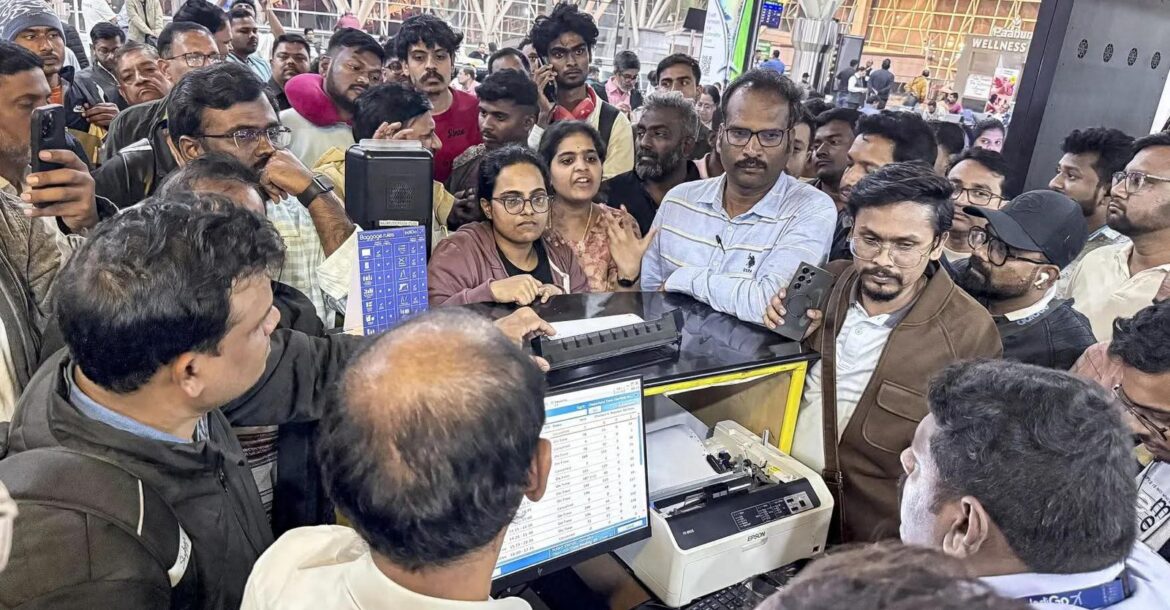

Terminals in Delhi, Mumbai, Bengaluru and Hyderabad were, consequently, overwhelmed with long queues, confused travellers, last-minute fare surges, and repeated announcements of cancellations.
For many families, students, officials and medical travellers, the disruption was not merely an inconvenience, rather, it represented a distressing collapse of a system on which they rely.
To begin with, the immediate cause of the crisis lay in the airline’s inability to adapt to newly implemented pilot duty and rest regulations issued by the Directorate General of Civil Aviation. Although these rules, requiring longer rest hours and stricter limits on night operations, were introduced to improve safety, IndiGo’s operational planning proved inadequate. Years of lean staffing, aggressive cost-cutting, and tightly engineered schedules had left the airline with insufficient pilot reserves to sustain its ambitious roster. Instead of preparing for regulatory changes, the airline froze hiring, misjudged crew availability and continued operating without meaningful buffers. Consequently, once the new norms took effect, cancellations escalated rapidly.
Read More
- What Shakespeare knew about economics before economists did
- Respect is earned, not expected: Rethinking the teacher-student relationship
- Never underestimate a woman who enjoys her own company
- Rethinking schooling in the age of Artificial Intelligence
- Reeling from endless social media content? Pause the doomscroll, rewind to screen-free time
Moreover, while regulatory changes served as the trigger, passengers quickly noted that only one airline suffered an operational collapse of this magnitude, thereby raising deeper concerns about India’s structural over-reliance on a single private carrier. Given that IndiGo handles a significant share of domestic connectivity, its failure created a system-wide shock. Travellers were left with virtually no alternatives, limited information, and owing to insufficient regulatory oversight of dynamic pricing, uncontrolled fare spikes, particularly acute during high-demand seasons. As a result, the episode highlighted the fragility of India’s aviation ecosystem and exposed existing vulnerabilities in price regulation and passenger protection mechanisms.
In addition, the cascading disruptions were not confined to domestic routes. Several international services experienced substantial delays, affecting business travellers, migrant workers, and transit passengers. Such international spillover effects further underscored how operational instability in one dominant carrier can compromise India’s global connectivity and credibility.
Consequently, events like these reignite an important policy debate: Does India require a strong, government-owned national airline to ensure systemic stability? A public carrier, either newly established or strengthened through existing state-run infrastructure, could, in principle, prioritise public interest over profit maximisation. Such an entity would have the explicit mandate to maintain adequate staffing, ensure buffer capacity, operate socially essential routes, regulate seasonal fare volatility and safeguard international schedules during periods of regulatory or market-induced stress.
By contrast, private airlines, operating on characteristically thin margins, often emphasise efficiency and cost-reduction at the expense of resilience. Under such conditions, systems function smoothly only in the absence of shocks. However, when regulations shift, weather disrupts operations or logistical challenges accumulate, passengers inevitably bear the consequences. A government-owned airline, by design, would not be permitted to fail under such pressures because its fundamental objective would be service delivery rather than profit generation.
Overall, the recent chaos has demonstrated that aviation, much like the railways, operates as a public lifeline rather than a mere commercial enterprise. The present experience should certainly be an eye opener for the government. Considering India’s geographic scale, socio-economic diversity and expanding economic activity, the country urgently requires a dependable public airline capable of anchoring the entire sector. The objective is not to eliminate private competition, but to ensure that no single private failure can paralyse the nation’s mobility infrastructure.
Ultimately, the IndiGo crisis serves as a stark reminder that efficiency, without adequate preparedness and regulatory foresight, is unsustainable. As thousands of passengers slept on airport floors and watched their plans disintegrate, one conclusion became unavoidable, India needs a stable, government-owned airline to guarantee that the right to travel, safely, predictably and fairly, is protected regardless of the challenges that arise.
– Dr. Saji Uthuppan, Lecturer of English & Social Worker





