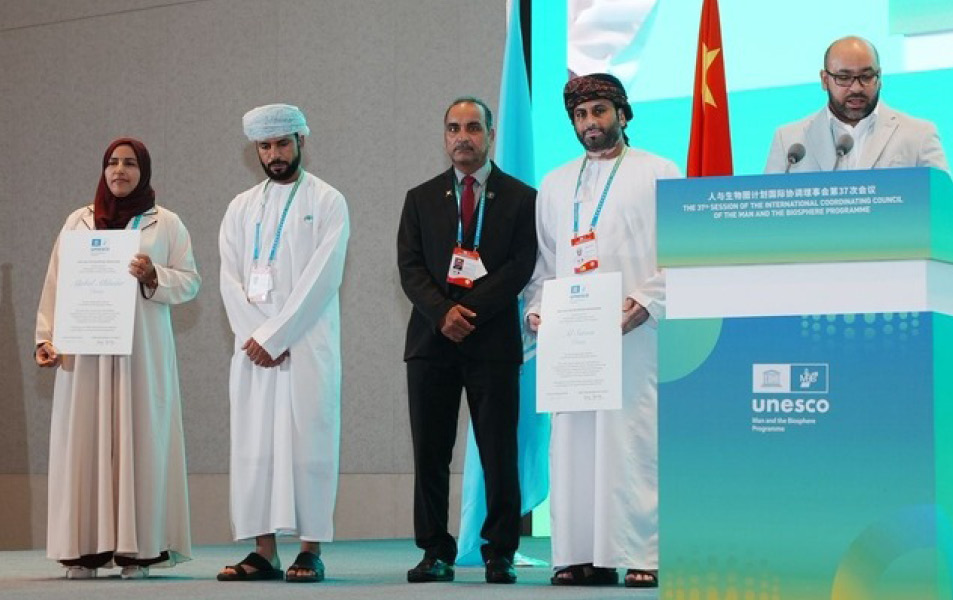

Beijing: The announcement was made during the 37th session of the International Coordinating Council of the Man and the Biosphere Programme (MAB-ICC), held in Lin’an, Hangzhou, China.
This recognition, the first of its kind for Oman, brings the country into a global network of 759 reserves across 136 nations that serve as living laboratories for sustainable development and coexistence between people and nature. The achievement is the result of close cooperation between the Environment Authority and the Omani National Commission for Education, Culture and Science, aligning with Oman Vision 2040 goals to integrate environmental protection with community development.
The Al Jabal Al Akhdar Reserve, spanning roughly 4,500 hectares in the Western Hajar Mountains, rises between 600 to 2,980 meters above sea level. Classified as a Key Biodiversity Area, it harbors 60% of Oman’s vascular plants. Among its ecological gems are rare species such as the wild olive tree (atam), endangered Arabian ibex and Arabian wolf, as well as over 71 bird species, including the golden eagle and Egyptian vulture.
Read More
- Oman, U.S. discuss bilateral cooperation and regional developments
- Oman breaks ground on RO 5.8 million tourism and commercial project in Masirah
- Oman airports handle 9.3 million passengers by end of August, down 7.1%
- Over 700 banned tobacco products seized in Oman’s Masirah Wilayat
- Muscat Municipality warns against illegal worker housing in residential neighbourhoods
The reserve is also home to more than 13,000 people in the transitional zone and 575 in the buffer zone, where communities continue to practice traditional farming and sustainable grazing. These practices underscore the reserve’s role as a model of harmonious coexistence between humans and fragile ecosystems.
Located in the Eastern Hajar Mountains, just 45 kilometers southwest of Muscat, the Al Sereen Reserve covers an expansive 103,888 hectares. It is classified as a Category II reserve by the International Union for Conservation of Nature (IUCN).
The reserve boasts more than 400 plant species, including 10 endemic and 4 endangered varieties. It is also home to Arabian gazelles, red and blue foxes, reptiles, and numerous bird species. Beyond its ecological wealth, Al Sereen holds significant cultural and historical value, with ancient rock carvings dating back to pre-Islamic times that chronicle the lives of early settlers.
Roughly 2,533 people live in its buffer and transitional zones, engaging in sustainable grazing, beekeeping, and ecotourism, activities that both preserve the environment and provide vital income. The integrated management plan, praised by the International Committee, blends conservation with research, education, and sustainable development.
The addition of these two reserves supports Oman’s commitment to the Kunming-Montreal Global Biodiversity Framework (KMGBF), particularly Target 3, which calls for protecting 30% of land and sea areas by 2030. The reserves’ buffer and transitional zones will be considered “other effective area-based measures” (OECMs), further boosting Oman’s global contribution.
This move also aligns with the Hangzhou Strategic Action Plan (2026–2035), which emphasizes intergenerational justice, indigenous community rights, and science-led innovation at the heart of sustainable development.





