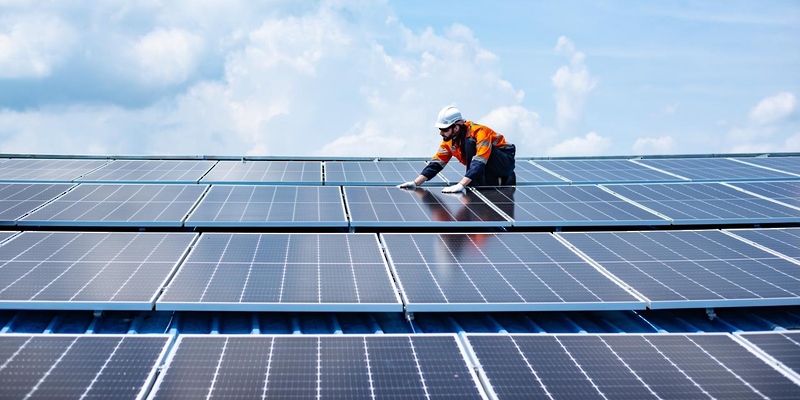
Muscat: The Ministry of Commerce, Industry and Investment Promotion has revealed that the renewable energy equipment sector—covering solar panels, wind turbines, energy storage, and green hydrogen production tools—is a core focus of Oman’s Industrial Strategy 2040. According to H.E. Dr. Saleh bin Saeed Masan, Undersecretary for Commerce and Industry, the strategy aims to modernize traditional industries by integrating innovation, technology, and sustainability to diversify products, boost local capabilities, and reduce carbon emissions.
Key to this transformation is the development of integrated industrial complexes. The Sohar Free Zone has become a magnet for major clean energy manufacturers, attracting three major solar energy projects valued at more than RO 1 billion. This includes United Solar’s groundbreaking polysilicon plant—the first of its kind in the Middle East—with an investment of $1.35 billion and over 80% completion as of April 2025. The factory will produce 100,000 metric tons annually, serving regional and global demand for the critical raw material used in solar cell production.
Further bolstering Sohar’s role, Chinese firm Jitai Solar signed a deal in late 2024 to establish a solar panel plant with a capacity of 5 GW annually, mainly targeting Gulf and African markets. Meanwhile, JA Solar announced a $564 million investment to build an integrated solar cell and panel factory in Sohar, with a projected production capacity exceeding 40 GW annually.
Read More
- Oman records highest temperature of 46.2°C
- Heavy rain and hail lash Oman’s Al Buraimi, triggering wadi flows
- Honourable Lady visits Omani Women’s Association in Salalah
- Oman Foreign Minister holds talks with Tunisia, Brunei on bilateral ties and global developments
- Oman, Kazakhstan review bilateral ties and regional developments
These developments mark the formation of an unprecedented industrial ecosystem, says Eng. Jassim bin Saif Al Jadidi, Technical Director at the Ministry. The solar complex will span the entire value chain—from raw material processing to panel assembly—reducing costs by up to 20% and ensuring supply chain stability in a volatile global climate.
With over 3,000 jobs expected and an anticipated boost in non-oil exports via Sohar Port, Oman is positioning itself as a key player in the global green supply chain. The government aims to further attract complementary industries—like glass, silicon, and battery production—making Oman a regional hub for renewable energy technologies.





