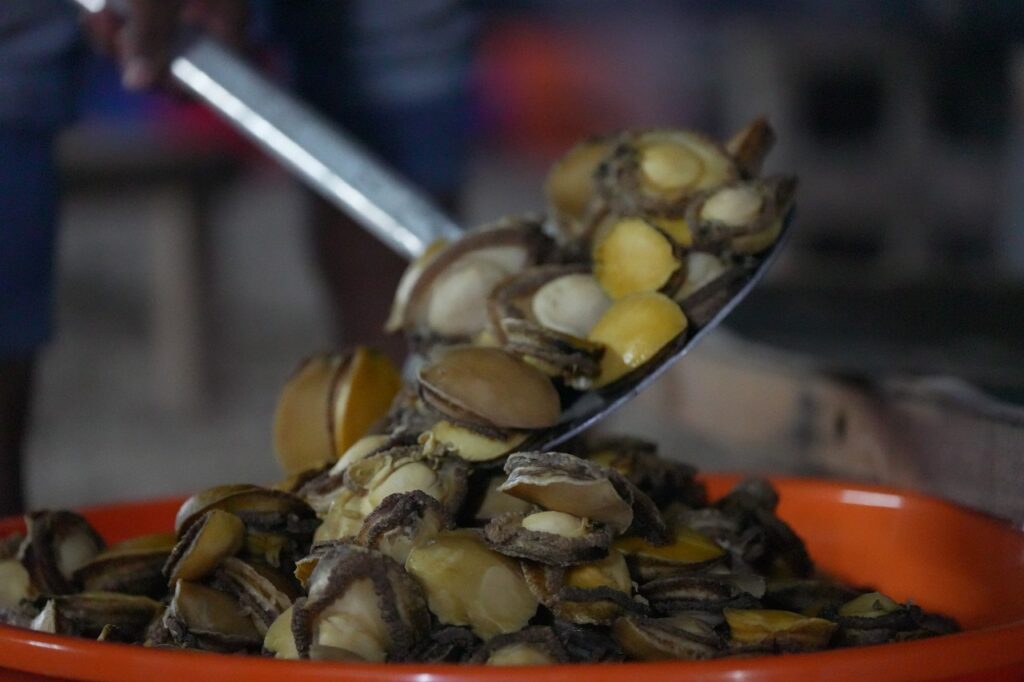
MUSCAT : The survey, conducted by the Fisheries Research Center at the Ministry of Agriculture, Fisheries, and Water Resources, recorded a production of more than 76 tons of abalone in just 10 fishing days, compared to 149 tons in 30 fishing days during the 2011 season.
This improvement, alongside a reduction in the number of licenses issued – 2,369 in 2024 compared to 4,418 in 2011 – reflects positive trends in the sector.

Engineer Muslim bin Salem Rafeet, Assistant Director General of Fisheries at the Directorate General of Agriculture, Fisheries, and Water Resources in Dhofar Governorate, stated that the Wilayat of Sadah led production with a substantial 93.5 percent of total output, while the Wilayat of Mirbat contributed 6.5 percent.
The Ministry of Agriculture, Fisheries, and Water Resources has emphasised its commitment to sustaining Oman’s abalone population by implementing sustainable practices. These include establishing minimum size requirements for catch, setting seasonal bans on abalone fishing, and ensuring the use of proper fishing tools and methods. Additionally, the Ministry works to raise awareness of these regulations through social media and community outreach.
In the 2024 season, the Department of Fisheries in Dhofar formed a specialised team to oversee the season, which focuses on ensuring the sustainability of the fishery. The Ministry also introduced a new visual identity to highlight the importance of this program.
For the 2024 season, a total of 2,475 licenses were issued, including 2,369 diving licenses. The Wilayat of Mirbat received the highest number of diving licenses at 47 percent, followed by Sadah with 42 percent, and Salalah at 7 percent. The remaining licenses were distributed across other regions such as Taqah, Shaleem, and the Al-Hallaniyat Islands.
34 percent of licenses were issued to first-time divers, while 66 percent went to citizens with previous diving experience. The Ministry also granted 106 licenses for processing, storing, and trading abalone, with 11 centres approved for trading this season.
The Omani abalone, locally known as As’sufailah, is unique to the Sultanate and inhabits the southern coastline, extending from the Sharbatat area in the Wilayat of Shalim to the Al-Halaniyyat Islands, and on to the Niyabat of Hasik and Hadbin in the Wilayat of Sadah. This valuable resource plays a critical role in the local economy, offering a significant source of income for communities while also contributing to export revenues.
The average local price for Omani abalone is around RO 45 per kilogramme, while the price on global markets has reached approximately RO 200 per kilogramme, demonstrating its international demand.
In a move towards modernising the fisheries sector, the Ministry utilized drones for the first time to monitor abalone fisheries and guide coverage. Additionally, digital transformation was implemented in the license application process, marking a significant step forward in improving efficiency for the 2024 season.
For all the latest news from Oman and GCC, follow us on Twitter, Instagram and LinkedIn, like us on Facebook and subscribe to our YouTube page, which is updated daily.
Read More
- Oman, Kazakhstan review bilateral ties and regional developments
- Oman’s Health Ministry urges public to act on suspected unsafe food
- Low clouds, fog expected over Muscat and Al Batinah
- Oman sets October 15 deadline for approval to use national symbols on products
- Oman, Iran agree framework for safe shipping corridor through Strait of Hormuz