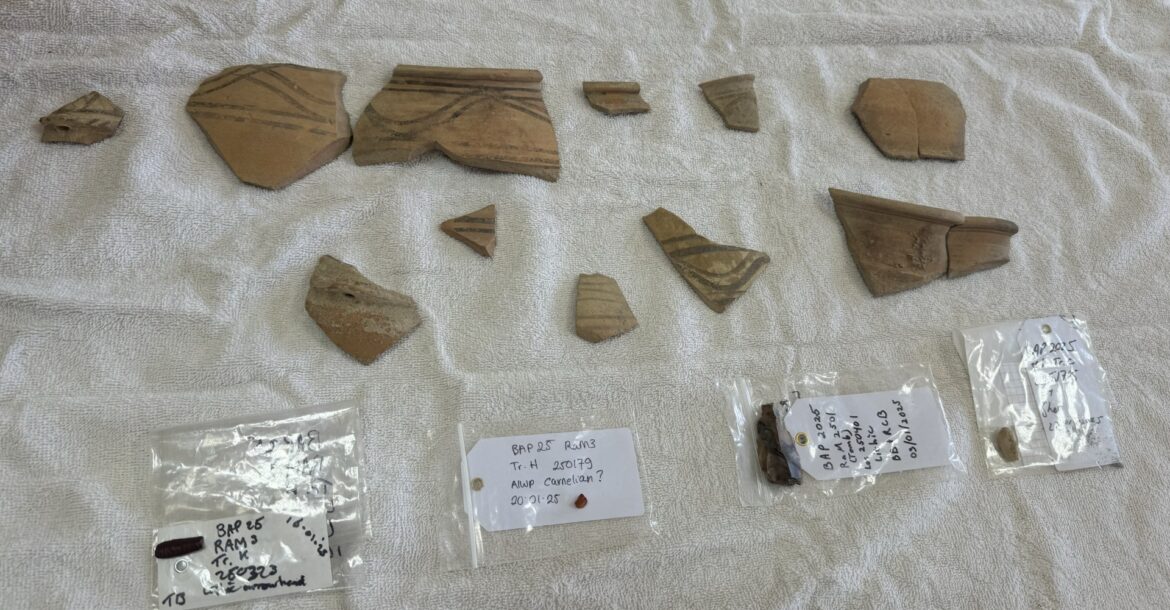

MUSCAT : Excavations at Rakhat Al Madrah, near the UNESCO-listed ruins of Bat, have revealed graves from 3200 to 2700 BC and four buildings from the same era, offering a rare glimpse into ancient civilizations.
The Ministry of Heritage and Tourism, in collaboration with an American mission from the University of Pennsylvania, led the excavation. Dr. Jennifer Swerida, head of the mission, noted that this season’s work focused on a large structure, possibly used for communal activities, as evidence of ovens and walls suggests continued use until the early Islamic era.
Among the artifacts unearthed were:
Read More
- His Majesty Sultan Haitham returns home after state visits to China, Brunei
- Oman’s digital economy contributes 9% to GDP as investments reach RO 1.3 billion in 2025
- Muscat Municipality announces traffic diversion on Al Khuwair service road from November 4
- Oman clarifies expat recruitment rules after agency talks
- Oman police arrest two over vehicle theft, number plate tampering and resisting officers in Seeb
A Neolithic flint arrowhead
A red agate amulet and pottery from the Umm al-Nar era
A metal tool head from the early Islamic era
An imported ceramic jar from the Indus Valley
Additionally, soil samples containing ancient plant remnants were collected, aiding researchers in reconstructing past environmental conditions and human activity in the area.
Sulaiman bin Hamoud Al Jabri, Head of the Technical Section at the Department of Archaeological Sites, highlighted the Ministry’s long-standing efforts in attracting international archaeological missions. Since the 1970s, experts from Denmark, Germany, Japan, France, and Italy have studied Bat’s rich historical landscape.
The current excavation team, a joint mission from the University of Pennsylvania and the University of Leiden (Netherlands), has been working on the Bat site since 2007. Their research spans towers, tombs, soil studies, and ancient water sources, including the Rakhat Al Madrah site, located 7 km from Bat.
Bat, one of Oman’s most significant UNESCO-listed archaeological sites, continues to reveal insights into ancient civilizations, cultural evolution, and past technologies.
For all the latest news from Oman and GCC, follow us on Twitter, Instagram and LinkedIn, like us on Facebook and subscribe to our YouTube page, which is updated daily.





