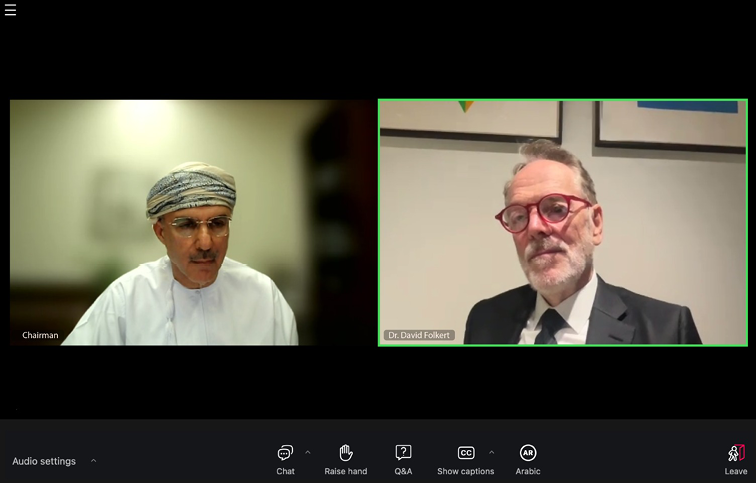

MUSCAT : The Muscat Stock Exchange (MSX) proudly hosted the third edition of its flagship event, the MSX Chairman’s Dialogue, a dynamic platform dedicated to exploring pivotal global economic shifts and fostering visionary thought leadership. This highly anticipated virtual session, themed ‘The Global Economy: A Story of Historical Transformation and Global Opportunities,’ brought together MSX Chairman Mohammed Mahfoodh Al Ardhi and Dr. David Folkerts-Landau, Group Chief Economist and Global Head of Research at Deutsche Bank, for an insightful and thought-provoking discussion.
The dialogue attracted over 360 registrations, including prominent government officials, business leaders, entrepreneurs and students. The significant turnout underscored the event’s growing importance as a platform for meaningful discussions about the shifting global economic landscape.
In his introductory speech Mohammed Mahfoodh Al Ardhi remarked: “The MSX Chairman’s Dialogue continues to provide an invaluable platform for addressing the complexities of our evolving global economy. In recent years, the world order has appeared more uncertain than ever. From newsrooms to boardrooms, the pressing question remains – What next?”
Read More
- Omani Brand AMTUR Gold & Diamonds expands to Qatar with opening of 14th branch
- Development Bank Sustainability expert joins Duqm Summer Podcast Series
- Oman refinery output falls 3.7% to 129 million barrels
- GCC stock trading rises 19.5% as markets record $618 billion in deals
- Oman Air creates first-ever Chief Guest Experience Officer role
Dr. Folkerts-Landau, a globally respected economist with an illustrious career spanning the University of Chicago and the International Monetary Fund, shared a wealth of insights shaped by decades of navigating market cycles. Framing his analysis around the unprecedented unpredictability of the current global order, he illuminated the profound transformations reshaping the economy, from the rise of groundbreaking technologies to shifts in international power dynamics.
The session delved into pressing global issues, including the decline of multilateralism, the rise of transactional diplomacy, and the fragility of international institutions. Dr. Folkerts-Landau underscored the urgent need for a rules-based global system to mitigate escalating geopolitical tensions and maintain stability in an interconnected world. He illustrated how disruptions, such as regional conflicts affecting supply chains, can create ripple effects across industries and continents, making international cooperation imperative.
Reflecting on the growing influence of Asia and the Global South, he pointed to the world’s gradual transition from a unipolar to a multipolar structure. While this shift presents opportunities, it also fosters friction, necessitating strategic diplomacy to navigate emerging complexities. He further explored the dual nature of technology as a transformative force, capable of uniting and dividing societies.
Highlighting Artificial Intelligence (AI) as a transformative milestone in human history, Dr. Folkerts-Landau likened its impact to that of agriculture or the industrial revolution. “We are no longer just amplifying muscle power; we are manufacturing intelligence – a resource that has propelled humanity from caves to skyscrapers and from walking to flying. AI is poised to revolutionise industries, address scientific challenges, and drive unprecedented efficiencies,” he remarked. However, he cautioned that the race for AI supremacy will not only shape industries but also redefine geopolitics, as nations compete for dominance in this pivotal field.
On advanced economies, he discussed the stagnation caused by bureaucratic systems and emphasised deregulation as a catalyst for innovation and growth. Dr. Folkerts-Landau predicted that strategic policies, particularly in the United States, focusing on energy exports, flexible labor markets, and technology-driven deregulation, would lead to robust productivity and sustained GDP growth.
He also addressed the intensifying geopolitical tensions, particularly between the U.S. and China, noting the latter’s rising technological and manufacturing leadership and its implications for global markets. Simultaneously, he highlighted Europe’s economic vulnerabilities, including strained budgets and challenges in adapting to shifting U.S. policies and trade dynamics.
As the global economy undergoes rapid transformation, the MSX Chairman’s Dialogue reaffirms its commitment to equipping stakeholders with the tools and insights needed to navigate uncertainty, seize emerging opportunities, and foster sustainable growth in an ever-changing world.





