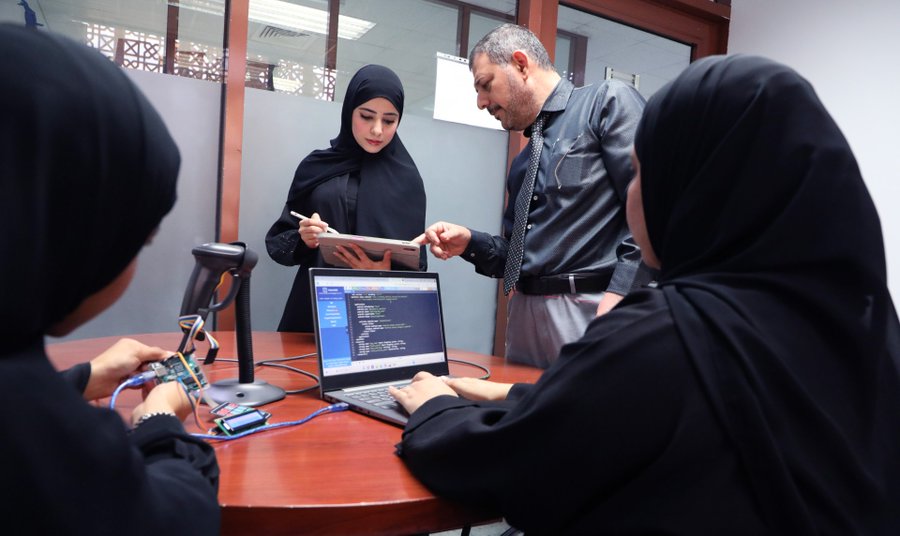

MUSCAT : The innovative project, funded by Oman’s Ministry of Higher Education, Scientific Research and Innovation, is overseen by the university’s Technology Transfer Center and Business Incubator.
The team, comprising Heba bint Nasser Al-Maamaria, Adhari bint Ali Al-Mahrouqia, and Rawan bint Hamdan Al-Maamaria, under the guidance of Professor Jabbar Youssef from the College of Computer and Information Technology, has introduced a shopping cart with embedded technology aimed at simplifying and enhancing the shopping journey.
Explaining the project, Heba Al-Maamari shared that the smart cart is equipped with a touch screen and barcode scanner, enabling shoppers to view product details instantly, including name, type, price, and stock information, through a central database connected via Wi-Fi. This cart also offers self-checkout capabilities, allowing customers to pay directly from the cart, bypassing long checkout lines and enabling a seamless shopping exit.
Read More
- Oman’s military medical city uses robotic system to remove kidney tumour
- Six jailed in Oman over Mazoon Dairy embezzlement and bribery case
- Oman deepens China ties, elevates Brunei relations in His Majesty Sultan Haitham’s Asia visits
- HH Sayyid Bilarab patronises Royal Guard of Oman’s Annual Day celebrations
- Oman partners with Visa to attract high-spending luxury travellers
Beyond convenience, the cart can manage personalized shopping lists, show promotions, track budget spending, and notify users of expiration dates and available discounts, providing a tailored shopping experience. “The importance of the smart cart lies in helping to solve the problem of huge congestion in central markets and major stores during discount offers or weekends, which eliminates the need to wait in long queues. The proposed smart cart also ensures a smooth and efficient experience for customers and retailers, as it improves the quality of service, provides customers with a comfortable shopping experience, reduces waiting time and increases the percentage of purchase,” said Heba, highlighting the potential to enhance customer service quality.
Adhari Al Mahrouqi emphasized the project’s goals for Oman: leveraging IoT to improve shopping convenience, implementing a self-billing system, and advancing mobile applications to manage purchases effectively. These innovations not only boost customer satisfaction but also aim to impact operational efficiency in retail settings. The research further investigates the smart cart’s effect on the overall customer experience, with a comprehensive review of past studies guiding its implementation.
Rawan Al-Maamari detailed the scientific approach taken, which included analyzing previous research, defining key project requirements, and consulting stakeholders. With a focus on applying IoT technology in retail, the team hopes the smart shopping cart project will gain commercial backing to serve Omani consumers and support job creation for new graduates.
“The team hopes that the idea will find someone to adopt it so that it can be produced commercially, considering it a great opportunity to serve the Omani community and present innovative and creative ideas that contribute to developing information systems and products that serve the Omani consumer, and help open promising job opportunities for newly graduated students so that they can be effective contributors to the advancement of the labour market in the Sultanate of Oman and the move towards global markets,” Rawan noted.
For all the latest news from Oman and GCC, follow us on Twitter, Instagram and LinkedIn, like us on Facebook and subscribe to our YouTube page, which is updated daily.





