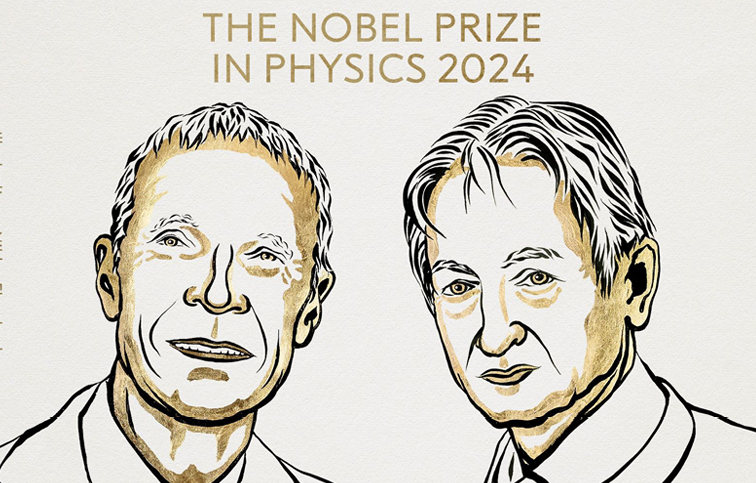

MUSCAT : Their pioneering work utilizes tools from physics to develop methods that underpin today’s advanced machine learning technologies.

John Hopfield is recognized for creating an associative memory network capable of storing and reconstructing images and patterns. Geoffrey Hinton is celebrated for inventing a method that autonomously identifies properties in data, enabling tasks such as image recognition.
“This year’s two Nobel Laureates in physics have used tools from physics to develop methods that are the foundation of today’s powerful machine learning,” the Nobel committee said in a press release.
The laureates’ research, dating back to the 1980s, harnesses principles of physics to advance artificial intelligence. Hopfield’s network employs atomic spin characteristics, treating nodes like pixels to reconstruct distorted images. Hinton built on this foundation with the Boltzmann machine, a model that learns to recognize data patterns through statistical physics.
Ellen Moons, Chair of the Nobel Committee for Physics, highlighted the significant impact of their work, stating, “In physics, we use artificial neural networks in a vast range of areas, such as developing new materials with specific properties.”
For all the latest news from Oman and GCC, follow us on Twitter, Instagram and LinkedIn, like us on Facebook and subscribe to our YouTube page, which is updated daily.
Read More
- Air India appoints former Ethiopian Airlines Chief Tewolde Gebremariam as new CEO, MD
- GCC bottled water market reaches $7.55 billion
- Lightning strikes kill 14 people in India’s Jharkhand
- Libyan coast guard rescues 29 migrants off Sirte coast
- Magnitude 6.3 earthquake strikes southern Philippines; no tsunami warning issued





