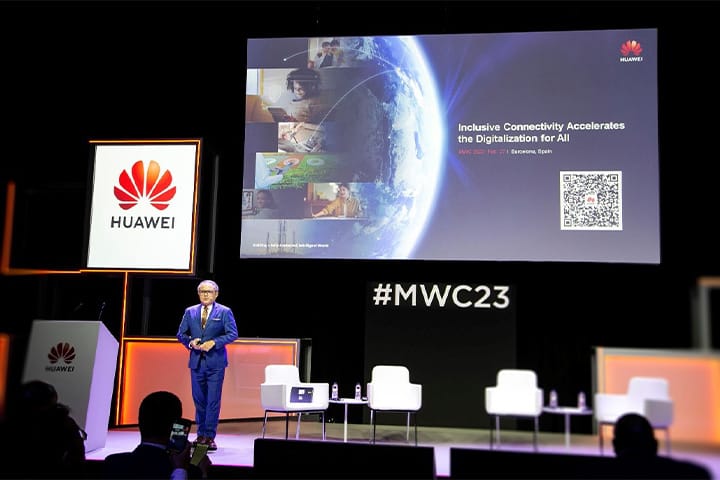

Barcelona: Lots to see, lots to meet, lots to explore…yet, without proper time management, one would not be able to cover the end-to-end excitements that the Mobile World Congress 2023 has in store for the four packed days of infotainment, as far as technology is concerned.
I was honored to be invited to attend and participate at this annual event that occurs every year in Barcelona, Spain, where the best of the best in technology come under one roof to demonstrate and share what the future holds for the society. This year, MWC2023 highlight was about unveiling tomorrow’s future, but today!
Being a member of TAS, one of the leading online publication in the Sultanate, I decided to write an exclusive in-depth article on one of the interesting topic that was shared during the event, the “Inclusive Connectivity” – a means to ensure that the widening digital gap is closed and meaningful connectivity is achieved. And yes, it was intriguing to see Huawei sharing its recently launched Inclusive Connectivity 2.0 Solution, a service focusing on building networks in remote areas and complex environments. The solution combines datacom, optical network, and wireless products, designed to bring connectivity to rural and remote mountainous areas.
Read More
- Oman localises transformer production with RO 15 million investment
- Oman property prices go up 22.7% as Muscat leads residential land gains
- Global recognition meets local pride : ABM students awarded at Oman Climate Week
- Oil prices slip as Brent falls below $105
- OPEC Fund approves up to $40 million for Sustainable City – Yiti development in Oman
Launching the solution was Hong-Eng Koh, Global Chief Public Services Industry Scientist of Huawei, who addressed the governments and expressed that the ultimate goal for countries around the world is to achieve inclusive and equitable digital services, bridging the digital divide – yes, you heard it right, ensuring everyone has a means to be connected, educated and, as a result, productive too!
The launch focused on the trends in the sector’s digital transformation and looking at ways to promote economic and social development, while improving the quality of life of citizens.
The goal behind the Inclusive Connectivity 2.0 is to simply reduce network construction costs and speed up roll out, driving fast and cost-effective national informatization – this helps governments around the world improve service delivery and improve the quality of life in hard-to-reach areas – thus ensuring even government services are utilized by the citizens electronically and digitally as well.
Tons of millions of people around the world still lack access to mobile broadband networks, despite the steady growth of connectivity around the world. It was nice to see Huawei addressing how governments around the world have launched strategies to build digital infrastructure in remote areas. According to Huawei, public services must be focused on people. In low- and middle-income countries, rural residents are 33% less likely to use mobile Internet than urban residents.
Therefore, Huawei works with the public sector to help countries enhance their national digital infrastructure, accelerating digital transformation in public services and helping governments around the world go digital. “Huawei enables our government, education and healthcare clients globally in their digital transformation journey through our comprehensive technologies including 5G, F5G, Cloud, Big Data and AI. We help our clients in their national backbone, last mile connectivity, to achieve their goals in digital society, digital economy and digital government,” said Hong-Eng Koh.
Smart technologies that are continuously developed to help automate and simplify the lives of people and business as a whole would deeply be integrated with the physical world. The session with Huawei explained neatly how all services, including personal entertainment, work, and industrial production, will be intelligently connected.
This means that networks will have to evolve from ubiquitous Gbps to ubiquitous 10Gbps, connectivity and sensing will need to be integrated, and the ICT industry will have to shift its focus from energy consumption to energy efficiency. Cloud-based and multi-cloud enterprise applications are also becoming a new trend.
The cloud applications will need real-time, reliable, and easily accessible connectivity, bringing new opportunities to transmission networks, whether they are between edge cloud nodes, between edge cloud nodes and central clouds, or between enterprises and the cloud.
According to Huawei, it is instrumental to build the “cloud + network” infrastructure via top-level design to deliver comprehensive digital public services to citizens and achieve interconnection throughout. The integrated “cloud + network” architecture enables the public sector to easily and securely exchange data across networks and regions, offering one-stop services for the public.
At the same time, it can create a centralized, secure, and reliable bearer environment for government departments to connect with each other and increase their collaboration efficiency. This ultimately achieves higher governance efficiency.
Is “Inclusive Connectivity” another trend, fad or is it a reality in the making? Well, in this manner, Huawei is ready to work with its industry partners to deliver a ubiquitous connectivity experiences with innovative wireless, optical, and IP technologies.
Huawei has joined the CAMARA project led by the GSMA, where it aims to help carriers transform networks into service enablement platforms and monetize better customer experience.
The Chinese technology pioneer is continuously investing in innovation to provide easy-to-deploy and cost-effective connectivity for remote areas. This is done by promoting development of applications for low-price devices fit for rural areas with partners, enabling people in remote areas to access the network and benefit from the changes brought by the digital world.
Huawei’s rural network solution has provided voice and data connections, enabling diversified digital services for 60 million people in remote areas in over 70 countries.
Yes, tomorrow was demonstrated today at MWC2023 – and inclusively connectivity was surely a highlight that excited me the most, where everyone tomorrow will be connected in one way or another, and digital divide will be history!





