

There are certain movies that tempt you to revisit, simply watch over and over again.
There are certain movies where you see the reflection of your life, your society. There are certain movies that are still fresh even after decades of release. That is what differentiates the works of Sreenivasan – be it his scripts, acting or directorial ventures. His humour and social vision are unparalleled in those films. His movies offer enough space for you to agree or disagree but you can never ignore them.
I am a great fan of his films despite the reservations I have about the apolitical vision it airs. This is because I like the humour, and even the black humour, he attempts to reflect the society. Even the characters he portrays are at the receiving end of his own humour. Probably, that ability makes him diverse and unique.
Read More
- What Shakespeare knew about economics before economists did
- Respect is earned, not expected: Rethinking the teacher-student relationship
- Never underestimate a woman who enjoys her own company
- Rethinking schooling in the age of Artificial Intelligence
- Reeling from endless social media content? Pause the doomscroll, rewind to screen-free time
Even in the hospital bed following cardiac bypass surgery, when hoax news did the roundabout his health conditions, he welcomed everything with a smile and said, he should welcome it, as these are also the gifts of the people! But he is all set to come back to action before the camera and behind the camera.
Sreenivasan, who made his debut with Manimuzhakkam, as Noolan Antony, made his mainstream presence felt in the 1980s with the milestone works like Mela (1980), Vilkkanundu Swapnangal (1980), Kolangal (1981), Yavanika (1982), Lekhayude Maranam Oru Flashback (1983), Poochakkoru Mookkuthi (1984), Panchavadi Paalam (1984), Akkare Ninnoru Maran (1985), Chidambaram (1985), T. P. Balagopalan M. A. (1986), Gandhinagar 2nd Street (1986), Ninnistham Ennishtam (1986), Oridathu (1986) and Vellanakalude Nadu (1988) to mention a few. By then the Mohanal-Srinivasan combination had captured the attention of the viewers.
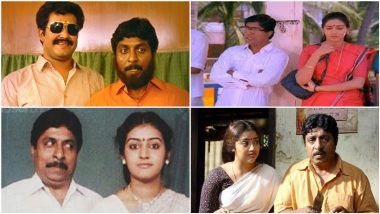
A major break was the 1987 film Nadodikkattu which made them immortal. They reappeared in two sequels Pattanapravesham (1988) and Akkare Akkare Akkare (1990). While Nadodikkattu and Pattanapravesham were directed by Sathyan Anthikkad, Akkare Akkare Akkare was a Priyadarshan film. Priyadarshan used the pair in his Chithram as well. But in Roshan Andrew’s Udayananu Tharam (2005), the same combination takes a totally different turn.
Even now the Dasan-Vijayan combination is a humorous milestone. Two youths, the proud ‘B-Com First class’ graduate Dasan and his less educated roommate and sole friend Vijayan are still as young as ever. They are intimate friends who always pull the legs of each other. What makes his comic scripts transcend time is that they touch the chord of the realities of life.
Most of the major characters that captured the audience’s fancy were in the movies of Sathyan Anthikkad and Priyadarshan. Incidentally, these characters were scripted by him only and he knows how to sculpt each character in tune with his character traits.
Kamal is another director who gave some unique characters to this inimitable actor who knows how to portray humour and family drama. In the 1995 movie Mazhayethum Munpe, written by Sreenivasan we witness his expertise in handling highly dramatic and emotional subjects. In the 1998 movie Ayal Katha Ezhuthukayanu, again by Kamal, we experienced a unique blend of humour and family drama.
Then, coming to Katha Parayumpol (2007), written by the actor himself and directed by M. Mohanan, we see a totally different Sreenivasan, as Barber Balan. Even the humour in this film has the tinge of tears, which makes it a timeless creation. Even his son Vineeth discovered the potential of his father beyond the mould of comedy and gifted him a few brilliant characters in Thattathin Marayathu and Aravindante Athidhikal.
A milestone in the early phase of his career is Sandhesam, released in 1991. The film does not just deal with political activism in Kerala but it also takes major digs at the political parties in the state. Even now it is a widely debated movie, though the political fraternity considers it an ‘apolitical’ movie. But the political stand taken by the actor-writer-director has its root in this movie. He is equally vocal about the corruption prevailing in the society and the attitude of the Left and the Right fronts in the political landscape of Kerala.
In response to a question on his keeping away from the mainstream political parties of Kerala, and cooperating with 20-20, a small political movement in Kerala, a couple of years back, he said, “Even if there is an iota of goodness in society, we should support that. We haven’t seen that all these years in any of the traditional political parties. There has never been a movement like this in Kerala.”
As a director, he made two films, Vadakkunokkiyanthram (1989) and Chinthavishtayaya Shyamala (1998). Both these works are relevant even today and his understanding of society and the struggles that the women face is evident in both the films.
However, he has often courted controversy for his political stand and even his criticism of modern medicine at the same time undergoing treatment in private hospitals. But he continues to air his views because he has justification for that.
Even amidst his busy schedule, he finds time for organic farming and such activities underscore his commitment to society. A man who is an artist to the core, Sreenivasan became a great success because of his commitment only.





