
MUSCAT: The Sultanate of Oman has participated with the countries of the world, on Tuesday, to celebrate the World Water Day for 2022 under the slogan ‘Ground Water – Making the Invisible Visible’ and its idea revolves around the fact that groundwater is not visible, but its impact is visible everywhere.
The Sultanate of Oman, represented by the Ministry of Agricultural and Fisheries Wealth, Water Resources and other competent authorities, has paid great attention to the water sector since the beginning of the modern Omani renaissance. The main pillars, plans and programs for managing, developing and protecting water resources were laid down in accordance with the components of the national strategy and the Water Wealth Protection Law.
The Ministry has established 12 artificial rain stations (ion technology) in the Sultanate of Oman to enhance the amounts of rainfall to increase the groundwater level, a technology that partners with nature to enhance water resources, emphasising that this technology has proven successful in the Sultanate in enhancing rainfall during the past six years by (from 15 to 18 percent), according to statistical reports whose data are collected through various means, such as rain gauges distributed around rain-seeding stations in the various governorates of the Sultanate.
Read More
- Oman’s National Polio Laboratory achieves 100% in WHO proficiency test
- Oman Labour Ministry records nearly 3,800 compliance violations in nationwide inspections
- Oman’s CPA shuts marble and ceramic trading firm in Rustaq over consumer complaints
- Saudi Airlines to launch direct Muscat-Riyadh flights from October 27
- Oman, Saudi Arabia to strengthen economic partnership at 7th coordination committee meeting
The ministry stated that, during the past year, it implemented a project to connect 6 artificial rain stations through a (microwave) communication system.
The ministry explained that the annual renewable water resources in the Sultanate are estimated at about 1,318 million cubic meters, and the demand for these resources is increasing, especially in the agricultural field, and consumes approximately 83 percent of the annual water needs. Noting that the water deficit in the Sultanate of Oman is estimated at 316 million cubic meters each year.
The ministry indicated that groundwater represents 83 percent of the water sources in the Sultanate, followed by desalination water at 10 percent, while surface water constitutes only 5 percent, and treated wastewater represents only 2 percent.
The ministry stated that groundwater is the main source of fresh water in the Sultanate of Oman and that its sources are multiple. Rain is the main source of feeding renewable resources, as quantities of it are stored in the various water-bearing rocky layers below the surface of the earth to be extracted later through wells, aflaj and springs.
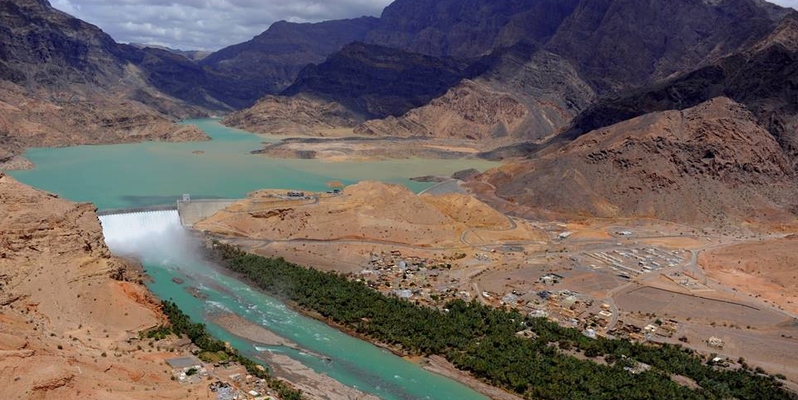
With regard to dams, the ministry explained that it has implemented dam projects of all kinds due to their importance in feeding the aquifer and limiting the interference of sea water with groundwater recharge tanks, in addition to its role in providing more groundwater to ensure the continuity of various development projects.
And it indicated that there are in the Sultanate of Oman until the end of 2021 about 174 dams of three types, distributed as follows: 56 dams for ground recharge, 115 dams for surface storage, in addition to 3 dams to protect against flood risks, with a storage capacity of approximately 325.767 million cubic metres.
The ministry stated that 1274 licenses were issued during the past year, including 876 licenses to drill a new well.
The ministry indicated that it has developed a master plan for the management and development of water resources in the Sultanate and to find solutions and alternatives to confront the high rates of water consumption and the imbalance in the water balance in the Sultanate of Oman. Seawater and wastewater treatment and artificial seeding experiment.
The ministry explained that it is working on implementing a project to introduce modern irrigation systems into farms irrigated with wells, with the aim of technicalising and rationalising water use and preserving water wealth. This is done by collecting aflaj water in ground tanks and linking it to a network of modern irrigation systems to reduce wastage from streams, in addition to developing agricultural transactions in terms of re-improving the crop structure.





