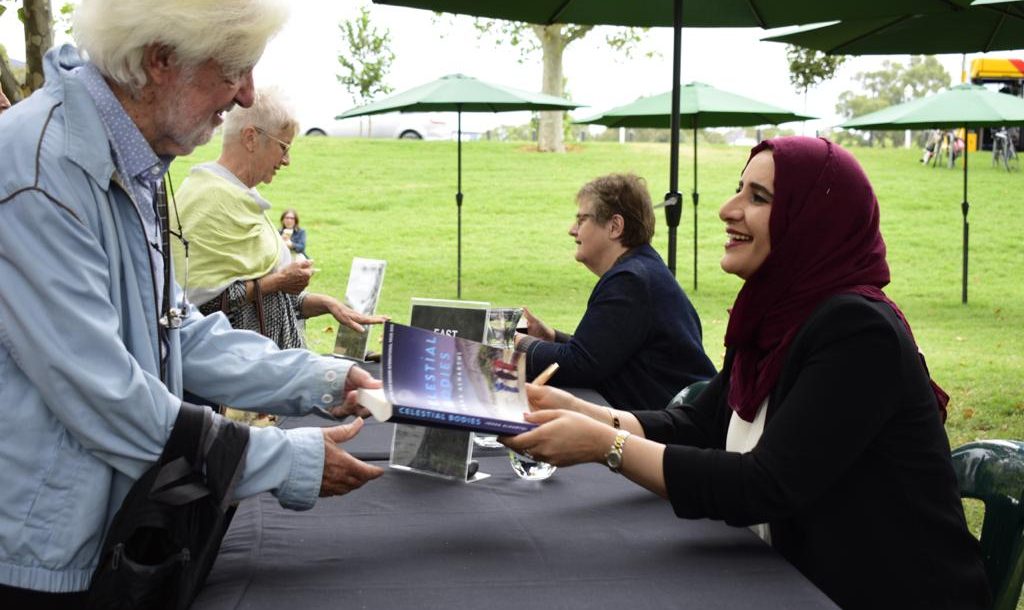

The unputdownable work of fiction set in an imaginary Omani village was packed with “surprises throughout” and the rare gift for telling differently the universal tale of “love, loss, friendship, pain and hope” defying “every stereotype you might expect” left the eminent jury of the much-acclaimed Man Booker International Prize so mesmerised that the tough job they got together to do turned out to be swift and simple for them.
And their verdict, without surprise, went in favour of Jokha Al Harthi. Jokha is a dreamer but not every dreamer can accomplish what she did – to win one of the biggest literary awards in the world.
On May 21, 2019, Jokha stood in front of the world to win the Man Booker International Prize for her novel Celestial Bodies translated by Marilyn Booth from the Arabic version, Sayyidat Al Qamar.
Celestial Bodies was selected from an almost entirely female and independently published shortlist to win the award, which goes to the finest work of translated fiction from around the world.
Jokha saw off competition from writers including former winner Olga Tokarczuk, acclaimed French author Annie Ernaux and Colombia’s Juan Gabriel Vásquez. She became the first Omani women to win the coveted prize.
Celestial Bodies, set in the Omani village of Al Awafi and orbits around the lives and loves of three sisters, is also the first novel originally written in Arabic to win the award.
Jokha, an associate professor at the College of Arts and Social Sciences, Sultan Qaboos University, says the characters in Celestial Bodies experience the universal feelings of “love, loss, friendship, pain and hope”.
“They take on sacrifices and struggles and find joy in writing, or in art, much the same way as anywhere else,” says Jokha, who grew up in a family of poets. Her first literary work was published at the age of 23.
Celestial Bodies, published in 2010, was Jokha’s second novel, following her 2004 debut, Manamat (Dreams). In 2016, Jokha’s third novel, Narinjah (Bitter Orange), was published and went on to win that year’s Sultan Qaboos Award for Culture, Arts and Literature.
Man Booker Prize chair of the judges Bettany Hughes described Jokha’s novel as a surprise package: “It avoids every stereotype you might expect in its analysis of gender and race and social distinction and slavery. There are surprises throughout. We fell in love with it,” Hughes said.
Jokha’s writing comes from her observations and imaginations. Jokha’s works are now translated into more than 20 languages that showed the world the literary talent of an Omani woman.
“Writing is a fantasy and if you’re not brave enough don’t attempt to write… I draw inspiration to write from everything in life. You need to be a good observer to be a good writer. I like to use my imagination to fill the story.”
Jokha Al Harthi
Read More
- Travel agency representative in Muscat jailed, agency shut for a year over cancelled trips
- Oman’s CDAA urges mountain safety after foreign national critically injured in Jabal Shams fall
- Oman’s media must adapt to AI while upholding accuracy, minister says
- Oman forecasts thunderstorms from October 25 as low-pressure trough approaches
- Oman, UK agree to deepen defence, investment and technology partnership





