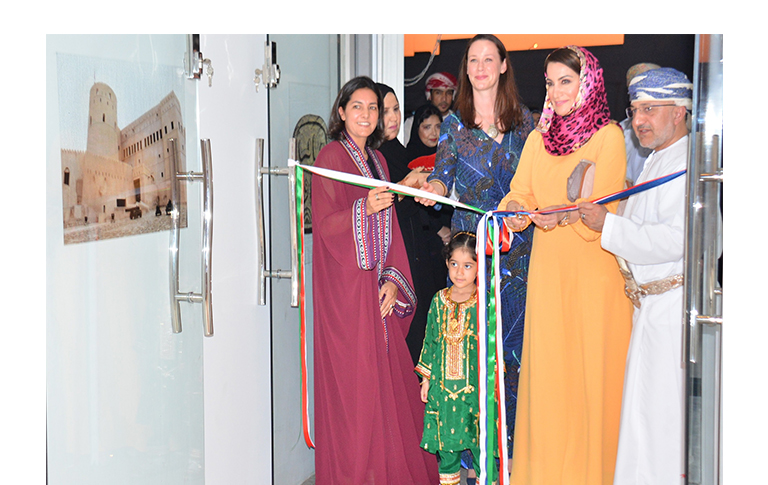

Muscat: Under the Patronage of Her Highness Sayyida Dr. Mona bint Fahd Al Said, Assistant Vice-Chancellor for International Cooperation at Sultan Qaboos University, the Ministry of Heritage and Culture recently opened the ‘Wild Oman’ exhibition. Running throughout November, first at Sayyid Faisal bin Ali Museum (Natural History Museum), and later at Bait Al Baranda, the exhibition features the stunning works of wildlife artist Violet Astor. Contributions from the exhibition will be donated to the Environment Society of Oman (ESO) and used to support studies of Oman’s Egyptian Vultures and Steppe Eagles, both listed as Endangered on the International Union for Conservation of Nature’s (IUCN) Red List.
His Excellency Salim bin Mohammed Al Mahruqi, Undersecretary for Heritage Affairs at the Ministry of Heritage and Culture, said, “‘Wild Oman’ highlights the richness and natural diversity that is spread across different geographical areas in the Sultanate. It also supports the efforts of the Natural History Museum to preserve the natural heritage of Oman, and spread awareness on vital environmental issues. The Museum has become an important reference for studies on environmental diversity, as well as a destination for scientists, researchers and graduate students in various fields. The exhibition and accompanying talk offer an exceptional opportunity for students to see a visual presentation of the wildlife in the Sultanate and cultivate a deep appreciation of the environment.”
The artwork showcases an array of the Sultanate’s most threatened species including the Arabian Oryx, Arabian Leopard, Nubian Ibex, Arabian Tahr, Hawksbill Turtle, Golden Eagle, Egyptian Vulture and others. Astor, a keen educational enthusiast, gave an educational talk on the opening day to school children about the importance of preserving the country’s beautiful natural heritage.
Read More
- Travel agency representative in Muscat jailed, agency shut for a year over cancelled trips
- Oman’s CDAA urges mountain safety after foreign national critically injured in Jabal Shams fall
- Oman’s media must adapt to AI while upholding accuracy, minister says
- Oman forecasts thunderstorms from October 25 as low-pressure trough approaches
- Oman, UK agree to deepen defence, investment and technology partnership

Her Highness Sayyida Tania Bint Shabib Al Said, President of ESO, said: “We thank the Ministry of Heritage and Culture and Violet Astor for supporting us in conserving the wildlife, and particularly the raptors, of Oman. To date, 54 species of raptors have been recorded as migrants or residents, and the Sultanate is a stronghold for a number that are of conservation concern. To ensure the survival of these magnificent birds of prey, conservation must be underpinned by sound research, which is strengthened by initiatives like this.”
Astor added, “It has been such a pleasure to collaborate with the Ministry of Heritage and Culture and the Environment Society of Oman on this worthy project. Oman’s unique and spectacular wildlife is celebrated but it is also in danger so this exhibition is my small contribution to supporting the valuable endeavours of those who are trying to conserve it. I very much enjoyed sharing my experience with visitors and engaging with the country’s next generation of environmental activists and artists, and hope that my work will serve to inspire others to join the cause.”
Sheikh Ma’an Al Rawahi, Chairman of the New Generation Group at the Anglo-Omani Society, said, “we are always working to strengthen the bond between the Sultanate and the United Kingdom through joint collaborations. This exhibit plays an important role in highlighting the Sultanate’s efforts in preserving natural diversity and wildlife.” The official opening of ‘Wild Oman’ was held on the 4th of November at Sayyid Faisal bin Ali Museum (Natural History Museum). From 5th – 7th November, the exhibition will be open daily from 8am – 5pm. From 10th – 30th November, the exhibition will move to Bait Al Baranda, Muttrah, where it will be open from Saturday – Thursday, 9am – 1pm and 4pm – 6pm.





