MUSCAT: Oman condemned on Wednesday “irresponsible” attacks on commercial vessels, including oil tankers, off the United Arab Emirates coast this week and called for joint efforts to avoid incidents harming regional security and stability.
“The Sultanate stresses the importance of joint regional and international efforts to ensure maritime safety and avoiding anything that harms regional stability and security,” said a foreign ministry statement published by ONA.
Last Sunday, the United Arab Emirates (UAE) reported that four commercial vessels were targeted by “sabotage operations” near the territorial waters of the UAE without causing casualties at around 6 am.
Read More
- Oman condemns deadly church shooting in Jordan
- Online shoppers have a right to an invoice, Oman consumer authority says
- Oman and UK unveil £1 billion-plus AI data centre plan for Salalah
- Oman plans 84 digital economy initiatives by 2030, expands focus on private sector
- His Majesty Sultan Haitham returns home after UK state visit
According to the UAE ministry, the incident occurred near the UAE’s Fujairah emirate, one of the world’s largest bunkering hubs which lies just outside the Strait of Hormuz.
The strait is a vital global oil and gas shipping route, separating the Gulf states and Iran, which have been embroiled in an escalating war of words with the United States over sanctions and the US military’s regional presence.
Around 40% of the world’s traded crude oil is transported through the Strait of Hormuz between Iran to the north and UAE and Oman to the south.
In other words, between 17 million and 18 million barrels per day of crude oil pass through the Strait of Hormuz, including 90% of Saudi Arabia’s output and 75% of Iraqi exports, in addition to all oil exports from Iran, Kuwait, Qatar and Bahrain.
The Strait of Hormuz is crucial as there are no alternative routes and the pipelines owned by the UAE and Saudi Arabia cannot carry as much oil as tankers, and while Saudi Arabia and Iran have alternate seaports, their neighbours do not.
“Subjecting commercial vessels to sabotage operations and threatening the lives of their crew is considered a dangerous development,” according to the statement uploaded by WAM, the official news agency of UAE.
Meanwhile, media reports quoting shipping sources identified the Saudi vessels as Bahri-owned very large crude carrier tanker Amjad and crude tanker Al Marzoqah.
Tanker industry tracking sites show the Amjad is currently anchored several kilometres off Mirbah near Khor Fakkan and Al Marzoqah anchored off Fujairah port.
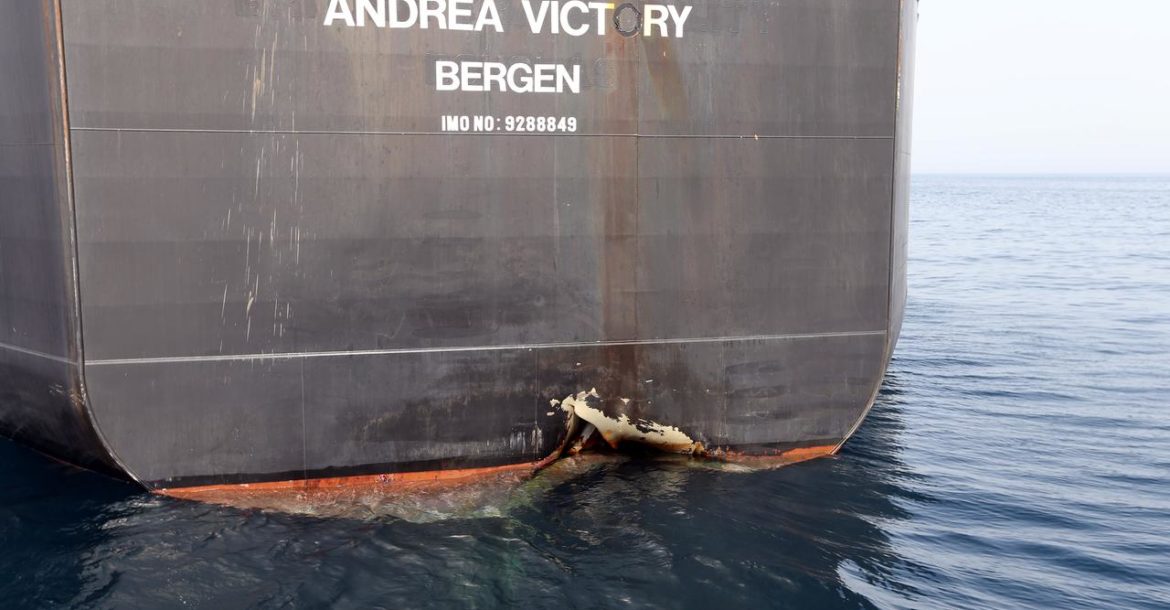
The two other ships have been identified as the A Michel – registered in Sharjah – and the Andrea Victory from Bergen in Norway.
The Norwegian tanker suffered hull damage after being struck by an unknown object at the waterline, its managers, Thome Ship Management, said in a statement.
On Sunday morning itself, there were unconfirmed reports that some 10 oil tankers anchored at the Fujairah port were in flames.
Social media posts claimed that American and French warplanes had been flying over the port at the time of the incident.
The reports of fire and explosions, apparently originated in Al Mayadeen, a Lebanese broadcaster and news outlet regarded as pro-Hezbollah.
They were picked up and reported by Sputnik news, which is funded by Russia, and spread across social media by pro-Iran Twitter accounts.
Fact checks reveal that an image of a flaming tanker purporting to be evidence of the attack was a picture of a tanker called the Kashmir on fire in Jebel Ali in 2009.
Among the comments spread by some accounts along with the news stories were warnings that it was not safe to travel to the UAE and that air travel had been severely disrupted.
The UAE Foreign Ministry described the claims as “baseless and unfounded.”
It was only on Monday that Saudi Arabia’s official news agency quoting its Energy Minister confirmed that two Saudi tankers were targeted in a “sabotage attack” off the coast of the UAE.
Minister Khalid Al-Falih said the two tankers were targeted off the coast of Fujairah and explained that one tanker was en route to the Kingdom to be loaded with Saudi crude oil to send to the United States to supply Saudi Aramco customers.
“Fortunately, the attack didn’t lead to any casualties or oil spill; however, it caused significant damage to the structures of the two vessels,” Al-Falih said.
The same day, following the ‘sabotage’ and countries rallying behind Saudi Arabia, US President Donald Trump warned Iran, saying that if Teheran does “anything” in the form of an attack “they will suffer greatly.”
“It’s going to be a bad problem for Iran if something happens,” Trump told media in the Oval Office.
Earlier, the US had warned that “Iran or its proxies” could be targeting maritime traffic in the region and foreseeing that, America was deploying its warships to the Persian Gulf to counter alleged threats from Teheran.
On May 05, the White House had issued a communiqué announcing that a battleship-carrier strike group, led by the USS Abraham Lincoln, and a bomber task force, including B-52s, were deploying off Iran’s coast.
On May 10, the Pentagon had also announced a second display of force: the USS Arlington and a battery of Patriot missile systems would join the Abraham Lincoln.
Meanwhile, ISNA, a news agency in Iran, quoting a senior Iranian Revolutionary Guards commander reported on Sunday that the US military presence in the Gulf used to be a serious threat but now represents a target.





