
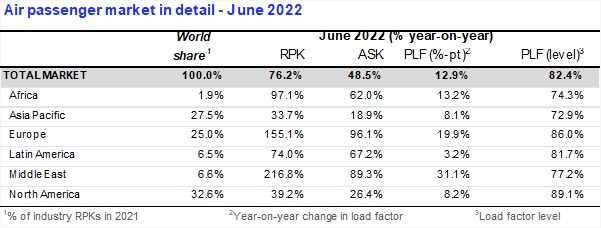
GENEVA: Middle Eastern airlines’ traffic rose 246.5% in June compared to June 2021. June capacity rose 102.4% versus the year-ago period, and load factor climbed 32.4 percentage points to 78.0%, a report by the International Air Transport Association has revealed.
The International Air Transport Association (IATA) announced passenger data for June 2022 showing that the recovery in air travel remains strong.
Total traffic in June 2022 (measured in revenue passenger kilometres or RPKs) was up 76.2% compared to June 2021, primarily propelled by the ongoing strong recovery in international traffic. Globally, traffic is now at 70.8% of pre-crisis levels.
Read More
- HH Sayyid Shihab presides over recital of Prophet’s life story at Al Alam Palace
- Oman’s CPA shuts travel agency in Rustaq over failure to deliver promised services
- Oman expands organic farm Yuzu to boost food security and local production
- Oman to host ICESCO delegation in Dhofar to strengthen cultural diplomacy and cooperation
- Dhofar Municipality launches wage support scheme for seasonal Omani workers
Domestic traffic for June 2022 was up 5.2% compared to the year-ago period. Strong improvements in most markets, combined with the easing of some Omicron-related lockdown restrictions in the Chinese domestic market, contributed to the result. Total June 2022 domestic traffic was at 81.4% of the June 2019 level.
International traffic rose 229.5% versus June 2021. The lifting of travel restrictions in most parts of Asia-Pacific is contributing to the recovery. June 2022 international RPKs reached 65.0% of June 2019 levels.
“Demand for air travel remains strong. After two years of lockdowns and border restrictions people are taking advantage of the freedom to travel wherever they can,” said Willie Walsh, IATA’s Director General.
“With the Northern Hemisphere summer travel season now fully underway, predictions that the lifting of travel restrictions would unleash a torrent of pent-up travel demand are being borne out. At the same time, meeting that demand has proved challenging and likely will continue to be so. All the more reason to continue to show flexibility to the slot use rules. The European Commission’s intent to return to the longstanding 80-20 requirement is premature.
“Just look at the issues that airlines and their passengers at some hub airports are being confronted with. These airports are unable to support their declared capacity even with the current 64% slot threshold and have extended recent passenger caps until the end of October. Flexibility is still essential in support of a successful recovery.
“By capping passenger numbers, airports are preventing airlines from benefitting from the strong demand. Heathrow Airport has tried to blame airlines for the disruption. However, Service Level Performance data for the first six months of this year show that they have failed miserably to provide basic services and missed their Passenger Security service target by a massive 14.3 points. Data for June has not yet been published but is expected to show the lowest level of service by the airport since records began,” said Walsh.





