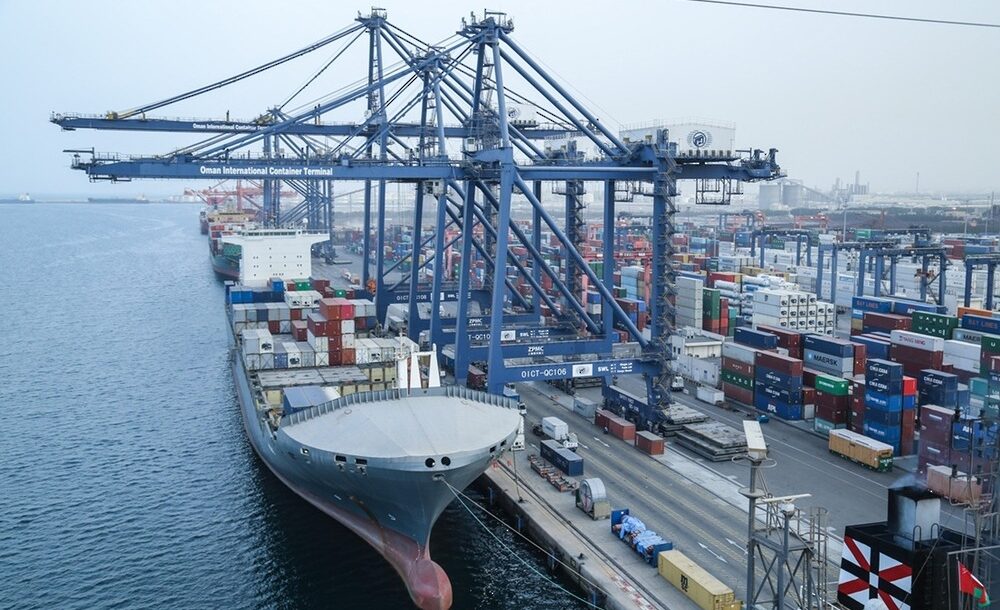

Muscat: Oman’s ports recorded strong growth during the first ten months of 2026, with cargo handling surging by 76.1 percent to 206.4 million tonnes, highlighting the Sultanate’s growing position as a regional trade and logistics hub.
According to H.E. Eng. Khamis bin Mohammed Al Shamkhi, Undersecretary of the Ministry of Transport, Communications and Information Technology for Transport, the total volume of goods handled at Omani ports and marine terminals rose from 117.1 million tonnes during the same period in 2025.
The number of vessels received by the ports increased by 40 percent to 15,613, compared to 11,151 vessels last year.
Read More
- Oil prices rise, but weekly losses loom amid supply fears
- Energy Oman, ExxonMobil sign deal to develop Oman’s Greater Makarem gas field
- Oman crude oil price increases by USD 0.57
- Mithqal signs Bank Muscat partnership, hits 900,000 donation taps on bank-integrated payment devices
- Oman businesses face e-invoicing readiness gaps ahead of 2027 deadlines, survey finds
Container handling also recorded significant growth, rising by 25.3 percent to more than 5.3 million twenty-foot equivalent units (TEUs), compared to approximately 4.2 million during the corresponding period in 2025.
Vehicle handling witnessed one of the sharpest increases, surging by more than 200 percent to 248,054 vehicles, compared to 82,568 vehicles a year earlier.
H.E. Al Shamkhi said the figures reflect the expanding role of Omani ports in supporting local, regional and international trade, while strengthening the country’s competitiveness in maritime transport and logistics.
He noted that trade through seaports represented approximately 37 percent of the total value of exports, imports and re-exports between January and August 2026. Seaports also accounted for around 88 percent of export value, 55 percent of import value and 40 percent of re-export value during the period.
The Port of Duqm emerged as a major contributor to the sector’s growth, recording a remarkable 1,459 percent increase in container handling.
The port handled approximately 120,000 TEUs by the end of October 2026, compared to around 7,700 during the same period last year.
Total cargo handled at the port increased by 25 percent to approximately 27 million tonnes, compared to 21 million tonnes in 2025, while vehicle handling exceeded 83,000 units.
H.E. Al Shamkhi said Duqm’s strong performance reflects its expanding operational capabilities and strategic location, making it an increasingly attractive destination for maritime businesses, logistics services and related investments.
Alongside the growth in maritime trade, Oman is continuing to expand its road infrastructure to improve connectivity between governorates and support economic development.
H.E. Al Shamkhi revealed that 12 new road projects were awarded during the first nine months of 2026, with work already underway on five projects covering more than 100 kilometres.
This brings the total number of road projects under implementation to more than 25, with 13 projects having achieved completion rates exceeding 50 percent.
The value of local content in road projects surpassed RO 200 million by the end of the first half of 2026, while approximately 1,500 Omanis were employed across these projects.
Meanwhile, Omanisation in the transport and logistics sector reached 23.6 percent by the end of August 2026. The rate stood at 61.5 percent in technical, specialised and leadership positions.
The Ministry signed six agreements for road projects across six governorates during the first nine months of 2026.
These include the remaining works of the Sultan Said bin Taimur dual carriageway project in Al Dakhiliyah and Al Wusta, the road leading to the Empty Quarter, the expansion of the Muscat Expressway, White Mountain Road and improvements to Green Mountain roads.
Work is also continuing on several strategic projects, including the Sultan Turki bin Said Road, covering the second part of the Sharqiyah Expressway from Al Kamil and Al Wafi to Sur, and the Sultan Faisal bin Turki Road connecting Dibba, Lima and Khasab.
Other ongoing developments include the Izki–Nizwa dual carriageway, the remaining sections of the first phase of the Sultan Taimur bin Faisal Road along the Al Batinah Coastal Road, and improvements to Al Mouj Road and its connection with 18 November Road.
H.E. Al Shamkhi said the continued development of ports and road infrastructure is aimed at strengthening Oman’s transport network, improving logistical efficiency and supporting trade and investment across the Sultanate.





